|
|
NOTE: this topic is a key topic on the AQA and iGCSE specifications. It is NOT a stated topic on the Edexcel or OCR specifications.
|
|
|
The Korean War was the first major armed clash between Free World and Communist forces, as the so-called Cold War turned hot. From a pamphlet by John J. McGrath of U.S. Army Center of Military History, written to honour Korean War veterans (2003).
The Korean War was the time when the Cold War became a global conflict. In 1945, Korea was freed from the Japanese. US troops stayed in Korea until 1946. The country was split in half at the 38th parallel:
The two countries hated each other.
|
Going DeeperThe following links will help you widen your knowledge: Resources from the Wilson Center
Podcast:
YouTube Korean War - BBC 20thC History (last 10 mins)
Did You Know?Korea was split at the 38th parallel because, when they were discussing what to do with Korea, the Americans could only find a small-scale map. | |
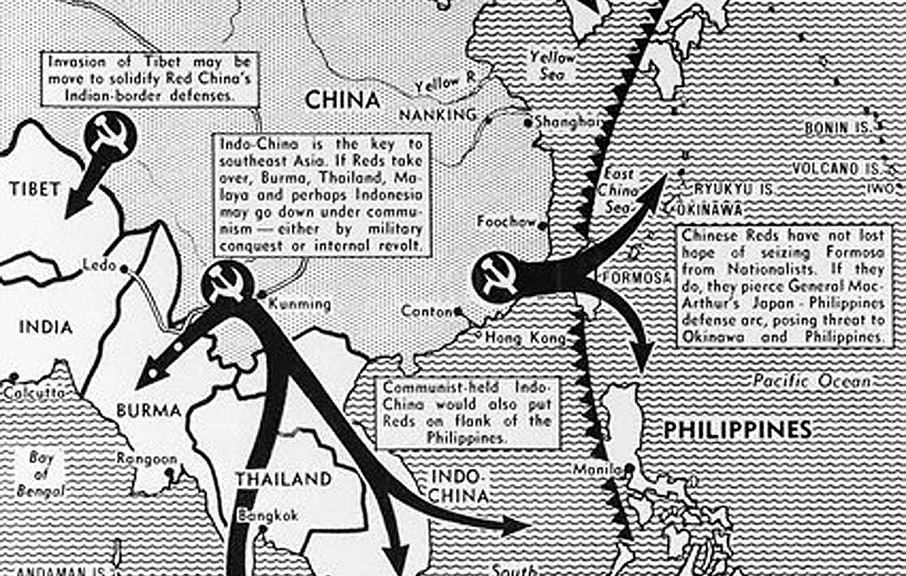
A. What caused it? [DUCKS]1. President Truman was interested in the Far East: Domino theory:
Source A
This map from an American magazine published 14th November 1950 shows how much they feared the spread of Communism in the far east.
Undermine Communism: Cold War:
2. Stalin, also, was involved in the Far East: Kim Il Sung visited
Stalin
3. Syngman Rhee In 1950, Syngman Rhee boasted that he was going to attack North Korea. It was a good enough excuse – the North Koreans invaded South Korea.
This started the Korean War. |
Source BAsia is where the communist conspirators have decided to make their play for global conquest. If we lose this war, the fall of Europe is inevitable. There is no choice but victory. US General MacArthur, speaking in 1950.
Consider:1. Study Source A. Why was Korea so important for the Americans? 2. Take each of the causes of the Korean War, and explain how it caused war.
|
|
Source C
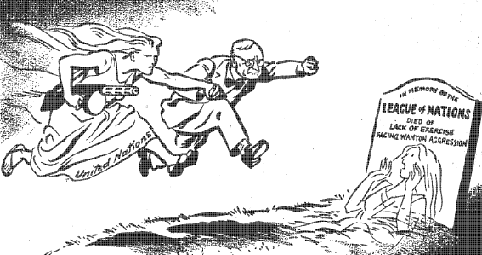
This cartoon by the British cartoonist David Low, from the Daily Herald (30 Jun 1950), shows Truman and the United Nations rushing to Korea’s aid. Click here for the interpretation
|
Did You Know?
The TV series M*A*S*H was set in the Korean War. Because it was written at the time of the Vietnam War, the programmes had a strong anti-war message. |
|
B. The Events of the War, 1950–53
The war had FIVE phases:
|
Korean War web sites: Account by a North Korean (detailed, but really instructive) No Gun Ri - a BBC investigation of a US atrocity
|
|
I |
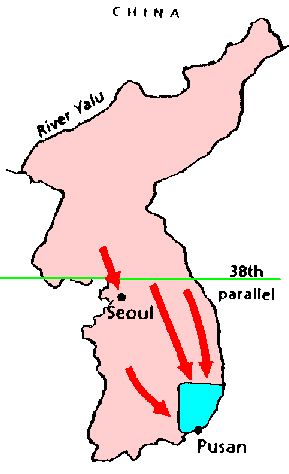
June - Sept 1950On 25 June 1950, the North Koreans attacked. They were very successful. The North Korean People's Army (NKPA) easily overran the Republic of Korea's army (the ROKs) They captured most of South Korea. The Americans were alarmed (see Source A). On 27 June they persuaded the United Nations to pass Resolution 83 supporting South Korea. The Americans sent troops to Korea to reinforce the South Korean Army at Pusan. |
|
II
|
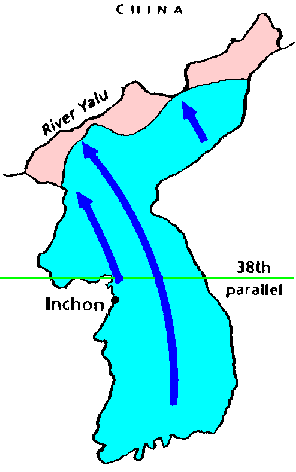
Sept - Nov 1950On 15 September, the American General MacArthur led a UN amphibious landing at Inchon (near Seoul) behind the NKPA . Out of the 300,000 UN troops, 260,000 were Americans. In danger of being cut off, the NKPA had to retreat. The Americans drove them back and recaptured South Korea. 125,000 NKPA prisoners were taken. On 7 October 1950 MacArthur invaded North Korea. He advanced as far as the Chinese border. He boasted that the Americans would be 'home by Christmas'.
|
|
III |
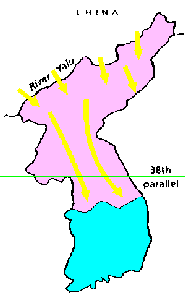
Nov 1950 - Feb 1951Now the Chinese were alarmed. On 25 November, 200,000 Chinese troops ('People's Volunteers') attacked MacArthur. They had modern weapons supplied by Russia, and a fanatical hatred of the Americans. Then, on 31 December, half a million more Chinese troops entered the war and attacked the Americans. They drove the Americans back (using 'human wave tactics'). They recaptured North Korea, and advanced into South Korea. |
|
IV |
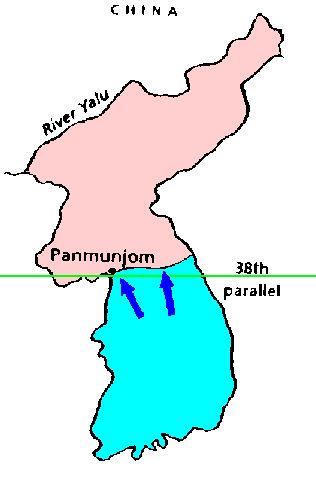
February – March 1951The Americans landed more troops. They used bombers. The Chinese admitted to losing 150,000 men dead - western sources put the figure at nearly a million Chinese and half a million North Koreans dead. The Americans drove the Chinese back, but admitted losing 35,000 American soldiers dead doing so (the Chinese claimed that the USA lost 390,000). MacArthur reached the 38th parallel in March 1951. |
|
V |
March 1951 – 1953Truman told MacArthur to stop. MacArthur was sacked when he publicly criticised Truman’s order. In January 1953, Eisenhower became American president. The Americans threatened to use the atomic bomb if China did not stop fighting. The Chinese agree to a truce, which was signed on 27 July 1953. Wikipedia puts the full battle death toll on all sides at just over 1.2 million, but many civilians also died in the war, with estimates varying from 2 to 4 million |
|
|
C. Korea and the Escalation of Tension [PUMACK]The creation of NATO significantly increased international tension between the superpowers in the 1950s: 1. Proxy War• Although fought under the banner of the United Nations, the Korean War was essentially a US war against communism, anticipating later interventions in Vietnam and Cuba. • The USSR also indirectly fought the US by supplying North Korea and China with weapons, advisors, and aircraft. Soviet pilots flew missions disguised as Chinese. 2. US–China Hostility and Sino-Soviet Relations• The Korean War transformed the Cold War from a European confrontation into a global conflict. • It brought China into the Cold War, increasing hostility between the US and Communist China (the US refused to recognize China at the UN). • The USSR supported China, but tensions grew because China felt the USSR had not provided enough help. 3. Military Blocs• The US added Greece, Turkey and West Germany into NATO (1955) and increased military aid to Western European allies, alarming the USSR. • The USSR formed the Warsaw Pact (1955) in response, dividing the world into two military blocs. 4. Arms Race• NSC-68 dramatically increased US military spending. • The USSR responded, increasing the size of the Red Army from 2.8 million (1950) to 5.8 million (1955). • The US threatened nuclear strikes against China (1953) to force peace negotiations. • The USSR increased its nuclear program, successfully testing a hydrogen bomb in 1955 to match the US. 5. Cold War intensified• Korea had taken the world to the brink of a nuclear war, so in 1953 Eisenhower introduced his ‘New Look’ foreign policy, which sought to replace confrontation with espionage and deterrence (nuclear and NATO); this looks like de-escalation, but really it was just carrying on the Cold War in a different ways. 6. Korea Divided• The war ended in stalemate, leaving Korea divided at the 38th parallel, with both US and USSR maintaining heavy military presence in the region. • Continued border clashes meant that East-West tensions remained high in Asia.
|
|
|
|
|
||
|
Spotted an error on this page? Broken link? Anything missing? Let me know. |
| |