The Korean War
Eyewitness: A North Korean Remembersby Young S Kim
Young Sik Kim --- Korean War Starts --- Korean War: 1950 --- US Invasion --- Battle of Hamhung --- Home by Christmas --- Fall of Hamhung --- Student Volunteers --- MacArthur's Fall
|
This paper was originally published on the web at http://www.kimsoft.com The site seems to have gone down permanently in mid-2005. I have copied the relevant sections and reproduce them here. I have tried to contact the author without success.
|
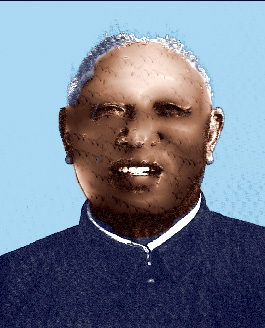
Young Sik Kim
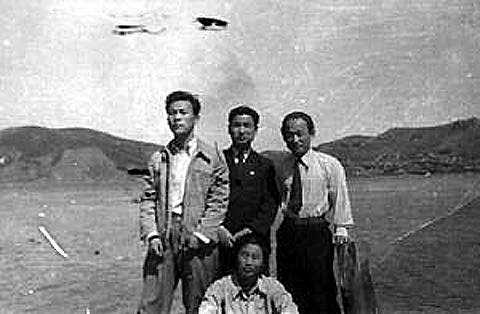
According to the book which purports to have been written by him, Young Sik Kim wrote this account in 1995. Born in 1935, he was the son of a rich North Korean landowner and businessman. Although born in North Korea, he was an anti-Communist, and worked for the Americans during and after the Korean War. In 1956 he went to the US to study Physics at Brigham Young University in Ohio, and became first a nuclear physicist and later (1980) director of a computer software company.
Looking back on his experiences, he reflects that: 'I have realized that my anti-Communist crusade was based more on my personal experience than an ideology. Kim Il Sung took away our land ... The Soviets took the food, factories and other properties left behind by the Japanese which should have belonged to the Korean people.' Now, he describes himself as a 'humane socialist-capitalist', and says that he resents the corruption of the South Korean officials and the racism of many Americans at the time: '[During the Vietnam War] the American people raised their voice when their military committed atrocities against the Vietnamese civilians. Lt. Kelly was court marshaled for a war crime at My Lai. There were thousands of My Lai's in Korea but not a single soul in America has raised a voice of conscience or remorse'.
Kim's final comment on the war deserves mention:
The Korean War was to defend a corrupt dictator Syngman Rhee and the ego of a weak American president, Truman, abetted by an old fading war-monger, MacArthur, groping for his last hurrah. A civil war which would have been short and relatively blood-less was turned into a major battle ground by Truman.
|
You need to Know: I cannot vouch for the validity of this source.
Young S Kim's website, Kimsoft, was accused on the web of being a fraud 'ghost site' run, not by Young S Kim, but by a number of professionals whose aim was to spread pro-North Korean propaganda. The site was banned by the South Korean government in 1997.
The host site's bias does not make this apparently first-hand account of the war any less useful, of course, provided that it is the account of a person who actually did witness the war. . And what if it is a modern invention - a hoax? Well ... it STILL has interest, but as a hostile secondary INTERPRETATION of the war.
|
The Korean War StartsJune 25 - Pyongyang: Kim Il Sung declares war and N. Korean Peoples Army invades S. Korea in force. At the same time, Radio Seoul says S Korean army units are advancing rapidly towards Pyongyang and will liberate N. Korea very soon. Radio Pyongyang claims major victories and widespread uprisings throughout S Korea. We are confused but want to believe the Seoul's version of what's going on and expect S Korean units to reach our town at any time.
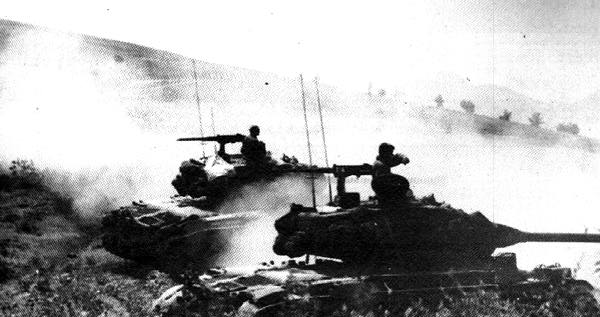
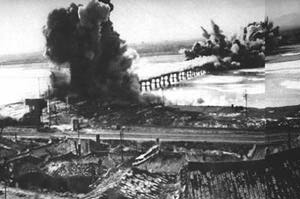
N Korean tanks cross the 38th June 25 - The invasion starts at 0400 hours on the Onjin Peninsula. N Koreans start shelling Kaesong at 0500 hours. The ROK 12th Regiment panics and runs south. By 9:30 a.m., Kaesung is in N Korean hands. Several US military advisers (KMAG) are taken captive. The main thrust is spear-headed by the N Korean Army 3rd and 4th divisions at Cholwon. The ROKA 7th Division collapses at Cholwon and the N Korean tanks race toward Seoul. June 25 - 9 a.m., John Muccio, the US ambassador to S Korea, cables the State Dept. - "an all-out offensive against the Republic of Korea has begun" It has taken the US and S Korean governments five full hours to realize what's happening. June 25, 10 a.m. - Washington, DC: Gen. Bradley, Chairman of the US JCS, hears about the invasion from United Press reporter Dayton Moore. Bradley is stunned and speechless. He is caught with his pants down. The general informs his chiefs of staff - "I am of the opinion that South Korea will not fall in the present attack unless the Russians actively participate in the operation. Therefore, if Korea falls, we may want to recommend even stronger action in the case of Formosa in order to offset the effect of the fall of South Korea on the rest of East Asia." June 25, 5 p.m. - Tokyo: MacArthur states "This is probably only a reconnaissance in force. If those asses back in Washington only will not hobble me, I can handle it with one arm tied behind my back." He will send a few fighter planes to the S Korean Air Force although those gooks won't know what to do with them. About at this time two N Korean YAK fighters strafe Rhee's residence. Rhee is set to flee for his life. US CIC people monitoring Rhee's phone notify Muccio. Muccio warns Rhee that the entire ROK Army will quit fighting if Rhee fled Seoul now. Rhee agrees to stay in Seoul with Muccio. Muccio makes arrangements for evacuation of American civilians. June 26 - 6 a.m., Syngman Rhee phones MacArthur at his house. An aid tells Rhee that the general is not to be disturbed and tells Rhee to call back in late in the morning. This drives Rhee into a rage - "American citizens will die one by one while you keep the general asleep in peace." Rhee demands to talk to the general now. Finally, MacArthur takes the phone and hears an enraged Rhee - "Had your country been a little more concerned about us, we would not have come to this! We've warned you many times. Now you must save Korea." MacArthur assures Rhee that he will take care of Korea. June 26 - 9:30 am, Pyongyang: Kim Il Sung speaks to the nation - "Dear brothers and sisters! Great danger threatens our motherland and its people! What is needed to liquidate this menace? Under the banner of the Korean People's Democratic Republic, we must complete the unification of the motherland and create a single, independent, democratic state! The war which we are forced to wage is a just war for the unification and independence of the motherland and for freedom and democracy." June 26 - 11 a.m., Radio Seoul (HLKA) says that the "Fierce Tiger" unit (Maengho Dae) of the 17th Regiment has liberated Haeju City on the Onjin Peninsula. It goes on to say that S Korean soldiers have killed 1,580 N Korean soldiers. Maengho Dae is led by Col. Kim Chong Won, formerly a sergeant in the Japanese Imperial Army, who fled N Korea in 1945. The 17th Regiment and the ROKA 1st Division are made of Japanese collaborators who fled the North. These units are commanded by two brothers (formerly with the Japanese Imperial Army) - Paek In Yop and Paek Sung Yop, respectively. US Ambassador Muccio orders evacuation of all American civilians. Some 700 Americans are loaded onto a Norwegian fertilizer ship at Inchon.. MacArthur is not worried - he believes that the ROKs will regroup and throw back the invaders. He is angry at Muccio for ordering the American evacuation. At this very moment, Muccio hears North Korean Army artillery closing on Seoul. Later into the night, Rhee Syngman decides to flee Seoul without asking Muccio's permission. A special train is requisitioned to carry Rhee and his close associates (and their relatives). The train leaves in the dark of the night. Somehow, the American CIC fails to inform Muccio of Rhee's flight This "easy' flight of Rhee gives rise to a conspiracy theory which claims that Rhee and MacArthur have connived to seduce Kim Il Sung into the Korean war. June 27, 1950 - Muccio flees Seoul. He drives his jeep south looking for the S Korean Government and Rhee. For the first time, MacArthur realizes the gravity of the Korean situation. He tells Foster Dulles "The only thing we can do is get our people safely out of the country." A courier delivers an urgent message from the Joint Chiefs of Staff. MacArthur tells the courier - "Tell them I'm engaged in seeing Ambassador Dulles off.. If I don't get back in time, have the chief of staff talk to the secretary." June 27 - A general panic hits the Seoul citizens and tens of thousands of refugees clog all roads leading south. Two days earlier, the ROK army engineers placed explosives on all bridges on the Han River. There are much debates on when to blow up the bridges. Gen. Chae and the US advisers want to wait - there are more than 10,000 ROK troops yet to cross the Han River - in addition to the countless refugees. The Deputy Minister of Defense orders the bridges destroyed promptly but Gen. Chae refuses - Gen. Chae is bodily removed from his command. Radio Seoul HLKA is still saying that S Korean troops are marching on to Pyongyang. Chae was killed a few days later in a mysterious circumstance and Gen. Jung Il Kwon (a former captain in the Japanese Imperial Army) takes over and obeys the command to blow up the bridge. The chief of the S Korean Corps of Engineers blows up the Han River bridge at 2:15 a.m. and kills several hundreds soldiers and refugees still on the bridge. He cuts off the main escape route for the retreating S Korean troops and refugees. The poor engineer was executed. Kim Paik Il and the Deputy Defense Minister who issued the order were untouched. June 27, 1950 - Washington, DC: The US JCS finally realizes that S Korea is about to fall without US ground troops. The much vaunted ROK Army is in full rout and there is little hope that it is about to regroup on its own. How could all those experts at the CIA and the military brass have missed their mark so badly? At a war council, Pres. Truman and Dean Acheson propose sending ground troops. Gen. Bradley opposes military intervention - "if we committed our ground forces to Korea, we would have to have a mobilization, at least a call-up of some National Guard divisions.". The meeting adjourns without any decision. The following day, Gen. Eisenhower urges the military and Pres. Truman to intervene in Korea. US Ambassador Muccio at last finds the missing S Korean government in Taejun. Rhee is holed up in a house virtually isolated from the world around him. Muccio is angry at Rhee for fleeing Seoul without his approval and Rhee is mad at Muccio for not providing US troops. June 29, 1950 - 8 a.m., Muccio picks up Rhee Syngman to meet MacArthur at Suwon. MacArthur's plane (Bataan) is attacked by a N Korean YAK fighter, but no damage is done. Rhee meets with MacArthur in private for two and half hours. No one knows what they have discussed. Big Mac states - "Give me two American divisions and I can hold Korea." Upon completion of the secret meeting, Rhee and Muccio head back to Taejun. Their plane narrowly escapes from another YAK fighter. June 29 - N. Korean Army takes Seoul - It is weird. We see pictures of N Korean soldiers marching in Seoul and yet Seoul Radio is still claiming some fantastic victories!! How can this be?
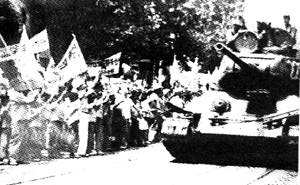
N Koreans tanks are welcomed by the Seoul citizens. At last the sad truth emerges. A column of S. Korean POW's passes through our town. Some are wounded and being carried by fellow POWs. The column is lead by a S Korean army officer still proud with his head held high. But the rest seem to be dejected and scared. Two women from the crowd throw rocks at the column. A N Korean army officer runs toward the women shouting something and the women run away. The crowd is quiet and sad. Some people are crying openly. So this is what our 'liberators' look like? June 29 - Washington: Dulles reports to Truman on the confused status of MacArthur and advises Truman to fire MacArthur now. But Truman is scared of MacArthur, who "is involved politically in this country and he cannot be recalled without causing a tremendous reaction. He has been built up to heroic stature." Dulles agrees with Truman, but promises his full support if Truman decided to fire MacArthur in the future. June 30 - Seoul: Kim Kyu Sik welcomes the Korea People's Army. Kim was one of the founding fathers of the Korean Provisional Government (KPG) in China. He was named its foreign minister in 1919 and he went to Paris (Treaty of Versailles) to petition for Korean independence - in vain. After liberation, he tried with other patriots to form a coalition government for all of Korea but failed. He managed to escape Rhee's assassins. Gen. Song Ho Song, former commander of the ROK 2nd Division, organizes the People's Volunteer Army manned by South Koreans. The US CIA reported: "The ROK government's past failure to win the support of its restless student class could account for more than half of Seoul's students actively aiding the Communist invaders, with many voluntarily enlisting in the Northern army. Apparently attracted by the glamour of a winning army, the morale of these recruits may suffer rapidly if the going gets rough...The working class generally supports the Northern Koreans, while merchants are neutral and the intelligentsia continue to be pro-Southern...The streets are crowded, especially with youths engaging in Communist demonstrations." I am bewildered by the easy victory over the S Korean Army. Newspapers are full of combat stories: S Koreans trying to stop tanks with hand grenades; S Koreans surrendering at the sight of a tank; S Korean soldiers turning against their own officers and so on. The US intelligence agents were well aware of the impending invasion. As early as 1949, these agents routinely warned MacArthur of the invasion plan. But these warnings went either ignored or unreported to the US decision makers. Kim Ilsung caught the US intelligence guys with their pants down. The CIA, the State Dept., the Army Dept. and the Far East Command were in " agreement that the possibility for an attack on the Korean Republic existed at this time, but they were all in agreement that its launching in the summer of 1950 did not appear imminent", said Gen. Bradley (chairman, Joint Chiefs of Staff). June 30 - MacArther reports to Washington - "The only assurance of holding the present line, and the ability to regain later lost ground, is through the introduction of US ground forces into the Korean battle area." The Army Chief of Staff (Gen. Collins), is taken in by MacArthur (and earlier by Ike) and changes his mind about not sending troops to Korea. Earlier MacArthur was given the authority to send a regimental combat team to Pusan to safeguard it for evacuation of US citizens. However, MacArthur wants Gen. Collin's approval to send one or two regimentals teams to the front lines. Collins goes over Bradley's head and gets Truman's approval and tells MacArthur - "Your recommendation to move one regimental combat team to combat area is approved." Thus the US intervention in the Korean War begins without the knowledge of its top military brass, Gen. Bradley. MacArthur has manipulated a weak president and gotten himself a chance for glory at the expense of the Korean people. MacArthur's personal ambition finds lofty justifications in a CIA recommendation for military intervention in Korea: - "Voluntary or forced withdrawal would be a calamity. US commitments abroad no longer would be trusted. Friendly nations might lose political control or feel compelled to seek an accommodation with the USSR. The USSR will proceed with limited aggressions. It would be politically and psychologically more advantageous for the US to mobilize in support of US and UN intervention in Korea rather than to mobilize after a withdrawal." Pres. Truman pays little attention to the CIA - he thinks the CIA has bungled the Korean affair and wants a more capable man to head the organization.
|
|
The Korean War - 1950: War of UnificationJuly 1,1950 - Muccio sends his deputy Noble to meet with Rhee Syngman. Noble asks Rhee to evacuate Taejun. Rhee is going mad and blames MacArthur (Rhee's "great God"), Truman and Muccio for the disaster in S Korea. Rhee announces that he and his wife are ready to die in Taejon - no more retreat. Rhee's wife finally talks the old man out of his madness. Rhee and his cabinet retreat to Taegu. July 2 - Japan: Col. Smith receives his marching order from Gen. Dean, commander of the 24th Division - "When you get to Pusan, head for Taejon. We want you to stop the North Koreans as far from Pusan as possible." Gen. Dean did not know where the ROK Army or Rhee was - he did not care. Col. Smith and Company are given a Messiah's welcome at Pusan complete with a marching band. MacArthur's pointman in Korea, Gen. Church, assures Col. Smith that "a few white soldiers will scare the shit out of the gooks and the war would be over in no time at all". July 3 - US war planes bomb ROK Army headquarters at Suwon, ROK tanks, ROK ammunition trains, and civilian targets still in S Korean hands. Rhee wants to know just whose side are the Yanks? MacArthur orders US planes to stay north of the Han River. S Korean police commits one of the worst mass massacres at Suwon under Donald Nichols (US CIC) supervision at Suwon. About 1,800 political prisoners are shot to death by the retreating police. Two American bull-dozers are kept busy digging ditches and burying the victims. The prisoners are brought in from nearby prisons in army trucks. They are lined up along the edge of a ditch and shot in the head while Donald Nichols dutifully photographed the scene. July 5, 1950 - Jukmi Pass (Osan): The N Korean tanks roll over the first American unit sent to Korea - The 1st Battalion, 21st Infantry Regiment, 24th Infantry Division, USA Army, code named Task Force Smith (after its commander, Col. Charles Smith). The task force had 540 men, 120 rounds per M1 rifle, two 75mm recoilless rifles, with 12 rounds, four 4.2" mortars, 2 days of C-rations and no working radio. Col. Smith escapes south with 86 survivors - the wounded, dead and heavy equipment are left behind. July 6 - Taejong: One of the worst atrocities of the war occurs. The S Korean police under the guidance of US advisers murder some 7,000 imprisoned guerrillas from Cheju, Taebaik, Yosu and other areas in the village of Yangwol near Taejung. The local farmers are forced to dig mass graves for the dead while the Americans video the massacres from their jeeps. July 7, 1950 - Beijing: Mao sees a disaster looming for Kim Il Sung and orders his military to prepare for military actions in Korea. Gen. Nie Rongzhen, acting Chief of Staff of the Chinese People's Liberation Army, convenes a series of meetings of the Military Affairs Committee. July 8 - The US military is worried about the Soviets stirring up trouble while US is tied down in Korea. A CIA internal report states - "It is not yet clear whether the USSR will force the Chinese Communists to give open support to the Korean operations or to start a new operation elsewhere in the area. The Peiping regime is unlikely to commit military forces to operations outside China on its own initiative, but almost certainly would comply with a Soviet request for military action. Chinese Communist troop strength and dispositions would permit intervention in Korea with little or no warning." Another CIA report asserts - "the Soviet leaders would be justified in assuming a substantial risk of general war during the remainder of 1950, arising either out of the prosecution of the Korean incident or out of the initiation of new local operations. Soviets are capable of employing against the continental US the twenty-five A-bombs estimated to be currently available. The Soviets may use TU-4 bombers possibly disguised with US markings on one-way missions, and clandestine introduction of nuclear weapons into key harbors by merchant ships." These reports never reached the top policy makers. July 9, 1950 - Tokyo: MacArthur sees his glorious career going down the drain. His army, which now outnumbers the communists, is losing badly in S Korea. MacArthur wants to use A-bombs in Korea. And Rhee urges him to drop the A-bombs right away. Rhee does not mind Korea turned into a no-man's land as long as he retains his power. A man who had embezzled Korean patriots in 1925 - wants his country destroyed to stay in power and satisfy an American megalomaniac's ego. MacArthur asks for ten to twenty A-bombs. Mac says - "I would cut them (Chinese and Russians) off in N Korea. In Korea I visualize a cul-de-sac. The only passages leading from Manchuria and Vladovostok have many tunnels and bridges. I see here a unique use for the atomic bomb - to strike a blocking blow - which would require a six-months repair job." Fortunately for Korea, the cool heads in Washington deny Mac's request. If no nukes, then MacArthur says he needs four infantry divisions in addition to the four he has requested two days earlier. July 10, 1950 - The American and S Korean troops are bottled up in the Pusan perimeter. The North Koreans are trying to hit Pusan from due west. The N Korean 2nd Army led by Gen. Mu Jong pushes south along the west coast. The Pang Ho San Unit (the 6th Division of the Mu's 2nd Army) takes Chinju. The People's Committees are resurrected in liberated areas in S Korea. Guerrillas come out from their hideouts and join the N Korean Army. More than 60 members of the Republic of Korea National Assembly join the N Korean cause. It is back to the early days of 1945 - we are getting liberated from the American colonials and their Japanese collaborators. Kim Il Sung is our national hero after all! July 19, 1950 - Chiang Kai Sek offers to send three of his best divisions to help Rhee. The Joint Chiefs of Staff think Chiang is trying to get a free meal out of Rhee's problems. Truman tells Chiang to mind his business - "The present military neutralization of Formosa is without prejudice to political questions affecting that island. Our desire is that Formosa not become embroiled in hostilities disturbing to the peace of the Pacific and that all questions affecting Formosa are to be settled by peaceful means as envisaged in the Charter of the United Nations." July 20, 1950 - N Korean newspapers are full of pictures of inhuman atrocities committed by the American soldiers: whole villages burned down, women and children machine gunned, captured soldiers beheaded and so on. The Americans routinely burn villages suspected of harboring guerrillas. Many are burnt just to deny sanctuary to the communists. Children and women are choice targets for the Americans. The Americans show no respect for Koreans, especially the ROK Army. The majority of combats are done by S Koreans and yet they are hardly mentioned in any war news or briefings. American units routinely diverted war supplies intended for ROKA to their own units. The American racism is not limited to the lower-level roughneck grunts. Gen. Hobart Gay, commander of the 1st Cavalry Division, states in public that he does not consider ROK troops ready for any serious combats. Gen. Gay evicts all Korean civilians, women and children, from his area of operation. His eviction includes S Korean police as well. The ROK government officials, including Rhee, are kept in the dark by the US military. Rhee gets war news from newspapers. July 20 - Taegu: The front lines have stabilized. The UN forces now outnumber the North Koreans - close to 100,000 men. The ROKA is back to 45,000, roughly 50% of its pre-war muster. The US commanders know that the Korean units are filled with farmers and youths pressed into battles with virtually no training. These conscripts are led by equally green "seven-day wonders" - second lieutenants mass produced by the S Korean 7-day "officer" school. The UN forces now have heavy tanks, modern artillery and mastery of the sky and the seas. A lucky strike by an American bomber wipes out the supreme command of the North Korean Army (South) - the turning point of the war. A solemn Kim Il Sung attends the state funeral of the dead war heroes in Pyongyang. July 23 - Tokyo: MacArthur cables the JCS: "Operation planned mid-September is amphibious landing of a two division corps in rear of enemy lines for purpose of enveloping and destroying enemy forces in conjunction with attack from south by Eighth Army. I am firmly convinced that early and strong effort behind his front will sever his main line of communication and enable us to deliver a decisive and crushing blow. The alternative is a frontal attack which can only result in a protracted and expensive campaign." None of the communist intelligence services pick up this cable. July 30 - Formosa: MacArthur is given a hero's welcome in Taipei. In an earlier secret cable to Truman, Chiang Kai Sek offered to resign and make MacArthur the new Generalissimo of Formosa (NB: Mac was offered the job of Field Marshall of the Philippines in 1940's). Here is a strange case: an American general is being interviewed for a job with a foreign government. MacArthur talks with Chiang with Chiang's American-educated wife interpreting - no outsiders are present: no one. including the CIA, knows what these old men have discussed. MacArthur wants to expand the war while Chiang wants the Yankee purse opened for him again. Aug. 1, 1950 - Beijing: Mao Zedong and the Soviet foreign minister Molotov discuss the Korean War. The CIA report on this meeting reads: "Thus the stage has been set for some form of Chinese Communist intervention or participation in the Korean war. Overt participation by regular forces would preclude admission of Communist China to the UN, while covert participation of Manchurian volunteers might ensure continued localization of the conflict. Intervention could be launched to restore peace by preventing further US aggression and could be linked with the USSR sponsored peace campaign. It is impossible to determine at this time whether a decision has been made. In any case, some form of armed assistance to the North Koreans appears imminent." Aug. 3, 1950 - The best known surgeon in N Korea, Dr. Lee, is killed in S Korea. Dr. Lee was the only Korean surgeon in Hamhung before the liberation. He was much respected even by the Japanese. After the liberation, he taught at Hamhung Medical College. When the War broke out, he volunteered to serve the People's Army fighting in S Korea. American bombs wiped out his medical unit near Taejun. Aug. 4, 1950 - A #500-bomb explodes on the roof of an abandoned factory mere 20 miles from Pusan - the N Korean People's Army Front Command Headquarters. The bomb breaks Gen. Kang Kon's arm, chief of staff (Kang Kon died on Sept. 8, 1950 by a land mine) and nearly misses Gen. Kim Chaik, the Front Commander. It does destroy the radio room and leaves only a single radio still operating. Kim Chaik realizes that he has missed a golden opportunity to take Pusan - he has wasted too many resources and time in his ill-conceived mop up operations in Chulla Namdo region.
N Korean Front Army HQ Aug. 5, 1950 - Beijing: The Military Affairs Committee orders Gao Gang, commander of the Northeast Military District, to complete combat preparations by the middle of August. Gao Gang has 4 armies, 3 artillery divisions and air units under his command. Aug. 6, 1950 - Beijing: Mao Zedung gathers his top generals - Chu The, Peng Tehuai, Su Yu, Nie Rongzhen, Deng Xiaoping, Ho Lung and others - to discuss the Korean War and the Taiwan invasion plan. Peng and Su advise Mao that the People's Liberation Army is not ready to invade Taiwan. The Army will need modern weapons and transports. Besides, the US Navy is the way because of the Korean War and the invasion must be postponed until the Korean War is concluded and the US Navy withdrawn from the Strait of Formosa.. Gen. Nie, acting chief of staff, PLA, reports that the N Korean Army is bogged down and the tide is about to turn against it. Gen. Nie is also concerned about the excessive loss rate (more than 40%) of the N Korean Army. Gen. Su Yu, in charge of the Taiwan invasion army, asks - "What is China supposed to do about it?' The PLA Supreme Commander, Zhu Te, replies - "The Revolutionary Committee has spent a great deal of time discussing the possibility - and I emphasize the tentative nature of our talks. The Committee feels, after giving the matter lengthy consideration, that we should urgently prepare contingency plans to back up the Korean People's Army if the situation on the Korean battlefront deteriorates. There seems little likelihood of this happening, but I need not remind you of the need for planning for any and every contingency." Gen. Ho Lung asks - "Is there any chance of the Americans using the atomic bomb?". Gen. Nie states that it is not likely because Stalin has the bomb, too. But, will Stalin help? Another general asks if the PLA is not up to invade Taiwan now, how can it fight the Americans in Korea? After much debates, the generals agree that China must be prepared to help Kim Il Sung. Peng states - "There is every indication that this bridgehead will be eliminated within the next two weeks. If it is not, then the possibility of protracted war in Korea cannot be ruled out. Look carefully at the geography. The Korean peninsula . Long and narrow. Remember the enemy. MacArthur the - what's the word?--the 'island-hopper.' The Korean peninsula lends itself to amphibious operations, though this will require a lot of daring. Our Korean comrades discount the possibility, but remember, whoever makes the first move, wins." "Remember also that a long and narrow landmass imposes its peculiar limitations on our field armies. In past campaigns we have habitually traded space for time when confronting a better-equipped opponent. Korea has no such space. It could turn out to be a straitjacket. A peninsula presents unusual supply difficulties. This occurred to me when I reviewed the American situation in Pusan. The Americans problems are considerably eased because distances within the Pusan perimeter are short. Although it is true that the enemy is forced to transport men and materiel great distances by sea. those supply lines are inviolate. They cannot be cut." "Our Korean comrades, on the other hand, are operating a long way from their supply bases. This is becoming a dreadful disadvantage. American air attacks on those supply lines are causing serious losses. The basic problem of Korea, for either side, is that the farther you advance the slimmer your supplies are likely to become." "China will become involved in hostilities in Korea only if the integrity of their Democratic People's Republic is directly threatened. There is no likelihood of any such disaster at present. Still, it is our business to cover every contingency, so let us assume that some incredible turn of fortune enables the American imperialists to launch a full-scale invasion north of the 38th parallel. The Chinese response, in my opinion, should be on a limited scale, sufficient to warn the aggressors. If that fails, we should attack with the full weight of the People's Liberation Army." Aug. 6, 1950 - Truman wants to know exactly what MacArthur has promised Chiang, but the old fox hedges. Truman sends Averell Harriman to Tokyo to grill the general and determine if he is mentally and physically fit for his job. MacArthur tells Harriman that: 1) Chiang offered him a full-time job commanding Chiang's troops, but Mac declined (Mac offered Chiang consulting services), 2) Discussed purely military matters. MacArthur then proposes to Harriman to "let Chiang land on Chinese mainland and get rid of him that way." Harriman believes the old general is going insane or senile Aug. 8, 1950 - American bombers appear daily and bomb railroad and bridges in Hamhung. Some 47,000 Americans are fighting in S Korea and they outnumber the communists. The N Korean Army has lost its momentum and the front lines stabilize on the Pusan perimeter - from Pohang on the east coast, Chinju on the southwest and Taegu on the north. The NKA 6th Division is stopped at Pohang and fails its mission to drive south along the coast to Pusan - the first (and the fatal) defeat of the N Korean Army. Aug. 10, 1950 - We have a sudden increase in wounded soldiers arriving in our town. The Hamhung Medical School is turned into an army hospital. My brother is only a sophomore at the School but my father thinks he will be drafted as an army doctor at any time. The army hospital is located at the foot of Mt. Unhung, only a few blocks from my house. The wounded soldiers are allowed out to roam the neighborhood and mingle freely with civilians. The soldiers pick flowers in the meadow across from my house (the hospital backs into the meadow). I spend hours fascinated listening to the war stories of these veterans fresh from the battle fields of S Korea. I get to know Comrade Choe very well. He is 35 years old - his family was killed by Koreans working for the Japanese in Manchuria. He joined the Chinese 8th Route Army at the age of 14. I met him a few days earlier in the meadow across from my house (back of the Hamhung Medical School - an army hospital now). As usual I was chatting with a group of wounded soldiers sun bathing in the meadow. I asked about the famous Chinese 8th Route Army - using the derogatory "Ddong ddae nom" (dirty chinaman). One of the comrades gave me a tongue lashing for using this term. This comrade was Choe. He told me his story - how he was taken care of by Chinese peasants when his family was wiped out in Manchuria. He went on to relate his war experience in China and S Korea. Choe says that the American soldiers rely on tanks and air planes. They are no match for us - man to man, but they do have more tanks and planes (which we don't have). He points to a wounded tank commander sitting next to him. His tank shot down an American B29 plane, but not before he was wounded. Comrade Choe says that the American soldiers are afraid to die. At the first sign of a trouble, they panic and abandon their weapons. The Americans like to play opossum. Choe recommends shooting "dead" Americans at least twice in the head. The Americans are afraid of night fighting because their air planes cannot help them during the night. They depend on trucks and jeeps for mobility - they don't like to walk any long distance. You destroy their vehicles and they surrender without fight. Choe's winning secret is to slip a few men behind the enemy positions and fire a few shots. This spooks the Americans into daze and frantic calls for help. Choe was leading an attack when friendly covering fires by a green-horn gunner hit him on the left foot. Choe has no bad feelings towards the gunner: he is eager to rejoin his unit. Aug. 20, 1950 - Stalin realizes that Kim Il Sung is about to go under and sends a military commission headed by Gen. M. V. Zakharov, deputy chief of staff of the Red Army, to Pyongyang. Zakharov plots out various military options - guerrilla warfare, Soviet volunteers, Chinese volunteers, and so on.
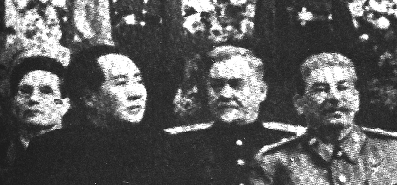
Mao Zedung, Bulganin, and Stalin Aug. 24, 1950 - Beijing: Gen. Deng Hua, Commander of the Northeast Defense Force, reports to Mao that Kim Il Sung's rapid advance has resulted in excessive extension of supply lines, that the great gap between forward and rear areas are likely to invite MacArthur to launch amphibious operations in the vicinity of Seoul or Pyongyang. Mao agrees with Deng Hua's assessment and warns Kim Il Sung and Stalin to slow down and beef up coastal defenses. Mao is worried that Kim will get China sucked into his war. China had been fighting for over 20 years. and it had only just been unified. The internal devastation had to be: repaired and land reform in newly liberated areas is in an unfinished state. In border districts there are bandits, spies. and Kuomintang remnant forces. Mao would prefer to prepare for liberation of Taiwan and Tibet. But the US imperialists are about to wipe out Kim Il Sung and he must be helped. Aug. 25, 1950 - An American general Dean, commander of the 25th Division, is captured hiding in a rice field near Taejung. His picture is a front-page news. Dean was in charge of the Taejung defense on July 19. His troops were wiped out by the guerrillas and N Korean troops, but Dean escaped and has been in hiding since. Finally, he is spotted and captured on this day. He is the ranking American POW of the Korean war. (NB. Col. Lee Hak Ku was the ranking NK POW. Gen. Walker, commander of the 8th Army, was the ranking KIA and Gen. Kang Kon, commander of the N Korean Army (South) was the ranking KIA on the communist side.). Aug. 25 - 1950 - The first major OPC operation, code named Trudy Jackson, is conducted by a US team led by 39-year old Lt. Eugene Clark of the US Navy. Clark was a Japanese linguist attached to MacArthur's G2. He is volunteered to lead an OPC team made of Lt. Youn Joung (ROK Navy), Col. Ke In Ju (ROKA), a US Army captain, and 10 Korean agents trained by Tofte. Col. Ke was formally an intelligence officer who was fired by Rhee for his failure to predict the invasion. August 28, 1950 - Hans Tofte flies Clark and the two Korean officers to an OPC camp at Sasebo. There they receive a quick lesson on covert operations and get teamed up a CIA radio team. Tofte gives Clark enough weapons, rice, dried fish, sugar, whiskey and gold bars to form a guerrilla army.
Lt. Clark and his CIA partisan unit near Inchon Aug. 28, 1950 - Kim Il Sung orders his final campaign to wipe out the Pusan perimeter. Pohang and Chinju and Nakdong front lines crumble, but the US 8th Army regroups and stops the campaign. This is the turning point of the war. The North Korean Army has run out of steam and goes down hill from this time on. The bulk of the Chinese war vets are dead or wounded. On Augst 31, 1950, the team boarded the British warship HMS Charity and left for Inchon. They were transferred to the S Korean warship PC-703 at the entrance of Flying Fish Channel. On Sept. 1, 1950, Lt. Clark and his team landed at Yonghong-do in preparation for the Inchon (14 miles from Yonghong) landing. Clark pressed some 50 islanders into scouting missions in Inchon. Informants called in the N Korean troops; the commandos escape to a nearby island of Palmi-do leaving behind the islanders. Those who helped the Americans were shot by the communists. Sept. 1, 1950 - Shenyang (Manchuria): Gen. Peng Dehuai establishes his secret army (Chinese Volunteers Army) headquarters at an old Japanese armory. Peng moves in with two battered suitcases an one book on butterflies - his only hobby. Sept. 5, 1950 - Nakdong: Kim Il Sung's final offensive, involving 133,000 ill-trained troops, to crush the Pusan perimeter comes to a halt. For the first time, the UN forces match the N Korean Army in numbers and fire power. By now the entire infantry fighting manpower of America is in Korea. Sept. 8, 1950 - Kang Kon, commander-in-chief of the N Korean Front Army and many of his staff are killed by a land mine. Kang was born on June 23, 1918 in S Korea and joined Kim Il Sung's army in 1933 and stayed with Kim until his death on the banks of Nakdong, S Korea. Two days later, Kim Il Sung holds a solemn funeral for Kang in Pyongyang.
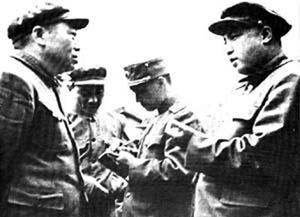
Kim Il Sung's top generals - Kang is first from right Kim Ilsung failed because he did not heed Sun Tzu's dictum - " ground over which it flows; the soldier works out his victory in relation to the foe whom he is facing. Therefore, just as water retains no constant shape Do not repeat the tactics which have gained you one victory, but let your methods be regulated by the infinite variety of circumstances. Military tactics are like unto water; for water in its natural course runs away from high places and hastens downwards. So in war, the way is to avoid what is strong and to strike at what is weak. Water shapes its course according to the nature of the, so in warfare there are no constant conditions. He who can modify his tactics in relation to his enemy and thereby succeed in winning, may be called a heaven-born captain. The five elements (water, fire, wood, metal, earth) are not always equally predominant; the four seasons make way for each other in turn. There are short days and long; the moon has its periods of waning and waxing." Kim Il Sung has failed to shape his tactics to fit the changing war circumstances. The Americans could and did read Kim's movements like a clock. Kim was beating his head against the wall. Sept. 10, 1950 - Shenyang: Peng Tehuai speeds up his preparation for Korean intervention. Peng sees that Kim Il Sung is fast fading away. Peng is faced with the enormous problem of assembling a an army of a quarter of a million: most field officers have no experience of fighting a conventional war against a well-organized army; transportation and communication are virtually non-existent. Mao Zedung thinks 3 weeks will be enough to place armies in N Korea, but Peng knows that it will take him at least 2 months. Peng plans his counter attack using a giant relief model of Korea. He tells his staff for the time on the record that the Korean situation is indeed very bad for Kim Il Sung. Peng has three field armies - the 38th, the 40th and the 42nd, the finest - of the 4th Army at his disposal. Two additional field armies - the 27th and the 39th - are being brought in from South China. Peng observes - "In war, numbers alone confer no advantage. Do not advance relying on sheer military power. Manpower alone will not win a war in Korea. Korea will be a battle of supplies." Peng continues: "Our planning must be flexible. In war, there are no constant conditions. We must match our methods to the prevailing circumstances: the terrain, the weather, the state of the enemy. Given the theoretical situation we have here, knowing our weaknesses as well as our strengths, I would oppose an all-out initial assault. But I would not advocate a purely guerrilla-style campaign. Our first response to an American invasion of North Korea should be limited. The PLA has not the equipment, the supplies, or the time to launch large-scale operations deep into Korea. If by some mischance the Americans and their allies ever invade the DPRK, we should halt them north of Pyongyang at the narrow neck of the Korean peninsula." Peng doubts if MacArthur would be so stupid as to move into the mountainous north and overreach himself - especially if he detected a large Chinese force in place. Peng orders more supply and engineering units; three more field armies arrive. Peng orders mobilization of local civilians for war. Sept. 12 - Truman fires Secretary of Defense, Louis Johnson, for insubordination and for leaking confidential information to Truman's political opponents. Johnson has been a staunch supporter of Chiang Kai Sek and MacArthur. Gen. George Marshall is recalled from retirement to take over the Defense Dept. Truman axes his head spook, Adm. Hillenkoetter. Gen. Walter Smith takes over the CIA. Sept. 15, 1950 - Shenyang: Gao Gang, the boss of Manchuria, calls for an emergency meeting. He informs the latest intelligence on a large American naval task force near the S Korean coast. Half way through the meeting, a signals officers brings in the news of Inchon landing. Peng Dehuai calmly proclaims to his staff - "The American counterattack has begun. This morning the imperialists landed on the Korean coast close to Seoul. The place is called Inchon."
|
|
US Invasion of North KoreaThe command center is an utter chaos. Some N Koreans officer run around and scream at each other without knowing what to do; while others are furiously burning documents. The commanding general faults his intelligence for bad information - he has been informed that "it is impossible to launch a full-scale amphibious operation at Inchon." On paper, the general has one division guarding Inchon, 3 divisions guarding Seoul and 4 divisions guarding Pyongyang. But, he knows that all these are "divisions' in name only and that he has at best 6,000 men to fight the invasion force of the X Corps - nearly 40,000 men. More than 4,000 N Koreans die. Civilians are indiscriminately napalmed and several captured N Korean nurses are shot by the Americans. Sept. 22 - Kim Il Sung at last faces up to the music and orders a general retreat. The US CIA estimates NK losses: out of the original force of 165,000, less than 40,000 manage to return home. All equipment in S Korea are lost. The N Korean Army has 30,000 to 50,000 new recruits in N Korea. The actual figures are: 30,000 out of the invading force of 90,000 return to N Korea. Virtually all senior commanders are back in N Korea. In addition, N Korea has a reserve of over 125,000 men intact in N Korea and Manchuria.
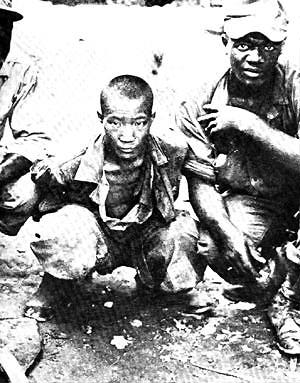
Black Gi's proudly show off a POW. Until the Inchon landing, the US JCS's primary concern was bracing for a Dunkirk at Pusan. With the abrupt and unexpected collapse of the North Korean Army, the JCS faces a new problem - to invade or not to invade N Korea. The overall US position is "one of steadfast patience and determination in opposing communist aggression without provoking unnecessarily a total war." In short, US is militarily NOT ready to fight USSR and China at this time. The primary interest of US is Europe - not Asia. Sept. 25, 1950 - The Chinese Army Chief of Staff, Gen. Nie Ronzhen, tells the Indian Ambassador that China will intervene in Korea even at the risk of a wider war with US. Indeed, Mao will welcome a chance to settle old grievances with the Yankee imperialists. A few days later, Chou En Lai tells the Indian Ambassador the same line. The Chinese recite the old debts owed to the Korean people: over 100,000 Koreans in the Chinese wars of liberation, of land reform, and against Chiang Kai Sek. The Ambassador passes on the information but Dean Rusk ignores "this Indian with a spade beard". Gen. Bradley (The JCS chairman) was opposed to MacArthur's war in Korea but Truman overrode his objection and approved stripping of US, Puerto Rico, Panama, Hawaii and Okinawa to feed MacArthur's army. Bradley tells Truman that a war with China is "the wrong war, at the wrong place, at the wrong time, and with the wrong enemy." The State Dept. experts on the USSR, George Kennan and Charles Bohlen, urge not to cross the 38th parallel. They believe that the USSR and China will join the war - if US invaded N Korea. But the hawks, Dean Acheson, Dean Rusk (the guy who drew the 38th parallel and who got US involved in the Vietnam War) and John Allison win the day and talks Truman into siding with MacArthur over the objection of the Joint Chiefs of Staff. Sept. 27, 1950 - MacArthur gets the official order to invade N Korea: "Your military objective is the destruction of the North Korean armed forces. In attaining this objective you are authorized to conduct military operations, including amphibious and airborne landings or ground operations north of the 38th Parallel in Korea, provided that at the time of such operations there has been no entry into North Korea by major Soviet or Chinese Communist Forces, no announcement of intended entry, nor a threat to counter our operations militarily in North Korea. Under no circumstances, however, will your forces cross the Manchurian or USSR borders of Korea" - Gen. Bradley, Chairman, US Joint Chiefs of Staff. Why invade N Korea and risk a wider war with China or Russia? Once again the US intelligence fails to serve the US national interest. About 90% of the CIA intelligence comes from MacArthur's headquarters. Much of Mac's intelligence come from Chiang Kai Sek who has vested interests in widening the war. This is the last chance for Chiang to regain the mainland China. Chiang and MacArthur have been in cahoots to promote a war with China. The CIA estimates: 565,000 communist troops in Manchuria (including about 70,000 Koreans) with more troops arriving from China. Chou En Lai's repeated warnings go unheeded. MacArthur does not think too much of the Chinese 'peasants' army. Sept. 27, 1950 - The British intelligence learns of a Chinese military council decision to intervene in Korea. US ignores this information. Simultaneously Chou announces publicly that "China will send troops across the frontier to participate in defense of North Korea." The hawks at the State Dept. led by Acheson and Rusk label Chou's statement a "bravado - part of a joint Soviet-Chinese diplomatic effort to save the North Korean regime." This arrogance (or ignorance) is shared by the CIA. The CIA analysis of Chou's statements reads: "Despite statements by Chou En Lai and troop movements in Manchuria...there are no convincing indications of an actual Chinese Communist intention to resort to full-scale intervention in Korea....From a military standpoint the most favorable time for intervention in Korea has passed.... While full-scale Chinese Communist intervention in Korea must be regarded as continuing possibility, a consideration of all known factors leads to the conclusion that barring a Soviet decision for global war, such action is not probable in 1950. During this period, intervention will probably be confined to continued covert assistance to the North Koreans." The consensus of the US top military is that the Russians are not ready for global war while China is not militarily capable of unilateral intervention - namely, "there will be no Soviet or Chinese communist intervention in Korea." Sept. 28 , 1950 - Seoul: MacArthur and Rhee make a triumphant entry to Seoul from Kimpo and hold a ceremony at the capitol. MacArthur says - "By the grace of merciful Providence, our forces fighting under the standard of that greatest hope and inspiration of mankind, the United Nations, have liberated this ancient capital city of Korea. It has been freed from the despotism of Communist rule and its citizens once more have the opportunity for that immutable concept of life which holds invincibly to the primacy of individual liberty and personal dignity....Mr. President, my officers and I will now resume our military duties and leave you and your government to the discharge of the civil responsibility." Rhee says - "We admire you. We love you as the savior of our race." MacArthur tells the press that the war is almost over and that the North Korean Army is basically wiped out. What remains is mop-up actions that even the S Korean Army can handle. Sept. 30, 1950 - The N Korean invasion of S Korea officially ends. The invasion has cost S Korea 111,000 killed, 106,000 wounded, 57,000 missing. 314,000 homes destroyed and 244,000 homes damaged. US losses so far: 5,145 killed in action; 16,461 wounded; 402 captured; 2,164 missing. The Inchon miracle elevates MacArthur to the status of an infallible god both in Korea and America. Once again the old general has performed a miracle and saved the American honor. No one, including the Joint Chiefs of Staff, dares to question MacArthur's military decisions. MacArthur is ready for another show and readies his X Corps (those troops involved in the Inchon landing) for the "second" Inchon at Wonsan. The X Corps would trap the N Korean Army for the final kill. Oct. 1, 1950 - Syngman Rhee orders Gen. Kim Paik Il to invade N Korea with or without US backing. Thus, Rhee realizes at last his dream of 'buk-jin' (march North). The second phase of the Korean War - invasion of North Korea - starts. US entered the war on the pretext of saving S Korea, but now that S Korea has been saved, the US objective changes to reunification of Korea by force after destroying the communist north. US changes from the defender to the aggressor. A sad Kim Il Sung addresses his people. N Korean Army reverts to guerrilla warfare. They withdraw into mountains in South and North Korea and prepare for a prolonged people's war. MacArthur thinks that his military genius has destroyed the communist forces and all that remains is a mop-up operation. Kim Il Sung. Kim asks Mao for help - "We request your special aid. Currently, with enemy forces attacking the area north of the 38th Parallel, our situation is extremely disadvantageous. In order to aid our forces. it is requested that the Chinese Peoples Liberation Army be directly mobilized for us immediately." Oct. 2, 1950 - Beijing: Mao notifies Stalin that China will fight US in Korea - "We are going to dispatch Chinese troops to Korea under the name of a Volunteer Force to fight the US Imperialists and Syngman Rhee's armed forces, side by side with our comrades, the North Korean forces. The reasons we are sending Chinese troops to Korea are that, if the US occupies the Korean peninsula, the Korean revolutionary forces would be completely removed, the US Imperialists would become more belligerent and arrogant, and it would result in a situation unfavorable to China." Mao requests that Stalin provide air and logistical supports. Stalin agrees to equip 100 Chinese divisions and send two Soviet air force divisions to Manchuria. Mao and Stalin agree that October 15 is the day to start the operation across the Yalu.
Gen. Peng in a field camp Oct. 8, 1950 - Peng Tehuai is given the command of the Volunteer Army (some 80,000 men) and prepares to enter N Korea. Kim Il Sung is a bad shape - he has only three divisions, one labor regiment, and one tank regiment intact and the rest of his army is in South Korea trying desperately to reach the reassemble area at Manpo. These units retreating from South are demoralized and without heavy equipment. Gen. Peng estimates at least two months to regroup and re-equip these units. Oct. 10, 1950 - Wonsan falls to S Korea's I Corps (the 3rd and Capital divisions) - however, ominously, North Korea's 5th Division controls the mountains and villages around Wonsan. My father runs a state farm near Wonsan. He escapes to our home in Hamhung. He moves us to our country home in Oro-ri, a small farming community a few miles north of Hamhung. Radio Pyongyang broadcasts Kim Il Sung's speech: "The Korean people are not standing alone in our struggle and are receiving the absolute support of the Soviet Union, the Chinese people,,".
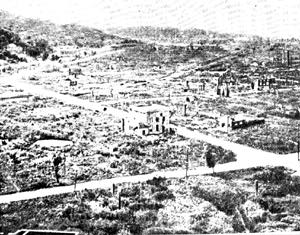
Wonsan completely ruined At the same time, Radio Peking broadcasts "The American War of intervention in Korea has been a serious menace to the security of China from the very start...The Chinese people cannot stand idly by with regard to such a serious situation - created by the invasion of Korea by the United States and its accomplice countries and to the dangerous trend toward extending the war. The Chinese people firmly advocate a peaceful resolution to the Korean problem and are firmly opposed to the extension of the Korean War by America." The Capital Div. (Sudo Sadang) moves 50 miles north to take my town Hamhung. The 3rd Div. stays put in Wonsan to safeguard the port for the US X corps including the 1st Marine Div. Wonsan is heavily mined by the Russian Navy. MacArthur brings in Japanese Navy mine sweepers lead by Adm. Takeo Okubo to clear the mines. This is the first official entry of the Japanese forces into the Korean War. MacArthur's generals are competing to be the first to reach the Yalu. MacArthur has not read Sun Tzu's The Art of War - "Thus, if you order your men to roll up their buff-coats, and make forced marches without halting day or night, covering double the usual distance at a stretch, doing a hundred miles in order to wrest an advantage, the commanders of all your three divisions will fall into the hands of the enemy. The stronger men will be in front, the jaded ones will fall behind, and on this plan only one-tenth of your army will reach its destination. "If you march fifty miles in order to outmaneuver the enemy, you will lose the commander of your first division, and only half your force will reach the goal. If you march thirty miles with the same object, two-thirds of your army will arrive. We may take it then that an army without its baggage-train is lost; without provisions it is lost; without bases of supply it is lost. We cannot enter into alliances until we are acquainted with the designs of our neighbors. We are not fit to lead an army on the march unless we are familiar with the face of the country--its mountains and forests, its pitfalls and precipices, its marshes and swamps." MacArthur is to lose more than five divisions for his folly. Oct. 11, 1950 - Stalin informs Chou Enlai that "The Soviet Union and China forces concluded a treaty of friendly alliance and mutual aid. In this treaty, if any one country is invaded by another country. the other must aid it as much as possible. This is clearly specified. Therefore, as far as we are concerned, we must strive, as much as possible, to limit military confrontation in Korea. As our Chinese comrades say, the Korean war must be made into a local war. If the US makes to bomb the mainland of China, we in the Soviet Union, will deploy our air forces to aid her. If things work out that way, the war will become unlimited and the possibility of it expanding to Europe or various places in the world increases. Because this is the case, as far as the air force question is concerned, it is necessary to be cautious. Instead. improving the equipment of the Chinese forces seems a good idea. We agree to your requests for urgent aid to equip your 40 divisions. However. this must be done in phases. Right now, we will move to first equip 20 divisions." Stalin got scared and has changed his mind about sending his air force to fight US. Stalin has realized that China and USSR have a mutual defense treaty which obligates him to fight on the side of Mao, if US goes to war with China. Stalin states that "Comrade Kim Il Sung must form a government in exile in northeast China" and that the best he can do for Mao is to send back the Chinese pilots in training in Russia. Stalin is playing a game with Mao and Kim. He wants to bleed US to death in Korea at the expense of Kim and Mao.
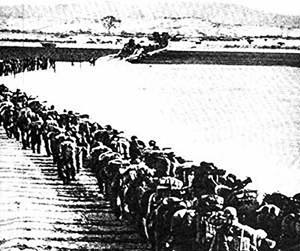
Peng's advance units cross the Yalu Oct. 11. 1950 - Beijing: Mao is furious at Stalin's duplicity- "Was everything not determined by agreement? How, in a situation where deployment orders had already been issued, could the Soviet Union unilaterally change their decision? If it comes to fighting, one must certainly fight to win,, absolutely. However, in the current situation, even without us having air superiority cannot do anything but fight. If we do not fight, as far as Korea is concerned, it will immediately go into the hands of the enemy. Also. after an announcement of unification by the Republic of Korea, it is not clear if we would fight or not. Stalin! All Socialist countries are looking to you. We are waiting for your support. But, you are saying that you are temporarily withholding deployment of the Air Force. For Truman's part, with Syngman Rhee fighting Kim I1 Sung, there was no delay in aid at all. If he had delayed even a little, Syngman Rhee would have collapsed and been destroyed. "Stalin! Why are you saying that you will postpone aid to China and Kim I1 Sung? As far as I am concerned, even if the Soviet Union commits air divisions to North Korea, I don't see that Truman will immediately and absolutely declare war on the Soviet Union. In the current situation, when the atomic bomb is already not a monopoly of Truman's country alone, what makes you believe that he would immediately declare war? What could he rely on that fight? Without the Soviet Union's help, if operations are only conducted with the Chinese volunteer forces, various types of difficulties will be forced. As far as these are concerned, in terms of numbers. they mean increasing the number of combat casualties. To what degree? 100,000 -- 200,000 -- if not. then 500.000? Hey, as far as the Chinese People are concerned. even though they do not want war, this will be relentlessly forced upon them." Oct. 12, 1950 - Mao tells Peng to stop his operations and wait for further instructions. Peng has already placed a sizable force in N Korea. Peng flies to Beijing.
|
|
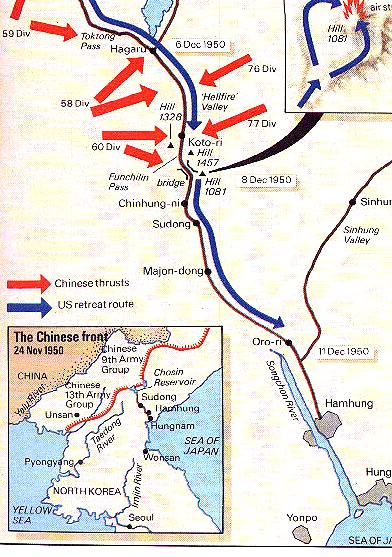
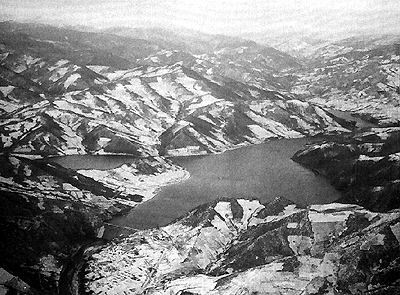
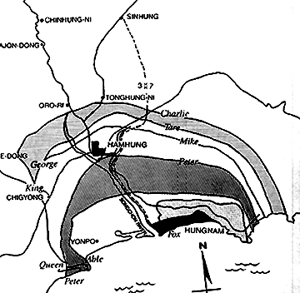
The Battle of HamhungA geography lesson - Hungnam is an industrial port city. It has a large ammonia manufacturing factory. Eight miles northwest of Hungnam is Hamhung, the capital city of the Ham-kyong-nam-do Province. Both cities are located on the Hamhung valley. Oro-ri is at the northern tip of the valley and the Sungchung River starts at Oro-ri, flows through Hamhung, and into the East Sea at Hungnam. A two-lane highway runs northwest from Oro-ri all the way to the Chosin Reservoir. The highway passes through Majong-dong, Sudong, Kotori, and Hagaru. Yudampo sits high in the rugged mountain terrain, some 60 miles from the East Sea. The so-called "highway" is nothing but a dirt track cut on the side of vertical cliffs. Many Soviet vehicles have fallen off the road in 1945.
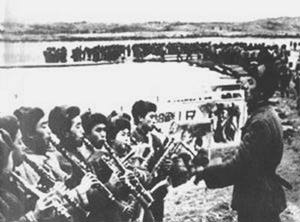
Hamhung area map Oct. 12, 1950 - I wake up in the morning to find the city completely deserted. The communists have left the town during the night. The air raid sirens are left wailing continuously - a prearranged signal for all party cadres to leave town immediately. One week earlier, all cadres were issued one Russian army survival kit and ordered to head toward Manchuria upon hearing the signal. Each man is allowed to carry only one knapsack and to hide or destroy important documents or equipment. I wonder how they managed to move all those wounded soldiers from the army hospitals in one night and where to? Our old family friend Comrade Chu (the former boss of the Hamhung Communist Party and my history teacher - the man from China) stops by our country home in Oro-ri (about 40 min. walk from our main house in Hamhung) to chat with my father. He is carrying one knapsack on his back and nothing else - probably, all of his earthly possessions are in his bag. Chu tells my father that the Chinese troops are already in N Korea. They have reached as far south as Kotori only a few miles north of Hamhung. It is only a matter of time when Gen. Peng's gigantic trap is closed shut and the UN forces annihilated. My father believes him - but I and Gen. MacArthur (whose agents have reported the same info) don't believe it; or rather we don't want to believe it. My father gives Chu a list of contacts in Kapsan and an envelop containing some money. The old comrade Chu walks northward as he had done years ago when the Japanese were about to arrest him. My father counsels those non-communists who held minor positions in the village government to go into hiding for a month or so. He figures that the UN forces will be gone by then. My father himself fled Wonsan where he ran a small state dairy farm and is lying low in Oro-ri. We have an apple orchard here. His wife #1 and wife #2, with their kids, are staying together for the duration of the war. His wife #3 is staying out in Hamhung - she is caring for her sick mother who cannot be moved. Oct. 13 - The Battle of Hamhung begins with an artillery duel. A lone N Korean howitzer fires on the column of S Korean troops approaching our city from Wonsan. S Korean artillery returns fire and kills the N Korean officer directing the shelling. All this activity is happening on the other side of Mt. Un Hung close to my house. A bunch of us watch the 'show' from the top of the mountain. Three men in civilian cloth race toward our city in an American jeep. It is a S Korean scout car looking for enemy units. No resistance - not a single N Korean soldier is to be seen. The jeep bypasses our city and heads north toward Oro-ri and disappears from our view. Nothing happens for an hour or so. We can see clearly the dead N Korean artillery officer still lying next to his howitzer. Then all of a sudden, the scout car reappears racing south. The men are frantically waving and shouting - tanks ! tanks !. We wait and wait - but no tanks appear. The sun sets and we all go home. I more or less run by the howitzer (and the dead body) and reach my house in Oro-ri in less than 25 min. On the way, I pass the S Korean guerrilla unit of Commander "X" (more on later) resting behind a farm building. The commander is exhorting his troops - mostly wearing high school student uniforms. It seems that everyone has a Russian Maxim machine gun, a heavy piece of machinery. I wonder how they manage run with the gismo. My father is mad at me for running around while there is a battle blazing outdoors. He orders everyone into our bomb shelter - actually our kim-chee storage cave. Every Korean house has a kim-chee cave, a large underground cavity used to keep kim-chee during winter. It is a large cavity dug deep in the ground with a thick earthen roof over it. Kim-chee caves double as bomb shelters - dating back to WW2. It is dark and damp inside the cave - besides all kinds of worms - ants, spiders, cockroaches, etc. -crawl all over us. The air is foul and hard to breathe - but my father is adamant that we all stay put. My sister blabbers - "Dad, Young Sik has a pistol in his school bag !". First, my father thinks she means a toy gun but soon he realizes that it's real thing. He takes my gun away and buries it. He says we will be all shot if either N Korean or S Korean soldiers find the gun. I don't want to tell him that I belong to an anti-Communist group - lest he may have a heart attack. Lucky for me, my mother is staying at our house in Hamhung and I have to put up with only one parent. My mother does not like hanging around my father's 2nd wife and spends as little time as possible in Oro-ri. During the night, S Korean troops in N Korean uniforms move in Oro-ri - unopposed. We can tell that they are S Koreans from their southern accent, US army issues and their hair (N Korean soldiers shave their head). They are going from house to house looking communists. Two soldiers burst into our house and ask us to line up. They are looking for military age men for questioning. One soldier stares at my teenage half system who is half naked. The soldiers move on and we go back to bed. Oct. 13, 1950 - Mao Zedong tells Peng and Chou Enlai (still in Moscow) - "As the result of an emergency agreement of all the various members of the Politburo, we have reached the unanimous opinion that it is advantageous for us to send troops to Korea. In the initial period, they will attack the ROK forces. In this regard, we have considerable confidence. First of all, we will put bases in the mountainous areas north of the line joining Pyongyang and Wonsan and rouse the Korean People even more. In Period 1, if only possible to annihilate several South Korean divisions, the situation in Korea will turn in an advantageous direction for us." Mao Zedong continues - "With regard to the adoption of the positive policies described above, for China and Korea and Asia and even going out to world as a whole, this is very advantageous. If we do not send troops, the enemy will control all the way up to the environs of the Yalu River, and, as far as the boasts of the reactionary forces within China are concerned. they would gradually grow higher and it would be disadvantageous for us in various respects. The whole of the Northeast Defense forces would be pinned down on the front line and the military forces in southern Manchuria would be completely dominated. For this reason. we came to the following conclusion. We should participate in the war. We must participate in the war. The profits from participating in the war would be very great. The damage from not participating in war would be very great." Oct. 13, 1950 - N Korean government moves to Kanggye, a remote mountain village near the Yalu. Oct. 14,1950: Andong (Korea-China border): Peng Dehuai sends the first train load of Chinese soldiers - the 334th Regiment, the 112th Division, the 38th Field Army - across the Yalu. Marching bands and school children give the soldiers a fine farewell. Soon after, the 42nd Field Army cross the Yalu at Manpojin. Peng's advance army is designated as the 13th Army Group under Li Tianyu. The 13th is ordered to stop MacArthur at a line just north of Chungchon River. Another field army, the 42nd, would move into regions east of the 13th to protect its flank and the temporary capital of N Korea, Kangye. Two additional field armies, the 50th and the 66th would move into Korea to reinforce the advance units. The latter armies would be designated as the 9th Army Group under Song Shilun. Peng has a total of 380,000 men under his control. The advance units cross the Yalu undetected by MacArthur. The Chinese intelligence has been monitoring American radio traffic and no mention is made of the crossing. Oct. 14, 1950 - During the night, S Koreans mine the road and wait for the enemy tanks heading in our direction. Early in the morning, three light tanks approach Oro-ri. The lead tank hits a mine and bursts into flames. One of the crew members manages to get out but shot right away. The remaining two tanks turn around and flee northward. We are happy to see S Korean troops. There is no formal welcoming party. We hang around the soldiers, trying to find out what is going on. I spot the ruined tank and decides to take a closer look - a bad mistake. A S Korean soldier grabs me from behind and threatens to shoot me. Lucky for me, the officer in charge stops the madman. It turns out the road is full of land mines and I was about to step on one - I guess the guy has saved my life and those of the soldiers nearby. I see that the mines are clearly marked and I am so stupid. Oct. 14, 1950 - Wake Island: MacArthur assures Pres. Truman that no Chinese would dare to face his army; that the Korean War is practically over now. MacArthur tells Truman that: "formal resistance will end throughout North and South Korea by Thanksgiving...We are no longer fearful of Chinese intervention. ..The Chinese have 300,000 men in Manchuria. Of these probably not more than 100,000 to 125,000 are distributed along the Yalu River. Only 50,000 to 60,000 could be gotten across the Yalu River. They have no air force. Now that we have bases for our air force in Korea, if the Chinese tried to get down to Pyongyang, there would be the greatest slaughter.". MacArthur continues his fairly tale to his rapt audience: "With the Russians, it is a little different. They have an air force base in Siberia and a fairly good one, with excellent pilots equipped with some jets and B-25 and B-29 type planes. They can put 1,000 planes in the air with some 2,000 to 3,000 more from the Fifth and Seventh Soviet Fleets. They are probably no match for our air force. The Russians have no ground troops available for North Korea. They would have difficulty in putting troops into the field. It would take six weeks to get a division across the border." Soviet archives show that some 100,000 Russian ground troops were packed and ready to move; and that Russian war planes were already operational in Manchuria. It is not clear if MacArthur was telling a white lie or was living in the fantasy world of a megalomaniac. Oct. 14, 1950 - Wake Island: Dean Rusk is not convinced and asks MacArthur point-blank - "What about the Chinese threat?". MacArthur answers: "I do not fully understand why the Chinese have gone out on such a limb and they must be greatly embarrassed by the predicament in which they find themselves." Truman believes every word of the great general - "Good-bye, sir. Happy landing. It has been a real honor to talk to you... I've never had a more satisfactory conference since I've been President,,,". Oct. 15, 1950 - Hamhung is secured and some form of life begins to return to the city. The radio station is back in business. City water is flowing again and we have the electricity back. The American engineers are superb! Its citizens are returning home by the thousands. Because of the American bombing raids and more importantly, due to severe food shortages, most citizens have left the city for the relative safety of the countryside. S Korean troops are under strict orders not harm any civilians. Any soldier who harms a civilian will be shot on the spot - "jik-kyok-chue-bun": so orders the commanding general who is originally from N Korea. These troops don't know a thing about the Chinese trap being set for them. Even now the Chinese are watching from their mountain positions and laughing to themselves. S Korean psychological war teams spring into action. Convoys of army trucks bring in loads of flour and other food items. They are piled high at several locations. Captured enemy supplies are added to the piles. Everybody is welcome to it. This is indeed unbelievable. These guys know how to win the heart and soul of our hungry citizens. Free concerts by the army bands are given daily. For the first time, since the days of the Korean People's Republic, we hear Korean folk songs - arirang, dara-dara, etc. No more Stalin songs! The general himself gives the welcome speech. He is a great speaker and talks about the ills of communism and peddles the virtues of Syngman Rhee. He says the war is almost over. Oct. 15, 1950 - US Navy Lt. Eugene Clark leads his second CIA OPC mission of the war (the first was at a scouting mission for the Inchon landing). Clark's first objective is to find friendly islands off the coast of N Korea where American pilots can find rescue teams. His second objective is to locate the lone N Korean radar site near the Yalu. His third objective is to pinpoint the source(s) of mines floating down from the Yalu estuary into the Yellow Sea. And, lastly and most importantly, he is to gather hard intelligence on the Chinese buildup in N Korea. Hans Tofte of the CIA OPC assigns 150 Korean guerrillas and 20 agents along with arms, food and gold bars. Clark and a radio team boards a S Korean Navy speed boat and the Koreans board 4 "fishing" boats maintained by the CIA. On the way to the Yalu, Clark loses two of the fishing boats and 75 guerrillas. He sets up a base on an isolated beach near Sinuiju. The Korean agents are sent out to find the N Korean radar site; a handful return (no radar is found) with reports of 300,000 Chinese soldiers south of the Yalu. Clark radios this information to Tofte. For some reason, Clark's report does not reach MacArthur. Oct. 16, 1950 - Happiness turns into ugliness. The communists guards at the Hamhung Reformatory (the same prison where my father was jailed by the Japanese) killed all political prisoners and dumped the bodies into wells. They poured gallons of acids into the wells in order to make identification difficult. More bodies are found at other sites. This is utterly unbelievable - how could they have done this to their own countrymen? The bodies are dragged up and laid out in an open field for the relatives to reclaim. The news of the massacres hits the news worldwide and trigger anti-red witch hunts. Anybody who had any connection with the communists is hunted down, beaten up and often killed - students are beating up their teachers, neighbors are accusing each other, school friends are accusing each other - the whole damn place becomes an inferno. The bad days of post-liberation when unruly mobs hunted down Jap-lovers are back again. Oct. 18, 1950 - Beijing: Mao orders Peng to start his move next day (Oct. 19, 1950). Chou Enlai informs Stalin that "I have just received a telegram from Mao Zedong and the Politburo. Our Central Committee has taken the decision to march troops into Korea at once!" Stalin is impressed - "The Chinese comrades are good after all". Stalin promises to send 2 air divisions as soon as he can.
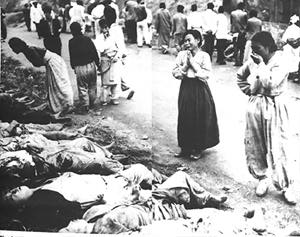
Political pisoners murdered by retreating communists in Hamhung Oct. 18, 1950 - The S Korean Army Command steps in and forms a civilian police unit. Everybody who is some body is trying to join the unit. Me and a close class mate Lee Chin Oh walk into a police station and apply for the job. The guy in charge looks at our papers (ID's) and tells me to get lost. He is angry at us and says - what a hell are you kids doing here? You have to be at least 18 years old. We realize how dumb the idea was and apologize for the inconvenience. We are about tail out there when a man walks in carrying a burp gun. He stares at my friend for a second and then grabs him by the neck - 'Hey, this boy is a communist spy!' I am shocked. I have known Chin Oh for three years now. His family used to own land (just like mine) and his father was killed by communists. His older brother fled to S Korea but he and his mother were left behind. He came to my house on the day Hamhung fell and has been staying with me since. It turns out that my friend was an informant of the Political Security Unit (jung-chi-po-wi-dae). The man with a gun takes my friend outside and I decide to split. I have not seen Chin Oh since that day - I presume that he was taken to a ditch and shot to death. (a few days later, Chin Oh's brother, a S Korean army captain, came looking for his family and it was my sad duty to tell him about his brother's final day.). One thing about my friend Chin Oh: I have confided to him my secret (and idiotic) plans for fighting communists but he did not betray me to the police. My brother and I join the Student Volunteer Army (SVA). SVA is made of boys (14 to 18 years) who are too young to serve in the regular army and also, older kids whose parents have the right connection. It's basic doctrine is 'Wha-Rang-Do' - the nationalistic youth movement during the Silla dynasty. SVA members help with civilian security, traffic control and occasionally work as guerrillas or intelligence agents. My father is against my joining SVA, but he knows how stubborn I am. He is sad with tears in his tired eyes. He must have realized that his #3 son is about to be lost to him forever. Indeed, this is to be the last time I see him. Oct. 19, 1950 - The N Korean capital Pyongyang falls to the ROK 1st Division commanded by Gen. Paik Sun Yup. This man was a lieutenant in the Japanese Imperial Army in 1945. His home town Pyongyang mistreated Paik and his family for their pro-Japanese actions. Paik Sun Yup and his brother Paik In Yup fled to S Korea, but several members of his relatives were killed - including Paik's son, whose head was sawed off. Gen. Paik enters Kim Il Sung's office. Kim's office has no less than 5 portraits of Stalin and one statue of himself. Oct. 19, 1950 - The Chinese Volunteer Army begins to cross the Yalu into N Korea. Some 250,000 Chinese troops move into positions in N Korea to surround the unsuspecting UN troops. Unbelievably, neither the US intelligence nor the air reconnaissance flights detect the movement of an entire field army.
Chinese Volunteers Army marches into N Korea Peng Tehuai follows Sun Tzu's dictum: "The general who is skilled in defense hides in the most secret recesses of the earth; he who is skilled in attack flashes forth from the topmost heights of heaven. Thus on the one hand we have ability to protect ourselves; on the other, a victory that is complete." Peng figures that MacArthur's ego and arrogance will cloud his visions and he would either ignore or fail to see the Chinese hordes waiting for him. Oct. 20, 1950 - Tokyo: MacArthur's intelligence chief issues an "end-of-war" announcement: - "Organized resistance on any large scale has ceased to be an enemy capability. Indications are that the North Korean military and political headquarters may have fled to Manchuria. Communications with, and consequent control of, the enemy's field units have dissipated to a point of ineffectiveness. In spite of these indications of disorganization, there are no signs, at the moment, that the enemy intends to surrender. He continues to retain the capability of fighting small scale delaying actions against UN pressure." Oct. 21, 1950 - Kim Il Sung meets with Peng Tehuai and works out common understandings on Sino-Korean war objectives. Peng and Kim agree to wage a guerrilla warfare if Peng failed to stop MacArthur. Peng's first objective is to stop further advances by the US forces and then envelope them into a giant trap and kill as many Americans as he can. As things have developed, MacArthur's forces collapsed faster than Peng expected and Peng decides to chase the Americans across the 38th parallel well beyond what Mao hoped for. Mao thought that it would take 3-4 months to establish a defensive line along the Wonsan-Pyongyang axis and to re-equip the N Korean Army and his Army with the Russian modern weapons promised by Stalin. He would have air cover provided by two Russian air divisions. He would then be ready to push the Americans as far south as he can. During the Cultural Revolution in China, Peng was accused of insulting and ordering around Kim Il Sung among other "crimes" and driven to a horrible death. Some Red Guards attacked Kim Il Sung's self-adulation and lavish life style. Peng wrote memoirs before his death. After Mao's death, Peng was restored to his former place of honor posthumously.
Peng and Kim Il Sung
|
|
Home by ChristmasHamhung - Student Volunteers Army: We are getting the basics - ideals of 'Wha-Rang-Do', ethics, military tactics. These are taught by college kids from S Korea. SVA units are organized on an egalitarian basis much like the Chinese People's Liberation Army - no ranks, only job functions such as squad leader, company leader and so on. Anyone can be elected to a leadership position by his peers. Those of us who are considered to be reliable (sons of landowners, capitalists, Christians, etc.) are organized into a special unit and get additional training - guerrilla and espionage techniques. Our teacher is Commander 'X' who was trained in S Korea and sneaked into N Korea in 1949, one year before the War started. He led a guerrilla army of about 50 men (mostly students) in the mountains around Hamhung. 'X' reports to and receives materials from a US spy unit (NB: as stated in a later section, this unit turns out to be the US AF 6006 Recon and Intel Squadron). He has been getting his supplies and men air dropped since the start of the war. Oct. 24 - US 1st Marine Div. moves to Hamhung from Wonsan and the ROK I Corps move out. We meet the US soldiers for the first time. MacArthur orders his commanders to drive to the Manchurian border with all speed and with full utilization of all their force - in a clear violation of the JCS directive to use only ROK forces in the Northeast Provinces. Gen. Bradley is shocked by MacArthur's insubordination and calls for a top-level meeting in Washington. MacArthur wins again: The ROK forces are too few and their commanders are too emotional to do the job.
Chinese infantry passes by US Army trucks Oct. 26 - N Korea (west): The Chinese regulars virtually wipe out the ROK 6th and 8th divisions at Onjin. Simultaneously, the ROK 1st Div. is hit hard and collapses at Unsan. The ROK Army in the west evaporates. The 8th Army's advance comes to a halt and the entire front lines are in chaos. MacArthur's intelligence chief (Gen. Willoughby - perhaps, the most incompetent man on MacArthur's staff) is still repeating - "the auspicious time for intervention has long since passed." Oct. 29 - N Korea (east): US 7th Div. lands at Iwon, northeast of Hungnam and starts a long march to Heysan, 100 miles from Iwon on the Yalu River. One regiment branches out to the Fusen Reservoir north of the Chosin Reservoir. MacArthur falls into Peng Tehuai's trap per Sun Tzu's dictum - "Thus one who is skillful at keeping the enemy on the move maintains deceitful appearances, according to which the enemy will act. He sacrifices something, that the enemy may snatch at it. By holding out baits, he keeps him on the march; then with a body of picked men he lies in wait for him." The 7th Division units pay dearly for MacArthur's arrogance. Nov. 1 - The US X Corps (Gen. Almond) moves to Hamhung. MacArthur orders indiscriminate carpet bombing of every village, town and city still in the communists control. For the first time, Russian MIG's manned by the Soviets appear to fight the Americans. The X Corps is made of the 1st Marine and the 7th Infantry. The Hamhung City Hall is the X Corps Headquarters.
Hamhung City Hall flying US, UN and S Korean flags Nov. 1, 1950 - Unsan: The 8th Regiment of the 1st Cavalry Division is virtually wiped out. The survivors join remnants of 3 ROKA divisions smashed by the Chinese in a general retreat. Nov. 2, 1950 - Beijing: Radio Peking (Beijing, Peking and Peiping are synonymous) announces officially that Chinese "Volunteer Corps" are in Korea fighting the US imperialists. The Volunteers are to protect the Hydroelectric Zone along the Yalu. This gives MacArthur an excuse for another spin to the Chinese intervention: "The Chinese, extremely subtle and obsessed with saving face, are attempting to have their cake and eat it too. " On the other hand, MacArthur's G2 chief, Gen. Willoughby warns "Although indications so far point to piecemeal commitment for ostensible limited purposes only, it is important not to lose sight of the maximum potential that is immediately available to the Chinese Communists. Should the high level decision for full intervention be made by the Chinese Communists, they could promptly commit twenty-nine of their forty-four divisions presently employed along the Yalu and support a major attack with up to 150 aircraft." A Chinese division has about 10,000 men. A field army is made of three divisions. Nov. 2 - US 1st Marine Div. moves out Hamhung and marches northwest toward the Chosin Reservoir. The 7th Marine Regiment reaches Sudong-ri on the same day and relieves the ROK 26th Regiment. The Chinese troops strike at the marines for the first time in the war. The marines push on north and reach Koto-ri on Nov. 7 after numerous skirmishes with the Chinese. Six Chinese POW's are brought back to Hamhung. It is obvious that they are NOT Koreans. I realize that Comrade Chu knew exactly what was going to happen. The commander of the 1st Marine wisely follows Sun Tzu's teachings - "When in difficult country, do not encamp. In country where high roads intersect, join hands with your allies. Do not linger in dangerously isolated positions. In hemmed-in situations, you must resort to stratagem. In desperate position, you must fight. There are roads which must not be followed, enemy armies which must not be attacked, towns which must not be besieged, positions which must not be contested, orders of the general which must not be obeyed." He disobeys MacArthur's order to push on (and saves his division from annihilation).
An aerial photo of the Chosin Reservoir The Chinese prisoners are not afraid of the Americans - having been treated fairly by the Americans - Yankee cigarettes, canned beef, chocolate bars, medical attention, etc. - far better than what they were getting from their own army. Their uniform is more or less of home-made variety. heavily quilted against the Korean winter. The Chinese have no military ranks and hence, their uniform has no place for any fancy stuff that the N Koreans have. Leaders are identified by their uniform which is identical to that of a soldier except it has an extra pocket. Another sign of an officer is a side arm. They wear no dog tags, instead they have their name and unit inscribed inside of their jacket. Under the quilt, they were whatever clothing they own. Since they own only one set of clothing, the sanitary situation of the Chinese army is not good. The Chinese bathe only twice in their entire life - upon exiting from the womb and upon death. The Americans douse the poor Chinese with DDT to rid the noxious lice. One of the best things the Americans brought to Hamhung is their DDT. Ever since my childhood, I have been waging a losing battle with lice - head lice, arm-pit lice, foot lice. Every day, I used to spend at least one hour on my battle with lice - you catch them and squash them by the hundreds, but they keep on coming back. The American DDT has solved my lice problem. I think the Chinese POWs will thank the Yanks for ridding their body lice. The Chinese are poorly armed. Most of them carry old Japanese or Russian 'Type R' rifles - both rifles WW1 bolt-action types. The only thing they are good for are bayonet banzai. They also carry American submachine guns and mortars confiscated from Chiang Kai Sek - courtesy of Uncle Sam. As a matter of fact, about three quarters of the Chinese used to be in Chiang's army. The Chinese soldier carries everything he needs on his person. His ration consists of powdered rice mixed with whatever staple he can get hold of. The powder is mixed with water and consumed while marching or resting. His ration is carried in a cloth roll pack which has pockets for daily portions. He gets dried fish to chew on now and then. The daily routine of a Chinese soldier is as follows: By daylight, he digs a fox hole for himself and eats his breakfast. During the day he hides in a fox hole motionless - only a scouting party moves around looking for enemies and the next camp site. At sunset, he packs his gear and starts his nightly march until daylight next day. He can cover as much as 18 miles a day on frozen mountain paths.
Chinese soldiers enjoying a hot meal By the end of October, Peng Tehuai had four armies, more than 250,000 men, positioned in N Korea - motionless and invisible to aerial recons. Gen. Lin is patiently waiting for an opportune moment to close his trap. Chinese soldiers carry one week's supply of rice, powdered millet and Soya bean in a cotton cloth tube hung over their shoulders. They have enough ammo and grenade good for one week's hard fighting. The Chinese army needs no trucks, no field kitchen, no clerks for paper work and no frills. Every man in a Chinese army is a fighter - compared to one fighting man supported by 4 support logistics guys in the American army. Nov. 4, 1950 - Chungchon River: The 119th and the 120th Divisions of the Chinese Volunteers Army smash the US 19th Regiment and the British 27th Commonwealth Brigade. Nov. 5 - MacArthur is ignoring, for whatever reason, eyewitness field intelligence reports being radioed to him hourly. He says that there are only a few thousands Chinese 'volunteers' and that he can whip them in no time at all. New orders are issued to hurry to the Yalu so that the Americans can go home before Christmas. This guy is either an idiot or has a secret magic in his sleeves. He will have all of us killed. He has been saying to everyone, including Truman, that China is incapable of intervening in Korea. Now that some 200,000 Chinese are in Korea, he is trying to find a way to save his face. If his Xmas campaign succeeded in kicking out the chinamen, then his misjudgments would be forgotten or justified. MacArthur's daily routine is as follows: Mac works seven days a week. His motorcade of MP's and a 1941 Cedilla arrives at Dai-ichi Building at around 10:30 A.M. Several dozen Japanese servants wait in line and bow deeply to their master. A waiting elevator takes Mac to his penthouse on the top floor which overlooks the Japanese emperor's palace. He works on speeches, mail and memoranda until noon. Maj. Gen. Courtney Whitney (an expatriate lawyer in the Philippines - not a military man) is Mac's personal secretary. Mac goes home for lunch at 12:00 and takes a long siesta. He returns to work at 17:30 P.M. and stays there until midnight. Gen. Charles Willoughby (Tokyo chief of intelligence - G2) is another faithful servant - whose job is to provide intelligence reports in support of Mac plans. For example, Mac wants to expand the Korean War into WW3 and therefore, Gen. Willoughby gathers "reliable" intelligence data and issues a definitive statement - "The Chinese and Soviets have decided against further expensive investment in support of a lost cause." Sun Tzu said: "Now the general is the bulwark of your army; if the bulwark is complete at all points; the army will be strong; if the bulwark is defective, the army will be weak. There are three ways in which a leader can bring misfortune upon his army: (1) By commanding the army to advance or to retreat, being ignorant of the fact that it cannot obey. This is called 'hobbling'. (2) By attempting to govern an army in the same way as he administers a government, being ignorant of the conditions which obtain in an army. This causes restlessness in the soldiers' minds. (3) By employing the officers of his army without discrimination, through ignorance of the principle of adaptation to circumstances. This shakes the confidence of the troops. "But when the army is restless and distrustful, trouble is sure to come from the other dissidents. This is simply bringing anarchy into the army, and flinging victory away. Thus we may know that there are five essentials for victory: (1) He will win who knows when to fight and when not to fight. (2) He will win who knows how to handle both superior and inferior forces. (3) He will win whose army is animated by the same spirit throughout all its ranks. (4) He will win who, prepared himself, waits to take the enemy unprepared. Hence the saying: If you know the enemy and know yourself, you need not fear the result of a hundred battles. If you know yourself but not the enemy, for every victory gained you will also suffer a defeat. If you know neither the enemy nor yourself, you will succumb in every battle." If only the Joint Chiefs of Staff in Washington heeded Sun Tzu, millions of lives would have been saved. Nov. 6, 1950 - Peng Dehuai orders his men to break all active combats with the enemy forces and withdraw to their mountain sanctuaries. Peng hopes that MacArthur has gotten the message and get out of N Korea without further losses. Peng needs to rest and resupply his troops. Peng needs time to assess battle performance of the enemy and refine his tactics. Nov. 8, 1950 - Peng Dehuai was wrong - MacArthur did not get it. MacArthur orders his air force to starts a massive bombing of Manchurian border installations, and anything standing south of the border - "every factory, every city, and village." The Joint Chiefs of Staff approve the order without consulting the State Dept. The air force commander, Gen. Stratemeyer, reports Mac's order to his superiors in Washington which is leaked to the State Dept. All hell breaks out. The State Dept. countermands MacArthur's order. But Truman sides with MacArthur.
MacArthur dares Peng by bombing Andong, the Chinese city where Peng's headquarters is located. Nov. 10 - Tokyo: Gen. Willoughby, chief of MacArthur's G2, reports: "In the frontier area, fullest advantage can be taken of the extent to which world opinion already is conditioned to acts of aggression and regards identification of a few regiments on the wrong side of a border as something less than overt action.. It will be much easier to ship up support of public opinion in China for major military operations if immediate threat to the Manchurian border can be claimed, which sources believe will be done despite the belief that CCF (Chinese Communist Forces) leaders are aware that the UN forces have no intention of crossing the Manchuria." Nov. 13 - The 7th Marine Regiment occupies Hagaru. The Chinese disengage and disappear. Peng Tehuai replaces his front line troops with fresh ones for the second major offensive. The Chinese army works on a "five-days to fight and 10 days to replenish" schedule due to their limited resupply capability. Fresh troops are loaded up in a rear area and then march forward to replace the exhausted and out-of supply front-line troops. Later in the war, the Chinese rely on captured war materiel to compensate for this weakness. Nov. 15, 1950 - Shenyang, China: The worst winter in 200 years is raging through Manchuria and Korea. Pen Dehuai welcomes this unexpected help from mother nature. Peng knows that the Americans are not prepared for winter combats. Peng rises at 5:30 A.M. and does an old-man's tai chi exercise by his bed. He does a short run-around in the courtyard - rain or shine - for about 20 min. At 6:30 A.M., Peng leads his staff on a jog around the command area, a distance of about 2 km. Peng eats breakfast of tea and a bowl of spicy rice gruel. He goes over cables and reports while eating. He attends the first staff meeting at 8:00 A.M. Meetings last all day and night until about midnight. Peng states - "First, although we were able to succeed in our initial attack operations, the enemy's main force units were not damaged. Since the main force units of the Chinese Peoples Volunteers had not appeared, the enemy were anticipating an attack. Second, the enemy was counting on his air power to cut our communications and food supply. This gave us an opportunity to deceive the enemy with regard to our intentions. Since we only sent a few troops, we were able to plant the impression that our food and supplies were insufficient. Third, because the enemy was armed with aircraft and tanks, it would be difficult for us to win if we fought directly with such an enemy." Peng's next move is to smash Ned Almond's US X Corps in Hamgyon Namdo. This task falls on 120,000 volunteers of the 9th Army Group commanded by Song Shilung. In the western front, the 13th Army Group lead by Li Tianyu will take Seoul and move southward as far as it can go. Peng tells his generals - "The enemy has learned nothing over the past few weeks. They continue to advance recklessly. To that extent, our first-phase offensive has been a failure. My strategy may have been overly cautious. But in an encounter of this nature, with so many unknown possibilities, it seemed essential to get into position and deliver deterrent attacks upon the Americans without provoking a level of retaliation that would escalate the Korean conflict into another world war." "But all we seem to have accomplished is to convince the Americans that Chinese troops have not entered Korea in any strength. This is unfortunate, because China now has no alternative but to teach the imperialists a lesson." Peng's intelligent agents have learned Mac's "home by Christmas" offensive plan and Peng continues - "And when it comes, the Chinese People's Volunteers will counterattack with all available force. The 9th Army Group will encircle and exterminate the US Marines around the Changjin Reservoir. Other enemy forces in that area will be mopped up along the coast. This should be possible, bearing in mind the enemy's scattered dispositions across difficult country."
US 7th Infantry moving through my birth-place, Kapsan. Nov. 15 - My birthday: No birthday party or cake for me this year. I have more important things on my mind. Are we winning or losing the war? MacArthur says we are winning, but everyone else is saying that we are losing. Our unit is on standby - we may be ordered into guerrilla actions or bug out at any time. No one is allowed to leave the camp. Nov. 20 - The 7th Infantry Div. reaches the Manchurian border town, Hyesan at the Yalu River. My birth place Kapsan is completely destroyed by the special request by MacArthur and Rhee - Kapsan was the guerrilla base of Kim Il Sung during 1932-1941. The Joint Chiefs of Staff has given MacArthur specific orders to stay far away from the Yalu, but MacArthur ignores the orders and tells his staff - "those asses in Washington" don't know how to fight a war. MacArthur is jubilant and believes he has been right about the Chicoms all along - "Heartiest congratulations, Ned (Gen. Almond) and tell Dave Barr that the 7th Division hit the jackpot." MacArthur takes his top generals and flies over Kapsan and Hyesanjin. Medals are handed out to all officers involved in this jackpot. Peng Dehuai's main problem is keeping his men fed, clothed and supplied with enough ammunition. Most supplies must be moved by less than 800 old trucks of unknown age. The Soviets have promised modern trucks and they have not arrived. Supplementing the trucks are the coolies recruited from Manchuria and Korea. Some half million Chinese coolies are required to ferry war supplies across the Yalu. And as many Korean coolies are needed to deliver the goods to the front-line soldiers. The coolies must be fed, housed and protected.
The Americans wade across the Changjin River where my father has built irrigation canals in 1930's. Nov. 18, 1950 - Peng's generals ask for artillery, air support, tanks and more food and ammunition. Stalin's promised help begins to materialize. Russian burp guns and machine guns arrive in huge numbers for Peng's army. Two Soviet air divisions are being moved to Manchuria. One air defense division is on its way. Peng's people could use better communications - anything better than the runners and 2,000-year old methods (bugles, flags, flares, etc.) in use. Nov. 23 - Thanksgiving: The Chinese have not returned and a general relief and optimism prevail. GI's have the best meal of the war - shrimp cocktail, roast turkey, fruit cake and mince pie - all you can eat. At a Hamhung hotel, Gen. Almond and his X Corps staff attend a ravish dinner party. Little they know that this would be the last meal for many Americans.
US 7th Infantry racing to the Yalu - Haesanjin is in the background Nov. 24 - MacArthur orders a general offensive to finish the war. Mac flies over Kapsan (my birth place) and Hyesan to gloat over destruction of Kim Il Sung's old Guerrilla base - totally unaware of the pending disaster on the ground and the end of his myth of the military genius of the 20th century. MacArthur addresses his troops: "The United Nations massive compression envelopment in North Korea against the new Red Armies operating there is now approaching its decisive effort. The isolating component of the pincer, our air forces of all types, have for the past three weeks, in a sustained attack of model coordination and effectiveness, successfully interdicted enemy lines of support from the north so that further reinforcement therefrom has been sharply curtailed and essential supplies markedly limited. The eastern sector of the pincer, with noteworthy and effective naval support, has now reached commanding enveloping position, cutting in two the northern reaches of the enemy's geographical potential. This morning the western sector of the pincer moves forward in general assault in an effort to complete the compression and close the vise." "If successful, this should be for all practical purposes end the war, restore peace and unity in Korea, enable the prompt withdrawal of United Nations military forces, and permit the complete assumption by the Korean people and nation of full sovereignty and international equality." This is the famous "Home by Christmas" promise made by MacArthur. Nov. 25, 1950 - Mao's son, Mao Anying, is killed in a bomb raid in Pyongyang along with scores of high-ranking Soviet advisers Anying was commanding an artillery unit moving toward the front when his unit was attacked by American bombers. Mao Zedung shows no emotion when informed of this tragedy and forbids publication of his son's death. Mao does not want any preferential handling of Anying's death. He is just one of the many thousands of the Chinese youth sacrificed fighting the American imperialists.
Mao and son, killed in Korea Mao Zedong has developed his own theory of warfare adapted from The Art of War by the 500 BC military genius Sun Tzu. Mao wrote: "Luring the enemy to penetrate deep in our territory is the most effective military strategy for a weaker army in a defense against a stronger army....Is it not self-contradictory to fight heroically first and abandon territory afterwards? One eats first and then relieves oneself; does one eat in vain?" Mao's strategy saved his Liberation Army many times during the Chinese Civil War. Kim Il Sung and Peng Tehuai are practicing this age-old Sun Tzu's strategy.
US 7th Infantry and 2nd Marine POW's at Chosin Ned Almond, the X Corps commander, flies to the Changjin Reservoir and tells Task Force Smith (the 7th Infantry Division) - "The enemy who is attacking you is nothing more than some remnants of Chinese divisions fleeing north. We are still attacking and we're going all the way to the Yalu. Don't let a bunch of Chinese laundrymen stop you." Almonds hands out medals and returns to his hotel suite in Hamhung. Task Force Faith, including its commander, Col. Don Faith, is squashed that night by the Chinese. Captured GI's are released to the US Marines stationed south of the Reservoir. Peng wants the 5th and 7th US Marine Regiments destroyed. Song Shilu's 9th Army Group has more than 100,000 men assigned to encircle and exterminate some 20,000 US marines - the best fighting men of the world. Peng doesn't care about the US 7th Infantry or the three ROKA divisions, numbering more than 100,000 men; he lets them escape from Wonsan, Hungnam and Chanjin via US, Japanese and S Korean ships.
|
|
Fall of HamhungNov. 25 - Peng Tehuai starts his long-awaited major offensive by smashing the ROK II Corps in the west and the US 1st Marine Div. in the east. The South Korean troops are out-flanked and out-run. Three S Korean infantry divisions collapse and evaporate in a single night. True to the military tactics of Sun Tzu (500 BC), Chinese bugles, gongs and flair fill the skies over N Korea.
Chinese mortars firing at US 2nd Marine units Sun Tzu said - "Let your plans be dark and impenetrable as night, and when you move, fall like a thunderbolt. When you plunder a countryside, let the spoil be divided amongst your men; when you capture new territory, cut it up into allotments for the benefit of your troops. Ponder and deliberate before you make a move. He will conquer who has learnt the artifice of deviation. Such is the art of maneuvering. The Book of Army Management says: On the field of battle, the spoken word does not carry far enough: hence the institution of gongs and drums. Nor can ordinary objects be seen clearly enough: hence the institution of banners and flags. Gongs and drums, banners and flags, are means whereby the ears and eyes of the host may be focused on one particular point. The host thus forming a single united body, is it impossible either for the brave to advance alone, or for the cowardly to retreat alone. This is the art of handling large masses of men. In night-fighting, then, make much use of signal-fires and drums, and in fighting by day, of flags and banners, as a means of influencing the ears and eyes of your army. A whole army may be robbed of its spirit; a general may be robbed of his presence of mind. Now a soldier's spirit is keenest in the morning; by noonday it has begun to flag; and in the evening, his mind is bent only on returning to camp. A clever commander, therefore, avoids an enemy army when its spirit is keen, but attacks it when it is sluggish and inclined to return. This is the art of studying moods. Disciplined and calm, to await the appearance of disorder and hubbub amongst the enemy:--this is the art of retaining self-possession. To be near the goal while the enemy is still far from it, to wait at ease while the enemy is toiling and struggling, to be well-fed while the enemy is famished:--this is the art of husbanding one's strength. To refrain from intercepting an enemy whose banners are in perfect order, to refrain from attacking an enemy army drawn up in calm and confident array:--this is the art of studying circumstances. It is an axiom not to advance uphill against the enemy, nor to oppose him when he comes downhill. Do not pursue an enemy who simulates flight; do not attack enemy whose temper is keen." The Americans are unprepared, both mentally and weapon-wise, to fight in the bitter colds of N Korea. The winter is so bitter that many GI's go into shock. Their thought processes are slowed, and any part of the body exposed to the elements, especially nose, ears, hands, and feet, actually hurt from the cold. GI gloves which have fingers are not helpful; only native mittens keep the fingers warm. Hypothermia is a not well-known to the American medics. Dehydration and lack of proper food enhance loss of body heat, which lead to an insufficient oxygen supply to the brain, which impairs the mind as well as physical functions - and to death. So much energy is spent on providing body heat that even the most simple activities such as walking and just standing become acts of extreme exertion. Yet, failure to move about could result in frostbite; movement causes pain, and to walk any distance on numb feet requires a super-human mental discipline. Glenn C. Cowart, an American military historian (author of Miracle in Korea), states: "Hunger, often was not satisfied by field rations. Sweets, because they produced energy, were craved for, and the desire for hot, sweet liquids such as hot chocolate was a constant fantasy. "Nor were problems confined to the human body. Malfunctioning weapons were the rule rather than the exception, until the troops learned to clean them more often and to forgo the application of oil to the moving parts, a standard procedure in warmer climes. Up in the mountains near Sachang-ni, where it was at least twenty degrees colder than in the lower elevations, some units were dismayed when the sub-freezing temperatures caused the firing tubes of the 4.2" mortars to split. Artillery shells fell short of their targets and radio equipment was effective only over limited distances. "The movement of tanks and trucks over roads made slick by ice and snow was increasingly dangerous as stalled and overturned vehicles impeded the men and equipment on roads meant for ox-carts. "The weather also played havoc with tactical air support. All operations were hampered, but carrier based aircraft felt the greatest impact due to the increased hazards of snow, ice, rough seas and surface fog for carrier takeoffs and landings. Missions utilizing land-based aircraft were also curtailed, but Air Force transports and Army light aircraft used in directing artillery fire continued to airlift items such as ammunition, rations, sleeping bags and blankets and, equally important, to evacuate the seriously wounded." Nov. 26 - MacArthur's Christmas offensive collapses and he at last orders a general retreat - the big bug-out begins in earnest. The Korean People's Army reappears from their mountain bases and cut off all highways leading to S Korea. More than 150,000 UN troops are trapped in the frozen battle fields of N Korea. This comes as a complete surprise to Truman and the US Joint Chiefs of Staff. Truman panics and threatens to use nukes in N Korea. However, the threat of nukes splits the UN allies who are already nervous about their involvement in the war. Truman realizes that US cannot go alone on the nuke issue and backs off.
US 2nd Marine units retreating to Hamhung Nov. 27, 1950 - The worst disaster of the day falls upon a 5,000-men Turkish Brigade. On the previous day (Nov. 26), the Turks attacked a company of S Koreans and inflicted heavy casualties on the "Chinese" at Takchon. The real Chinese ambush the Turks and only a handful manage to escape. Columns of military vehicles - tanks, trucks, jeeps, and self-propelled guns - stretch from the Chungchun River all the way to Seoul. Some half million refugees follow the retreating armies to south. People die of hunger and cold; and frozen bodies are found everywhere. Nov. 28 - Washington: Truman hears the bad news and goes into a shock. He has been assured as recent as three days ago that MacArthur was about to wind up the war and send the boys home by X-mas. Now, MacArthur wants more US troops. An emergency session of the National Security Council is convened. Gen. Bradley tells Truman that there is no more troops to send and that he is worried about the 300 Chinese bombers in Manchuria. The supply areas and air force bases of the UN Command are wide open to aerial attacks. The military wants preemptive strikes on the Chinese air fields, but Gen. Marshall advises against a general war with China. Marshall warns that a war with China will benefit the Soviets and open the continental US for Soviet nuclear and ground attacks. Truman is more worried about the negative impact the defeat would have on his political fortune. Truman loses confidence in the Joint Chiefs of Staff - "a bunch of gutless morons in fancy uniforms". Truman wants all JCS messages to MacArthur cleared by him personally prior to their transmission. Nov. 29, 1950 - MacArthur renews his effort to bring Chiang Kai Sek into the war. The Joint Chiefs of Staff have no bright idea either. The old general realizes that his "home by Xmas" promise was a stupid mistake and is looking desperately for a way out. Nov. 30, 1950 - Truman states in public: "The military commander in the field will have charge of the use of the weapons (A-bombs) as he always has." Unbelievably, Truman is not aware of the Atomic Energy Act provision which dictates that only the President can authorize use of the atomic bomb. Truman's statement shocks the international community. UN allies are ready to jump the ship. Nov. 30. 1950 - The US 2nd Division is mauled badly at Sunchon. It retreats south abandoning most of its equipment and some 6,000 casualties. Chinese commandos creep up to an American column and blow up its lead vehicle. The American column comes to a stop and the Chinese open up with machine guns, grenades and mortars. The Chinese run out of ammo and the survivors clear the wreckage and the column starts moving again until it is stopped by another Chinese commando unit. This 'Stop-and-Go' is repeated until the column is completely wiped out or it reaches a friendly territory. The US CIA reports: - "The Russians do not plan on war now but are willing to have it if they can bog us down in Asia...We should get out of Korea now, although we do not solve the problem by getting out. The Russians are sure we don't intend to get into war in Asia, and so feel that they can push us as far as they want. They could bleed us to death in Asia while defeating the rearmament effort in Europe." Dec. 1, 1950 - Pentagon: Defense Secretary Marshall meets with the Joint Chiefs of Staff to find a solution to the disaster pending in Korea. The consensus is that US cannot win the war and that the best course of action is to negotiate a truce and get out of Korea as soon as possible. The ball is passed to the State Dept. to start a negotiation to end the war. Dec. 4, 1950 - Gen. Smith, the 1st US Marine Division commander, tells a group of correspondents at Hagaru - "Retreat? Hell, we're not retreating. We are just advancing in a different direction!" The US Marine and Navy war planes from the Hamhung airport Yonpo and the carriers Leyte and Philippine Sea exact heavy tolls from the Chinese. US Air Force planes bring in supplies and evacuate more than 4,500 sick and wounded. Dec. 5, 1950 - Remnants of the US 8th Army (west) evacuate at Chinnampo. US troops have destroyed the city completely. Peng Dehuai is having the best time of his life; he has learned well from Sun Tzu - "Appear at points which the enemy must hasten to defend; march swiftly to places where you are not expected. An army may march great distances without distress, if it marches through country where the enemy is not. You can be sure of succeeding in your attacks if you only attack places which are undefined. You can ensure the safety of your defense if you only hold positions that cannot be attacked. Hence that general is skillful in attack whose enemy does not know what to defend; and he is skillful in defense whose enemy does not know what to attack. O divine art of subtlety and secrecy! Through you we learn to be invisible, through you inaudible; and hence we can hold the enemy's fate in our hands." Dec. 5, 1950 - The 3rd Division, US Army, moves northwest from Hamhung to rescue the 1st Marine Division trapped near Chosin Reservoir. Dec. 5, 1950 - Pyongyang is liberated by the Chinese forces - the 358th Regiment led by Col. Gu Dehua. Gu finds the city already liberated by Korean guerrillas. Traitors are rounded up and summarily executed. Kim Il Sung wants to move in right away. Dec. 7, 1950 - The CIA reports: "The Chinese Communists felt that use of the atom bomb in Korea as tactical support of UN troops would not precipitate war, but use of strategic atom bombing inside of Manchuria was another matter, and in that case, the decision on war would be left to Soviet Russia." The CIA goes on to state that the Russians have promised China 300,000 Soviet troops plus tactical support in case of war with US. Gen. Collins is sent to Korea on a fact finding mission and he reports that Gen. MacArthur is out of touch with reality - the old man does not know his own battlefield situation. Dec. 8, 1950 - The evacuation of what remains of the UN forces in the eastern front begins at Wonsan and Hungnam - courtesy of the US Navy. The US 3rd Div., a small detachment of S Korean army and the Student Volunteers Army are given the task of covering the withdrawal - destruction of war materials, refugee control, security, management of political prisoners and so on. There are rumors going around - the Americans don't want any N Koreans - refugees or the Student Volunteers Army - evacuated. The American Navy does not want anything to do with the Koreans. Dec. 9, 1950 - MacArthur wants 26 atomic bombs. His plan is to "drop 30-50 bombs strung across the neck of Manchuria; then introduce half a million Chinese Nationalist troops at the Yalu and spread behind the front lines from the East Sea to the Yellow Sea - a belt of radioactive cobalt which has an active life of between 60 and 120 years." He says that his plan is "a cinch." Many in US support MacArthur's plan. MacArthur and company also consider chemical weapons. MacArthur is not privy to the awful secret that the Soviets have more nuclear bombs in stock than US does; and that US does not have 26 A-bombs in all of its arsenals. Dec. 10, 1950 - By now it is evident to me that things are not going well for the UN. MacArthur has let me down. My dream of marching to Kapsan and reclaiming my family's lands and properties is dashed. The citizens of Hamhung are fleeing the city for the second time in four months. Those who have been openly persecuting the communists and their sympathizers are the first to disappear - the fortune of the war plays cruel tricks on the unwary. We expect nasty street fighting and a complete destruction of the city. The Americans are not prepared for the N Korean winter. The American jeeps, trucks and tanks stall in the cold. Their rifles and artillery pieces freeze and jam. Worst of all, the soldiers are not up to the rigors of fighting in sub-zero conditions. GI combat boots with laces freeze readily and changing sweaty socks require super-human efforts. GI's would rather stay inside a warm tent and become sitting ducks than sit in freezing foxholes.
US troops north of Hamhung - Orori is burning in the background Daily, I witness columns of the beaten army streaming south from the Chosin Reservoir. The 7th Div. is trapped in the desolate slopes of the Jangbaik mountains. We see in the eyes of the survivors the horrors of the war. The soldiers walk in columns like so many zombies, about to drop off and die. No marching songs, no talking and no sounds except the frozen hard snow getting crushed under their heavy combat boots. It is dead cold at -10 degrees F without wind-chill. The winter winds from Siberia push the poor fellows southward, in the right direction - at least, they are getting some help from Mother Nature. The thump-thumps of Chinese mortars are getting closer and closer to our camp. The Americans burn down my country home in Oro-ri. Dec. 11, 1950 - Pyongyang: A mass rally welcomes a small contingent of the N Korean Army led by Kim Chaik. Kim Il Sung gives a brief speech and officially thanks Peng. Peng traveled from Manchuria to Pyongyang in a brand-new Russian Molotov truck. Kim Il Sung throws a gala party for his guests. Most Russian diplomats and advisers are back in Pyongyang. Peng Dehuai attends the party in frayed and patched-up fatigues while Kim Il Sung wears a white jacket covered with medals and blue pants with broad red stripes. The 1st US Marine Division retreats to Hamhung. Dec. 12, 1950 - Peng Dehuai visits the 50th Field Army commanded by Zeng Zesheng, a former Chiang Kai Sek's general. Zeng's troops are mostly former Nationalist soldiers. Peng ask - "Tell me, Comrade Zeng, how long will it take you to reach Seoul?". Zeng answers - "One month." Peng says - "A month is too long. There's is a vacuum down there. We have got to fill it while there is time." Peng's original plan was to regroup the 13th Army Group to south of the Taedong River while the US X Corps in the east front is eliminated by the 9th Army Group. The 8th US Army has collapsed much earlier and faster than Peng had anticipated and there is huge no-man's area between Pyongyang and Seoul. The table has turned on MacArthur. Kim Il Sung and Mao Zedung want to liberate South Korea. Peng Dehuai orders his men to invade S Korea. Dec. 13 - More Chinese POWs are brought to our camp for interrogation. Their story is pitiful. They are always hungry and don't have the physical stamina for long marches or combats. The Korean winter is too much for the Chinese. Weapons freeze and shells do not explode. Their hands are so cold that they are unable to pull grenade safety pins. Mortar tubes shrink so much so that shells won't fit. There is no easy way to evacuate or treat wounded. They have no radios and all orders are carried manually or bugles. They complain of inept senior commanders - those who are more keen on politics than military tactics. They have squandered many chances to wipe out the Americans. The Commandant announces that the Student Volunteers Army will be evacuated to S Korea by the S Korean Navy. However many want to stay and fight the communists. Commander 'X' and his guerrillas sneak away. A good many others call it quit and desert us. Our ranks keep on shrinking day by day. We have no hard feelings to those who are deserting us. I am thinking seriously about going home myself. Things are getting more and more confusing - MacArthur is saying that the retreat is only temporary and that we will be coming back in a month or so. Somehow, his words do not sound sincere. Communist radios report that Truman is planning to bug out of Korea altogether. Dec. 12, 1950 - The 3rd Army Division retreats to the outskirts of Hamhung and sets up a series of phased defensive lines for the Hamhung-Hungnam beachhead. The outermost line Charlie is centered one mile south of my country home in Orori. The third line Mike is drawn just north of Hamhung and it is the last defensive position for Hamhung. The 4th line Peter is south of Hamhung (the city is to be abandoned without fight), and the last line Fox is to defend Hungnam. (map: US 3rd Infantry defensive retreat battle plan - phased withdrawal of Gen. Soule. Defense perimeters are code-named Charlie, Mike, Peter, etc.) It is a mystery why the Chinese are not attacking us in force. They have more than enough troops to finish us off. Some people say that it is because Truman has told Mao to go easy and let the Americans go in peace from Hamhung, or else he will drop the A-bomb. Others say that the Chinese don't have the muscle to encircle and annihilate the Americans. Still others say that all China wants is to kick out the Americans. Kim Il Sung himself commands a new N Korean Army Corps and guerrillas in the Hamhung Battle. The Chinese forces (the 9th Army Group) are commanded by 43-year old Song Shi-lun. Gen. Song graduated from Whampoa Military Academy and participated in the Long March. Ironically, his American opponent Gen. Soule studied in Peking in 1920's and is the only American general versed in Chinese war tactics. Song has faced the US 1st Marine, 7th and 3rd Infantry Divisions. Song's initial attacks on the 1st Marine and the 7th Infantry were successful; but his continued attacks on the entrenched American positions cost him dearly in human lives and lost opportunities. Song should have bypassed the 1st Marine and moved south towards the sea; and cut the US supply lines from Hungnam, Yongpo and Wonsan. Gen. Song succeeds in expelling the Americans from N Korea, but fails to annihilate the Americans. In the process, some 40,000 Chinese have died and many thousands more are out of action with frostbite and wounds. Gen. Song accepts full responsibility and offers to resign. Gen. Zhang Renchu, commander of the attack troops, attempts to kill himself. Kim Il Sung judges Song to be a timid and ineffectual commander. Song and the 9th Army Group are rotated back to China upon completion of the Hamhung Battle.
US defensive lines around Hungnam Peng Dehuai does not blame Song or his officers; instead, he blames Mao Zedong for the failure of his troops. Peng flies to Beijing for a showdown with Mao. Peng informs Mao that unless Stalin got off his ass and made good on his promised assistance, the Chinese Army has some surprises coming. Peng wants to know why the Chinese Air Force, equipped with fancy Russian MIG's, is not doing its share of fighting - American war ships and supply trains are sitting ducks waiting to be bombed. What a hell are these planes for? And, lastly, Peng takes the blame for the astronomical casualties and offers to resign. Mao Zedung knows Peng too well and calms him down. New Chinese armies equipped with Soviet arms are ready to replace Peng's old armies. Heavy artillery, tanks, modern communications gear, trucks, and air support are on the way. Peng is satisfied and returns to his headquarters in Shenyang.
Mang-se-gyo being destroyed by the retreating US troops. Dec. 15, 1950 - Line Charlie (near my country home in Orori) falls to Chinese and within few hours, Line Tare falls; the communists are breathing down on Hamhung. N Korean soldiers in American and S Korean uniforms appear in Hamhung. The main body of the US troops evacuates Hamhung and moves to Hungnam. The section of Hamhung south of the Sunchung River is abandoned and the Sunchung River bridge (Mang-se-gyo) is blown up. The bridge is about one mile from my home. I have spent many happy hours under the bridge swimming and fishing. The bridge has been destroyed and repaired many times during the war. In August 1950, several formations of B29 bombers attempted to destroy it but failed. Then, one day a lone B29 appeared and destroyed one section of the bridge with a single bomb. However, the communists repaired it within a few hours. The main traffic across the Sungchun River was via a secret shallow fording a few miles north of the bridge. Dec. 16, 1950 - Hamhung: Out of the original 600 members, the Student Volunteers Army (Hamhung Unit) is down to less than 100. We are ordered to pack up and march to a collection point where S Korean army trucks are waiting. The city is under American control and the Americans don't want the S Koreans evacuating us - that is the reason why the trucks cannot pick us up at our camp. Besides, the streets are clogged with panicky refugees heading towards Hungnam. I carry a 50 pound bag of rice - which is more than any load I have ever carried in my life. The only other items I have are in my pockets. That's the total sum of my earthly possessions when I left home for the last time.
N Korean refugees heading south We push our way through throngs of refugees. Some of the refugees spot their kin in our column and shout: Are you leaving? Where is your brother? And so on. This is how I saw my mother and sister for the last time. Later on, I have learned that my mother was helping an elderly neighbor and fallen back due to frequent rest stops. Some time during the day, the US commander forced the S Korean troops to stop the flow and turn back the refugees. Unfortunately, or perhaps, fortunately, my mother and sister were among those who were turned back. Checkpoints are set up at every corner to arrest enemy agents and guerrillas trying to infiltrate. They are disguised as refugees, S Korean soldiers or KATUSA's. We (Student Volunteers Army) are assigned to do the screening in Hamhung and Hungnam. We arrest more than 120 communists - our former classmates and neighbors. Their orders are to blow up ammunition dumps at Hungnam evacuation points. Late in the evening, Line Mike, the last defense of Hamhung, falls.
Rear-guards of the Big Bugout at Hungnam Dec. 17, 1950 - We reach Hungnam. S Korean soldiers are going door to door ordering all civilians to rush to the port. They are demolishing houses block by block. Factories are dynamited first by sappers and then shelled by US warships. In the midst of all these, our small band of the Student Volunteers Army and US Army engineers sits and waits for our evacuation ships to arrive. More deserters leave us. Some 300 refugees from Hungnam are waiting for the same ship. N Korean guerrillas in American uniforms (pretending to be KATUSA's) attack rear guard units in and around Hungnam. Things are chaotic. Fires and explosions all around us; US Navy shells whistle overhead; and US war planes fill the sky over us. People scream and children cry; and the thump-thumps of Chinese mortars get closer and closer. Dec. 18, 1950 - Peng Dehuai is furious at the slow pace of his generals comfortably housed on the Kim Il Sung University campus. Little has been done about invading S Korea. Peng sees the window of opportunity slipping by and threatens to fire any commander not doing his best to speed up the invasion preparation. To his disgust, Peng finds that some generals have been waiting for the Soviet tanks and artillery en route to Korea via the Trans-Siberian railways. Peng doesn't care about the X Corps - it will be gone sooner or later on its own accord. Dec. 18, 1950 - Peng issues the Third Campaign battle orders. The 260,000 men of the 13th Army Group are on the march again to wipe out the US 8th Army once for all. Mao Zedung is happy and so is Kim Il Sung. But Peng has serious reservations. He sees no problem in capturing Seoul, but going beyond Seoul will play into the enemy's game plan. His surprise attacks on the 8th Army has yielded huge war supplies which eased his supply problems; but from this point on, there will not be surprises and the enemy will be fighting from well defended positions. The Rear Services Department has 180,000 coolies to move war materiel. Chinese railroad engineers are being brought from China to repair N Korean railways. In addition, some 6,000 trucks are in Korea. The 13th Army Group needs 1,000 tons of supply each day. Each Chinese soldier needs 10 pounds of food and ammunition a day. By comparison, an American GI needs 60 pounds of supplies (food, cigarettes, beverages, clothing, ammunitions, mail, etc.) a day. N Koreans share one bitter lesson they have learned in S Korea - tanks are not worth the trouble of supplying and maintaining them. Heavy snow and freezing rain impede the 13th Army Group. The soldiers loaded down with 10-days of ration cannot move far in the blinding snow storms. There is not much Peng can do about the bad weather.
N Korean refugees getting aboard a S Korean Navy LST at Hungnam Dec. 19, 1950 - The US Army abandons Yonpo - the air base near Hamhung and all positions southwest of the Sungchun River. Dec. 21, 1950 - Kim Il Sung convenes the third plenum of the Worker's Party Central Committee at Kanggye. Kim accuses his trusted aids of incompetence and laxity in party discipline; blames everyone except himself for his defeat - Kim Il, Mu Chong, Choe Kwang and other generals are specifically condemned and expelled from the Party. Gen. Mu Chong, the ranking Korean in the Chinese Army, is relieved of his command of the 2nd Corps. Kim Il Sung accuses Gen. Mu Chong of (1) illegally executing soldiers retreating from South and (2) not obeying Kim's order to defend Pyongyang to death. Gen. Mu rebuffed Kim's order and took his forces to Mukden (China) for regrouping. His forces would have been wiped out, had he obeyed Kim's order to stay put. Mu Chong is stripped of his rank and put in charge of a prison, and later in charge of construction gang. He was eventually turned over to the Chinese but died of an illness, a sad broken man. Gen. Mu Chong went to China in 1920 and graduated from Henan Military Academy. Mu was commander of artillery of the 8th Route Army and participated in the Long March. He was active in Kim Tu Bong's Korean Independence League. He was the ranking Korean in Mao's Red Army. In Yenan (=Yanan), Mu formed the Korean Volunteers Army and trained Korean officers. Mu and his officers returned to N Korea in 1945. Kim Il Sung says that the war has separated the loyal from the disloyal Party members and that proper measures will be taken to punish the disloyal irrespective of their position. Kim instructs the Inspection Committee headed by Ho Kai I, the ranking Soviet-Korean, to purge the Party. Ho is to purge 450,000 of the 600,000 Party members. (One year later, Kim purges Ho himself for Ho's excessive purging of the Party members.) Dec. 22, 1950 - Hungnam: All US troops except some 9,000 men of the 3rd Division have left N Korea. The Student Volunteers Army and a battalion of ROK special forces remain in Hungnam. Our perimeter is only 12 square miles outside of which are hordes of Chinese and N Korean troops.
Hungnam Harbor - the Big Bugout Dec. 23, 1950 - The commander of the US 8th Army, Gen. Walker, is killed by N Korean partisans. Walker's jeep is hit by anti-tank rocket fired from a hilltop and crashes into a S Korean Army troop carrier. This is a revenge for the commander of the N Korean Army (South), Gen. Kim Chaik, who was killed in an American bomb raid. Kim was with Kim Il Sung's Revolutionary Army from its inception. His death was mainly responsible for the half-ass performance of the N Korean troops in the Pusan perimeter. MacArthur's army is crumbling fast. The communists are on the offensive. Peng Dehuai has learned well from his old master Sun Tzu - "If we do not wish to fight, we can prevent the enemy from engaging us even though the lines of our encampment be merely traced out on the ground. All we need do is to throw something odd and unaccountable in his way. By discovering the enemy's dispositions and remaining invisible ourselves, we can keep our forces concentrated, while the enemy's must be divided. We can form a single united body, while the enemy must split up into fractions. Hence there will be a whole pitted against separate parts of a whole, which means that we shall be many to the enemy's few. And if we are able thus to attack an inferior force with a superior one, our enemy will be in dire straits. "The spot where we intend to fight must not be made known; for then the enemy will have to prepare against a possible attack at several different points; and his forces being thus distributed in many directions, the numbers we shall have to face at any given point will be proportionately few. For should the enemy strengthen his van, he will weaken his rear; should he strengthen his rear, he will weaken his van; should he strengthen his left, he will weaken his right; should he strengthen his right, he will weaken his left. If he sends reinforcements everywhere, he will everywhere be weak." Dec. 24, 1950 - The much awaited S Korean LST (Landing Ship Tank) arrives. The Student Volunteers Army units and S Korean army engineers are the last to be evacuated. We board the S Korean Navy ship, Dong Hae (the East Sea).
A S Korean Navy LST at Hungnam Dong Hae is already loaded down with some 600 refugees and several S Korean demolition units with dozers and one captured tank. We are given the job of policing the refugees - mostly residents of Hungnam who are forced to leave. US and S Korean engineers are blowing up the whole city. US navy guns are hitting the town point-blank in order to cover our retreat Volley after volley of heavy guns go over our head. The shells are so close to us that we can smell the gun lubrication oil. In the distance, US Navy fighters are firing rockets at the Chinese troops on the surrounding mountains. There are only five US Navy warships left in the harbor. Finally, the ship is loaded. The captain gives the order to move out. The heavily loaded ship groans and shakes - but nothing happens! Our ship is over-loaded and the props are stuck in the mud! The captain tries to rock the ship back and forth to get free - but it makes things worse, the prop shaft gets bent Panic spreads through out the ship. There are talks of transferring officers to an American warship and leaving the rest behind. The captain orders everyone off his ship. He figures that might help free his ship. The ship will not budge. We are sitting ducks for Chinese mortars - but none comes in our way. More of our comrades and refugees walk away - none of us tries to stop them. Gen. Almond, commander of the X Corps, gets off his command post aboard the USS Mount MacKinley and pins the Distinguished Service Cross on Gen. Soule's chest (commander of the 3rd Infantry Division.) on the beach of Hungnam. The USS Missouri and a number of destroyers bombard Hungnam at point-blank to cover the evacuation of the rear guards. The 15th Regiment is the last to evacuate at 1:30 P.M. The US Navy underwater demolition teams dynamite buildings, wharves, and trains. The demolition is finished at 2:40 P.M. and the last of the US personnel is off the beach. Dec. 24, 1950 - US Navy frogmen are called in. They blow-torch off the bent shaft and free the ship. The American Navy decides to tow our ship to the S Korean port of Samchok where we will be transferred to another LST. We board our ship again. At last we leave the burning city behind. For most us, this is the last glimpse of N Korea. It is the Christmas Eve of 1950. The refugees remain on the deck. The wind mixed with sea water hits your face like a sand blaster. Everything is frozen. The S Korean seamen feed the refugees - the very first meal as the citizens of the Republic of Korea. The meal consists of a rice ball about the size of a softball and a can of salted shrills (tiny shrimps). The feeding process goes well. However, the problem of sanitation is an entirely different matter. The seamen were not quite prepared for this.
Hungnam being destroyed by the US Navy. Dec. 25, 1950 - Our ship is towed to Samchok and the US Navy vessel leaves. The S Korean troops are transferred to a ship waiting for them at the port. They are urgently needed in the front. We (what remains of the SVA ) and the refugees land. A welcoming party of the local residents greets us. The residents are mostly poor farmers and have been through a hell of their own. The S Korean Navy does not have a replacement ship for Tong Hae and orders the captain to fix the ship. It takes three days to repair the shaft. Meanwhile, we are split into groups of 5 and stay with local families - the police makes sure that the poor residents cooperate. Dec. 26 - Washington: Truman holds a war council and drafts a "final" directive on how to wind down the war to Gen. MacArthur. "We believe that Korea is not the place to fight a major war. Further, we believe that we should not commit our remaining available ground forces to action against Chinese Communists forces in Korea in face of the increased threat of general war. However, a successful resistance to Chinese-North Korean aggression at some position in Korea and a deflation of the military and political prestige of the Chinese Communists would be of great importance to our national interests, if this could be accomplished without incurring serious losses..... You are now directed to defend in successive positions, inflicting such damage to hostile forces in Korea as possible,,." Dec. 28, 1950 - The Dong Hae is ready to go, but first she must take care of a minor matter: there are 20 communists civilian prisoners aboard. The captain is ordered to take his ship out to the open sea and throw them overboard. This also allows the captain to check out the seaworthiness of his ship. We board the ship for the last time and head to the island of Koje. The UN command has designated this wretched island in the Strait of Korea as the main holding area of refugees. The US Joint Chiefs of Staff draw up a plan to quit Korea. The plan includes evacuating a quarter million Koreans to a Pacific island - a Korean Formosa - and puts an end to the Korean War.
Chinese infantry("human waves") mopping up US Marine 2nd Division units at Chosin Dec. 29, 1950 - Chinhung-ri, near Hamhung: The Chinese 9th Army Group headquarters unit occupies a school building. A partially damaged church is made into a field hospital. A column of trucks transport wounded soldiers to a railway station for the long journey to China. Chen Yi, former commander of the field armies making up the 9th arrives on a fact-finding mission. Mao Zedong wants to know why the 9th has performed so miserably. Yi meets with the front field army commanders - Zhang of the 26th and Nieh Fengche of the 27th. Yi concludes that the failure was due to: (1) bad weather - the Chinese armies were not properly clothed for the extreme cold and tens of thousands froze to death; (2) inadequate supply - soldiers ran out of ammunition and grenades at critical points and had to break off; (3) lack of air cover resulted in unnecessary delays and deaths; (4) lack of artillery - the troops had to rely on small arms, grenades and satchel charges which often failed to explode.
Gen. Song Shi Lun, commander of the 9th Army Group, Hamhung Battle The 3rd Corps of the Korean People's Army is headquartered in my home-town, Hamhung - a ruined city. Almost all buildings have been demolished by the retreating Americans. Land mines and unexploded bombs are everywhere - another parting gifts left by MacArthur. Surviving citizens wait in line for bits of food being doled out by young communists. N Korean soldiers, cadres and ordinary folks are combing through their old neighborhood looking for their loved ones.
|
|
Student Volunteers Army at KojedoDec. 31, 1950 - We arrive at the island of Koje. The first stop is Jisepo. Jisepo was a naval base during the Yi dynasty, but it is now a fishing village. It is blessed with a natural harbor with a large lagoon. Its climate is mild and the seashores team with edible seaweed and shellfish - an ideal location for war refugees. Its population is probably less than 2,000. Over one hundred US army tents are erected for N Korean refugees on the beach. The refugees from Hungnam are dropped off and we head for Jangsepo, the administrative center of Kojedo. Jangsepo - We finally reach our destination. Jansepo has a larger population than Jisepo and has some modern buildings. A group of S Korean police come aboard. We are shocked to notice that they are wearing the Japanese police uniforms - black cap and black cloth. They have even retained the Japanese name - Gei-sha-tzu! I guess the N Koreans were not lying about the S Korean police being made of Jap collaborators. This is not a good start - maybe we have made a big mistake switching side? The policemen don't want a bunch of armed N Koreans (meaning us, the Student Volunteers Army) landing here. Why pick Jangsepo? No one knows for sure who has the authority to decide. Who will pay for our lodging and food? Refugees are taken care of by the UN. S Korean soldiers are taken care of by the Army. Who are responsible for us? We are neither refugees nor soldiers. Some guys think that the Education Minister is our boss (after all we are the 'Student' Volunteers Army), but others think that the Defense Minister is our boss (we are the Student Volunteers 'Army'). Our commander is called into the discussion and starts negotiating. The Navy captain has his orders to move on to another assignment and wants to unload us right away. The village chief wants a written order from the central government. After a long heated meeting, the policemen agree to let us land and provide a temporary lodging to us. They want custody of all of our weapons. They also want a written order from a S Korean authority clarifying what we are doing here as soon as possible. Our commander gives in to the police. He agrees to donate all the rice and other supplies we have brought from Hamhung. The navy captain agrees to take the commander to Pusan - the war time seat of Syngman Rhee's government. The commander says he knows some important people and will be back with funds and the official papers in a few days. We are led to a small abandoned warehouse - our new quarters. Our bedding is a sleeping bag on a hardwood floor. We are divided into groups of 4 and assigned to a 'patriotic' family. The poor locals are 'volunteered' to feed a group until our commander comes back with funds. We are not exactly welcome guests to the locals. The locals are dirt poor themselves , eking out a living doing who knows what. Our meals consist of potato plants (no potatoes!), seaweed, boiled barley and some other foul smelling stuff. Dec. 31, 1950 - The communists attack in force and close in on Seoul. The ROK Army once again fold and run. Gen. Ridgway (the new 8th Army commander after Gen. Walker's death) orders a general retreat, south of the Han River. Jan. 4, 1951 - Seoul falls to the communists for the second time. On the east, the US 2nd Div. gets clobbered by the North Korean Army once again and abandons Wonju in a rout. The commanding general is fired. The communists run out of war supplies and pause for replacements. The front lines run along the Kum River. Gen. Ridgway brings up the X corps (evacuated from Hungnam with me) from Pusan to join the battle. Ridgway learned an critical lesson from Sun Tzu - "holding a territory at all costs is a lunacy. Your primary goal is to kill the enemy, not occupying land". Mao puts it another way - "one eats first and then shits"; eating (killing enemies) comes first and taking real estate (relieving oneself) comes next. Gen. Ridgway is the first American general who understands how to fight the Asians. Sun Tzu said - "When you engage in actual fighting, if victory is long in coming, then weapons will be dulled and the soldiers' ardor will wane. If you get bogged down in an untenable situation, you will exhaust your strength needlessly. Again, if the campaign is protracted, the resources of the army will not be equal to the strain. Now, when your weapons are dulled, your ardor damped, your strength exhausted and your treasure spent, your opponents will spring up to take advantage of your weakness. Then no man, however wise, will be able to avert the consequences that must ensue. Thus, though we have heard of stupid haste in campaigns, cleverness has never been seen associated with long delays. There is no instance of an army having benefited from prolonged campaigns." Gen. Ridgway finds the 8th Army in shambles - "There is a definite air of nervousness, of gloomy foreboding, of uncertainty, a spirit of apprehension as to what the future hold... It is clear to me that our troops had lost confidence, I can read it in their eyes, in their walk. I can read it in the faces of their leaders, from sergeants right on up to the top." Ridgway fires five generals - commanders of the 2nd, 7th, 24th, 25th and 1st Cavalry divisions, all veterans of MacArthur's war in N Korea. Younger generals replace the old tired men ready for retirement. Ridgway reports - "the other fellow manages and he seems never to lack ammunition, the heaviest load in his logistics stream, though, of course, he uses impressed human carriers and every local form of transportation - oxen, camels, ponies and two-wheel carts....The Chinese and Koreans are in appearance but a shade above the human beast. It is by the use of such human canaille that the Soviets are destroying our men while conserving their own." Jan 8 - Ridgway orders his troops to shoot any civilian suspected of being a communist before "they become prisoners." He asks MacArthur's permission to use poison gas. MacArthur denies Ridgway's request. MacArthur leaves Ridgway alone for a while. Ridgway tries to educate MacArthur the basics of a limited war - To support the army in Korea, our mobilization base has been destroyed and our supply warehouses are bare. The United States is not capable of any major effort anywhere in the world except Korea." Ridgway is the first commander who knows how to handle MacArthur. Jan. 9, 1951 - The US Joint Chiefs of Staff issues an order to MacArthur - "Defend in successive positions as required by JCS 99935 (Dec. 29, 1950), inflicting maximum damage to hostile forces in Korea, subject to primary consideration of the safety of your troops and your basic mission of defending Japan. Should it become evident in your judgment that evacuation is essential to avoid sever losses of men and material, you will at that time withdraw from Korea to Japan." With the front lines stabilized by Ridgway, MacArthur's cockiness returns. The part about bugging out of Korea angers MacArthur and he shouts back to the JCS - "Is it the present objective of United States political policy to maintain a military position in Korea - indefinitely, for a limited time - or to minimize losses by evacuation as soon as it can be accomplished?...Its military position is untenable, but it can hold for any length of time up to its complete destruction if overriding political considerations so dictate.". Jan. 11, 1951 - The United Nations: The UN Cease-fire Commission is in full steam to end the war diplomatically. The Commission proposes: (1) An immediate cease-fire, (2) A political conference of all parties concerned and (3) Withdrawal of all foreign troops. A Chinese diplomat contacts a Chinese student in Washington, DC, who contacts a State Dept. employee - the Chinese diplomat wants to exchange "unofficial information." The State Dept. asks for the authentication of the diplomat - they want an American spy in Chinese prison released. The Americans are not aware their man has been dead for some time and that the Chinese cannot revive the man. Thus ends the first peace overture. Jan. 12 - Truman sends Gen. Collins and Gen. Vandenberg to meet with MacArthur to assess his mental status. At the same time, Truman sends a personal letter to MacArthur begging for his understanding of the American foreign policy. Concurrently, the JCS sends a long explicit instructions to MacArthur. MacArthur replies to Truman's long letter with a curt - "We shall do our best." Collins and Vandenberg go over the JCS directives with MacArthur in detail, sentence by sentence. Our Student Volunteers Army (SVA) detachment is made of an odd mix of people from N Korea. Everyone of us has a different reason why he has fled to south. There are deserters from the N Korean Army. They escaped from the Nakdong front and went into hiding in N Korea; when the US forces invaded N Korea, they came out of hiding. There are guys who went into hiding to avoid being pressed into N Korean Army. Most of us are teens nearing the military age. Jan. 25, 1951 - The UN forces go on the offensive. Ridgway combines the 8th Army and the X corps and then split it into two new corps - X and IX. The communists forces are pushed back to the Han River. MacArthur is quick to take the credit. Peng has learned that he cannot depend on Korean natives for logistics, that he is unable to maneuver freely to avoid combats on unfavorable terms and that he has little room for the tactics of avoidance as enunciated by Sun Tzu. Peng is forced to shed the people's war tactics and adopt the Soviet military doctrine of large formations backed by heavy fire power. Jan. 30, 1951 - Kojedo: Days have gone bye without a word from our commander. We begin to wonder if the man has deserted us. Those who can afford the boat ride to Pusan are deserting us. Ostensibly, they want to look for our vanished leader in Pusan. In order to pay for our food, we collect firewood in the mountains and peddle them in the town market. Those who have rudimentary English get jobs with the American CIC as interpreters. I am dejected - my idea of anti-communism crusade did not include physical labor for food. I envy the easy money my seniors are making working for the Americans. Unfortunately my English is not good enough for the job. I devote all of my free time to learning English - it is a matter of life or death for me. My brother decides to go to Pusan and try his luck there. On the first day in Pusan, he runs into an old school friend from Hamhung and gets a job at a south Korean army hospital. The South Korean Army is acutely short of medical people and anyone with any knowledge of medicine is hired on the spot and pressed into doing surgery and other advanced medical chores. My brother has only two years of medical education but he doing a surgeon's work at the hospital. He gets free meals and lodging at the hospital in addition to a small stipend. All "doctors" supplement their stipend with a side business - they steal medical supplies and sell them on the black market. Army hospitals are supplied by the Americans and no one feels bad about stealing them. There is plenty more where they came from. My brother is allowed to transfer from Hamhung Medical College to Seoul Medical College (refugee campus in Pusan) - no transcripts necessary. After a month of waiting, we decide to disband our unit ourselves. Those who are 18 years or older join the S Korean army - the police chief is more than willing to make the arrangement. The under-aged (me included) are sent to the refugee camp at Jisepo. This is how the Student Volunteers Army (Hamhung Unit) met its end. I learned three years later that our commander did obtain some fund from the Government (Education Ministry) but had decided to keep it for himself. He was discovered hiding among the refugees in Pusan, but there was no criminal charge brought against him. By this time, no one really cared much about the past. All of us are doing what we can to survive. Feb. 6, 1951 - Washington: Truman decides to accept a cease-fire with Korea divided more or less along the 38th parallel. The American public wants the boys brought back home and ends "Truman's war". Dadung (China): The 18th Guard Aviation Regiment of the Soviet Army moves to Dadung and join the air war against US. Some 160 MIG's with N Korean markings are deployed. Stalin moves five infantry divisions to the Rajin border area ready to move. Feb 15, 1951 - My comrades who joined the S Korean Army land at Samchok (a sea port on the east coast of S Korea) and walk right into an enemy ambush. Few survive. Most of my friends from N Korea perish in a single battle. The poor souls arrive in a single landing craft at Samchok - no covering fire and no scouting. The commanding officer thinks the town is free of the N Korean Army and orders his men offshore. As soon as the troops are assembled on the beach, the enemy open fire and cut them to pieces. The commanding officer still on the ship abandons his men and escapes. He is later court marshaled and executed for cowardice. Comrade Kim Ho was a student at Peking University (China) when the war broke out. He was sent home to fight the Americans but, instead, he went AWOL and joined the SVA in 1950. He worked for the US CIC for a number of years and emigrated to US where he earned Ph.D. in history. In 1985, he was killed in a motor cycle accident. Comrade Park Hong Chul was a student at Kim Il Sung University. He was a captain in the N Korean Army and fought at Inchon. He managed to straggle back to Hamhung and went into hiding. He joined the SVA in November 1950. He worked for the US CIC for three years and graduated from Seoul National University. He taught at a S Korean university until his retirement. Comrade Chang Suk was a student at Ham Hung Medical College when the war broke out. He was a captain (medical) and served in the Nakdong front. He straggled back to Hamhung after the Inchon landing and went into hiding. He joined the SVA and worked for the US CIC for 4 years. He went to Okinawa as an employee of the US State Dept. He retired in America in 1987.
My comrades (from Hamhung) in the S Korean Army - ROKA Comrade Kim Ung Sik (my brother) was a student at Hamhung Medical College. He went into hiding when the war broke out to avoid being pressed into the N Korean Army. He was one of the first to join the SVA and one of the staff officers. He joined the S Korean Army Medical Corps at Pusan. He received MD and Ph.D. in Seoul. He held several administrative positions in the ROK Ministry of Health. Upon his retirement, he emigrated to America. Feb. 17, 1951 - Jisepo: I am officially a civilian refugee. About 91,000 refugees from Hungnam, Hamhung and Wonsan are in the refugee camps at Kojedo. Refugees are housed in US army tents along the beach. They are organized into groups of 10 to 15 families.
With friends and a teacher on the Jisepo pier - The village of Jisep is in the background Each group designates a group leader who reports to the camp leader. Refugees are fed by the UN Command - each refugee is entitled to daily ration of rice, canned food (GI rations), and other consumer goods. Each family prepares its own meals on the beach. US army cans are used for cooking rice and soup. Children gather firewood and edibles from the ocean. The ocean provides a host of food - seaweed, clams, oysters and fish. The beach is ideal for cooking food - dried up driftwood make excellent firewood. I run into my neighbors from Hamhung. Jisepo was a hotbed of the Korean People's Committee in 1945. The local peasants and fisherman took over the island from the Japanese on August 15, 1945. The two or three rich landowners who owned all arable land were eliminated along with all Japanese collaborators on the island. The Committee refused to obey the US Military Government's order to disband and fought with arms the invading troops (mostly former Japanese police and army soldiers). Several hundreds of the island's youth were killed and their bodies were thrown into the ocean. Even now, human bones wash up on the beach now and then. Many of the islanders are still bitter and hostile to the Americans and their puppets. Refugee camps are run by corrupt people (refugees themselves) who pad the camp roster with ghosts. Ghost padding is also practiced by the Korean Militia ('Bang-Wie-Gung' - included many refugees of the military age) and some S Korean army commanders. The UN Command supplies daily rations and military pay based on head counts. The Commander of the Militia (reportedly a former body guard of Dr. Rhee) is executed for corruption. Refugees are encouraged to leave the camp and become self-supporting as soon as possible. Many refugees start up a business or move to Pusan where opportunities abound for quick-buck schemes. One way in which a corrupt refugee official makes money is not to report those refugees who have left the camp. Rations for non-existent refugees are sold to local residents or to the sole business of Jisepo - a rice wine brewery. The Dae Kwang School trustees (S Korea) help out the refugee kids by donating funds and teachers for a branch campus in Jisepo. Dae Kwang is funded by rich American and Korean Christians. Tents class rooms are set up on a mountain side. Students and faculty clear a patch of trees and brushes. Tents are donated by the US Army. The principal is a S Korean Christian woman genuinely motivated to educate the refugee kids. Some of the teachers are recruited from refugees. I enroll in the senior class along with 20 others. Feb. 20, 1951 - Gen. Ridgway mounts his second major offensive - Operation Killer. MacArthur decides to grab the headlines and shows up at the 8th Army headquarters and calls a press briefing. He tells the press - "I have just ordered a resumption of the offensive." The offensive is supposed to be a surprise attack and here MacArthur is broadcasting the UN plan to the whole world. What makes Ridgway angry is that MacArthur implies that he came to Korea to assess the situation himself and has decided to start the Operation Killer. Ridgway is outraged by MacArthur's apparent willingness to sacrifice American lives in order to keep his "public image always glowing.". Ridgway maneuvers to keep the old man out of Korea; he tells MacArthur that his visits to Korea are sure signals to the communists of an impending UN offensive and therefore MacArthur is not welcome to Korea. MacArthur concurs and agrees to stay away until an operation is well under way. March 7, 1951 - Suwon: MacArthur is back in Korea and steps on Ridgway's toes again. MacArthur makes a public statement which ridicules the American aim of a stalemate - why die for a non-win war - "die for tie"? MacArthur calls for war with China. Ridgway sees in MacArthur an exhausted and depressed man, a general who has lost his reputation, a defeated general looking for a miracle. To some, MacArthur reminded of Hitler during the last days of the Third Reich. MacArthur is busy rewriting the war history. He calls his "home by Xmas" campaign a brilliant success - "Our field strategy, initiated upon Communist China's entry into the war, involving a rapid withdrawal to lengthen the enemy's supply lines with resultant pyramiding of his logistical difficulties and an almost astronomical increase in the destructiveness of our air power, had worked well... The concept advanced by some that we should establish a line across Korea and enter into positional warfare is wholly unrealistic and illusory." March 10 - Tokyo: MacArthur announces his own plans for ending the war - "It can be accepted as a basic fact that unless the authority is given to strike enemy bases in Manchuria, our ground forces as presently constituted cannot with safety attempt major operations in North Korea. If I were still not permitted to attack the massed enemy reinforcements across the Yalu, or to destroy its bridges, I would sever Korea from Manchuria by laying a field of radioactive wastes - the byproducts of atomic manufacture - across all major lines of enemy supply. Once the enemy supplies are exhausted, American reinforcements and Chinese Nationalists will make simultaneous amphibious and airborne landings at the upper end of both coasts of North Korea, and close a gigantic trap. The Chinese would soon starve or surrender. Without food and ammunition, they would become helpless. It would be something like Inchon, but on a much larger scale." March 20, 1951 - The US CIC (Counter Intelligence Corps) 308th Battalion (Kangnung Unit commanded by a Mr. Adams ) sets up a shop in an office at the rice wine brewery. The man in charge is Mr. Chung ("big Ming"), a former Japanese policeman from Hungnam. Mr. Chung reports to an American based in Pusan. Chung's job is to find communist agents hidden among the refugees. He recruits informants among the refugees for this. Chung is paid by the Americans by the number of "intelligence" reports he sends. I am known as the English "expert" in Jisepo and I offer my service to the CIC. I translate CIC agents reports into English for Mr. Chung. I also translate instructions coming to Mr. Chung into Korean. My pay is the privilege of sleeping in the CIC branch office during the night - if Mr. Chung does not need the room for his frequent affairs with refugee women. Another form of pay I receive working for Mr. Chung is the dried rice from the brewery. Rice is cooked , dried and then mixed with yeast for fermentation. I get to eat as much of the dried rice as my stomach can hold. In addition, I get to watch Mr. Chung fornicate - he says, it is part of my pay.
I get to be friend with the brewery owner's son (a few years older than I am) who loves to watch the show with me. Not much to do on this island. I have walked around the island several times now and not much new sight-seeing left. I spend about half of my time studying English and the other half talking politics with my fellow refugees. The first CIC presence in Korea was the 607th, "K" Sub-Detachment, a small 3-men outfit, stationed at Kimpo. Its primary mission was the detection and prevention of subversives against US Air Force units in S Korea. It was also involved in screening S Korean civilians working for US units. The K detachment was embraced by Syngman Rhee as a means of suppressing his political opponents. By 1947, the 607th had evolved into a large scale spy and counter-spy organization manned mainly by S Koreans. It had placed informers in the ruling circle of the Korean Workers Party and reliable agents in N Korea. It had accurate intelligence on N Korean agents' infiltration routes, methods of operations, and destinations. Donald Nichols, a US Air Force master sergeant, was in command of the operation. Nichols had direct access to Rhee and other ruling elite's of S Korea. Nichols had many of the leading politicians under wraps via friendly persuasion and coercion. Nichols writes in his autobiography - "I soon learned one of the most effective ways to control high level politicians is through a state of fear. Everyone has a skeleton to hide; find out what, where, or who it is, and you have your man more-or-less under control. I used this tactic with any official I couldn't win over by sheer friendship and magnetism. There was a lot of guerrilla warfare activity in S Korea prior to 1950. Often, leaders of these groups were apprehended, their heads were cut off, placed in containers of gasoline and brought to headquarters for identification and proof." In October of 1949, Rhee established the S Korean Air Force, made of a handful of US Army observation L-5 planes. Its primary function was intelligence over-flights over N Korea. Nichols was made an honorary citizen and colonel of S Korea by Rhee. Nichols' outfit was designated as the US AF 6004th Air Intelligence Service Squadron (AISS) based in Pupyon near Seoul.
|
|
Gen. MacArthur's FallApril 6, 1951 - MacArthur vents his anger and frustration of fighting a limited war in a confidential interview with the Spanish and Portuguese diplomats in Tokyo. In a nut shell, he wants a global war (under his command) with Russia - he would first drop A-bombs all over China and then move on to deal with the Russians. What about N Korea? MacArthur wants to nuke N Korea - kill every damn gook. MacArthur is unaware that the National Security Agency (NSA) is monitoring all diplomatic transmissions in Tokyo. The main NSA station in Japan is at Atsugi Air Force Base (also the CIA OPC base). The primary mission of the NSA is monitoring Chinese command cables, but diplomatic cables are also intercepted routinely. The NSA sends the intercepted cables directly to the White House. The cables contain MacArthur's boast that he can turn the war into war with China. Truman decides to fire MacArthur but he cannot reveal the existence of the intercepted cables for national security reasons (at this time few people know about the NSA or about its monitoring of diplomatic cables of US allies). Truman has to find other "official" reasons for firing MacArthur.
Gen. Douglas MacArthur - a Korea's savior or a war-monger April 11, 1951 - Washington, DC: Pres. Truman fires MacArthur for insubordination (and incompetence). The order is sent to MacArthur via the military channel which happens to be less efficient than the commercial news channels. MacArthur's wife hears the news before the presidential order reaches the general. The US Secretary of Army (Page) is given the job of formally replacing MacArthur with Gen. Ridgway. The Army Secretary Pace is given the job of asking Gen. Ridgway to take the UN Command from MacArthur. Pace is worried that Ridgway's formal attire which includes five hand grenades may hamper the new job given to the general. Pace wonders to himself - "if a hailstone hits one of those live grenades, they are going to need a new Supreme Commander and a new Secretary". Gen. MacArthur is not a happy camper. He thinks that Truman is "suffering from a malignant hyper-tension; his affliction is marked by bewilderment and confusion of thought.". MacArthur has received this information from Truman's physician, Gen. Graham, an admirer of MacArthur. Syngman Rhee is unhappy and sad to lose his "life" savior and master, the man who brought him from America in 1945 and kept in power ever since is gone. Rhee cries in public. Rhee has to learn to live with his new master, Gen. Ridgway. Soon after the firing, MacArthur's godlike myth starts to crumble. All sorts of facts, suppressed while Mac was in power, surface. His WW2 nickname Dougout Dug is brought up to remind his escape from battlefields in the early days of the Pacific War. He was given a large sum of money by the Philippine politicos. He wanted to become the Field Marshall of the Philippine Army upon his retirement. His wife had numerous affairs while he was away. Mac took her to the divorce courts several times. In 1932, he attacked with tanks the poor WW1 veterans groups seeking bonuses in Washington While serving as the Chief of Staff, Mac rented an apartment on Kalorama Road NW, Washington, DC and had weird parties with several prostitutes at a time. He would not have sex with the ladies, but loved to have the girls pamper him. More seriously, Mac had spells of deep depression with suicidal tendency. He would carry a loaded pistol and go through the motion of shooting himself on the head. On one occasion, Mac was about to jump out of a moving train at a spot (Tennessee River) where his father had won a Medal of Honor. In December 1937, after quitting the U.S. Army, Mac was hired by the Philippine Commonwealth Government to lead the Philippine Army. He was paid $33,000 per year and had the rank of 'Field Marshall' of the Philippine Army. His uniform consisted of black trousers and a white tunic with intricate designs. He was hired by the Filipinos in December, 1937. His Filipino Army was made of two under-strength infantry divisions (1st and 2nd). When WW2 broke out, the Philippine Army was mobilized and numbered 120,000 men. by December 1941. The Philippine Army included the 1st and 2nd regular divisions and mobilized reserve divisions of the 11th, 21st, 31st, 41st, 51st, 71st and 91st. Four of the Filipino divisions had Filipino commanders while the rest had American commanders. The Filipino led divisions with Filipino generals included the 1st Division-Brig. Gen. Fidel Segundo, the 2nd Division-Maj. Gen. Guillermo Flores, the 21st Division-Brig. Gen. Mateo Capinpin and the 41st Division-Brig. Gen. Alfredo Lim. Total Forces under MacArthur's command were: Philippine Army-120,000 men in 9 divisions, US Army in the Philippines-18,000 men mostly air, artillery and marine units and the Philippine Scouts-a unique US Army unit consisting of 5 regiments composed of 12,000 Filipinos and 900 American officers. The Philippine Scouts was an elite unit and had the best training. Some military historians say that MacArthur fled to Australia in panic and that he had sufficient forces to hold back the Japanese - Mac lacked neither the skill or the will to face the Japanese, man to man. During his tenure as the UN Commander, Mac lost touch with reality. He wanted credit for the battles won but blamed others for the battles lost. He acted as if he were the president of the United States and had deep contempt for his superiors (Joint Chiefs, Secretary of Defense, President, etc.). He was obsessed with "victory at any cost" even if it meant killing all humans on earth. His frequent letters and interviews with news reporters show a pattern of paranoia - supreme confidence on one moment and deep depression (Truman is letting me down) on the next varying with the battle field swings. His reliance on his own gut feelings rather than on detailed intelligence data had cost millions of human lives. If the table had been turned around, MacArthur would be labeled one of the worst war criminals in the 20th century. Sun Tzu said: "The art of campaign teaches us to rely not on the likelihood of the enemy's not coming, but on our own readiness to receive him; not on the chance of his not attacking, but rather on the fact that we have made our position unassailable. There are five dangerous faults which may affect a general: (1) Recklessness, which leads to destruction; (2) Cowardice, which leads to capture; (3) A hasty temper, which can be provoked by insults; (4) A delicacy of honor which is sensitive to shame; (5) Over-solicitude for his men, which exposes him to worry and trouble. These are the five besetting sins of a general, ruinous to the conduct of campaign." No one accuses MacArthur of cowardice (#2 on Sun Tzu's list) but the rest of the list - he is guilty of. April 19, 1951 - The US Congress gathers to hear their war hero. MacArthur brings with him his wife and son and his old cronies. MacArthur tells the US Congress - "I address you with neither rancor nor bitterness in the fading twilight of my life, with but one purpose in mind: to serve my country... I now close my military career and just fade away - an old soldier who tried to do his duty as God gave him the light to see that duty. Good-bye." Many congressmen weep openly. A lynching party is formed to go after Truman. Truman's response: "Nothing but a bunch of bull shit... Damn fool Congressmen crying like a bunch of women." MacArthur moves into Suite 37-A of the Waldorf-Astoria Hotel, compliment of the hotel management (actually, at a nominal rent of $450 per month. He stayed here until his death in 1964). A Gallup Poll shows 54% of the Americans supporting MacArthur's plans for punishing China, but only 30% supporting war with China. April 20, 1951 - Truman goes on the offensive to counter MacArthur's attacks. He leaks secret transcripts of MacArthur's statements at the Wake meeting to the New York Times. MacArthur has been making statements that contract what's been recorded in the transcripts. Apparently, he forgot about the transcripts and got caught telling white lies. The American people and the US Senate want to know the truths. Senate hearings are scheduled to hear from Gen. MacArthur and his accusers. May 3-6, 1951 - I am fascinated by the news coming from Washington. Gen. MacArthur is hanging his dirty laundry out in the open. All sorts of unbelievable revelations hit the news. The "Plan Everready" catches my attention. This is a revised version of the "Operation Everready" devised by Muccio in 1949. The Plan has three options: (1) ROK troops refuse to follow UN commands, (2) ROK troops go alone, and (3) ROK troops and civilians turn hostile to UN forces. Under (1), US forces would occupy major cities and military installation and place ROK units under increased (they are already being watched) surveillance. Under (2), ROK units will be disarmed and the ROK government will be taken over by US personnel, and under (3) Rhee and other leaders will be eliminated and the trusted ROK commanders will be put in charge (many Korean generals, including the Chief of Staff, Gen. Kim Paik Il, are on the US payroll). It is becoming clear how pitifully unfit this old man was for the UN Commander's job. The Senate hearings are exposing the old general for the first time and strip away the weird myths built for and by him since WW2. He was too damn old and outdated to command a modern war. He was not qualified for the job given to him by Truman. This man lives in a world long past. He does not quite understand the consequences of nuclear attacks. He thinks that the A-bomb is just a large TNT bomb - he knows little about radiation and other long term effects of nuclear bombs. He has zero regards for civilians. He has no idea what will take to wage a war with Russia and China at the same time. He has never heard of the word "collective security" - the most important post-WW2 US foreign policy! The JCS and others have repeatedly defined his job as an area commander of the Korean War, but MacArthur kept on exceeding his boundary and tried to dupe US into a wider war. His airplanes have "accidentally" bombed Chinese and Russian air bases. He had Chiang's and Japanese navy participate covertly in the war. He has sent Korean and Chinese sabotage teams to China and Russia. He has openly threatened war with China and Russia. MacArthur's statements often contradict documents prepared and signed by him. As for his "China is incapable of intervention" assurance to Truman at Wake, MacArthur tries to pass the buck to the CIA (justified) and oddly to the Chinese statements and glosses over the mountain of evidence gathered by his own G-2. Mac's statement that "the intelligence that a nation is going to launch a war is not...intelligence that is available to a commander, limited to a small area of combat. That intelligence should have been given to me." He was given ample data, but he chose to ignore them and rely on his own instinct. How about the "home-by-Xmas" promise? MacArthur says that at the time when he made the statement at Wake, the N Korean Army was virtually gone (actually there were 120,000 NKPA left) and no Chinese (over 200,000 in Korea) in Korea. The only 'problem' was that his request to bomb Manchurian targets was denied by Truman and therefore, Truman was responsible for the UN 'bugout' in December 1950. The truth comes out that this old man had his head buried in sands and refused to face the reality. He states that Russians had no nuclear retaliatory capability in Korea or China, when in fact they are capable of nuking US installations in Japan, Europe and US proper. In a nutshell, MacArthur is confident that he can win a global war while acknowledging lack of the enemy and US war making capacities. How about unleashing Chiang's army? MacArthur states that Chiang's troops are as good as any army he has seen, but the facts known to the JCS are that "their leadership is poor; their equipment is poor; and their training is poor...The trouble of it is Chiang is not accepted by a large part of the Chinese...Chiang has had a big chance to win in China and he did not do it. From a military point of view in my (Gen. Bradley's) opinion I don't think he would have too much success in leading the Chinese now. It's true that some of them are getting tired of the Communists and might be more loyal to him now than they were before, but in my opinion he is not in position to rally the Chinese people against the Communists even if we could get him ashore." Why not bomb the Manchurian sanctuaries? Gen. Marshall points out a fundamental fact that MacArthur and the fellow hawks fail to recognize - the communists are allowing UN sanctuaries in Japan and the rear areas on Korea. The Chinese and Russian air force volunteers have the means of hitting exposed docks in Pusan, supply transports and naval vessels, but they have not. Hitting their sanctuaries would invite retaliation. Beside China has a mutual defense treaty with Russia. More importantly, the US Air Force do not have the capability to hit targets in Manchuria - "The air force of the Unites States...is really a shoestring air force and these groups that we have over there now doing this tactical job are really about a fourth of our total effort that we could muster today, and four times that amount of groups in that area over that vast expanse of China would be a drop in the bucket." I remember the fear I had on Dec. 24, 1950 while waiting for evacuation at Hungnam. The port and harbor were jammed packed with exposed troops and ships. A few well-placed bombs could have wiped out some 100,000 UN troops. Gen. Collins testifies "we were dreadfully afraid that might be the thing that would release the Russian planes...and possibly submarine attack during the perilous evacuation from Hungnam. Troops evacuating from a port of that character, in commercial ships, are terribly subject to air and underwater attacks; and in my judgment, it would be a much too risky process." How about ROK troops? MacArthur's assessment of the ROKA varied from the worst to the best fighters - depending what he wanted. Gen. Collins states "Every time they are hit by the Chinamen, they just plain run." May 2, 1951 - Charles Marshall of the US State travels to Hong Kong and tries to resurrect contacts with China. Marshall is to contact Chinese agents and pass on, orally, secret feelers for US-China reconciliation and peace in Korea. The CIA comes up four names for Marshall to contact including a distant relative of Mao's actress wife. |
|