|
|
|
|
A move to test our ability and our will to resist. President Truman, speaking in 1949
The climax of the struggle for power over Germany and Europe. Avi Shlaim, Britain, the Berlin Blockade and the Cold War (1983)
The first major crisis of the Cold War, setting up the stage for the decades of tension that were to follow. Rebecca Byrnes (an Australian student) on Suite 101.com
The first point where war between the two superpowers was possible. ‘Booji’, a contributor to www.debatewise.com
The USSR had already disagreed with Britain and the USA at Potsdam (July 1945) about what should be done with Germany. Germany had been split into four zones. There had been particular disagreement about reparations: Britain and America had wanted Germany to recover economically, but the Russians had gained the right to take 10% of the industrial equipment of western Germany, and as whatever they wanted from their own zone in eastern Germany:
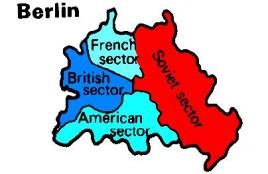
Berlin was also split into 4 zones. But Berlin was entirely within - and surrounded by - the Russian zone.
|
Going DeeperThe following links will help you widen your knowledge: Berlin Blockade web sites: Germany in the Cold War - basic overview
US State Department memo (pdf) setting out the US position Telegram (pdf) from A Paniushkin, Soviet ambassador to the US, setting out the Soviet position After Victory - an interview with Stalin in the Russian newspaper Pravda, October 1948.
NATO - essential reading
Flim clips and YouTube:
Consider:1. Think of as many reasons as you can why, in the period 1945-49, Germany was often at the centre of the Cold War.
|
What caused it? [CABAN]
Source B[The Americans had introduced a new currency into Berlin.] Old money flooded into the Soviet Zone. Some restrictions were placed on links between Berlin and western zones, but the Soviet side was ready to supply food to all Berlin. Yet every day 380 American planes flew into Berlin. It was simply a propaganda move intended to make the cold war worse. From a Russian history book.
|
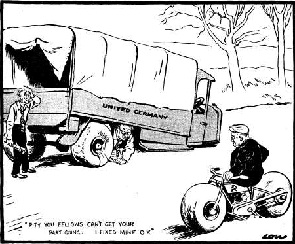
Source ABritain and America tried to restore German prosperity in their sectors, but the Russians systematically looted their zone. This Low cartoon of October 1946 shows Bevin (British foreign minister) and Byrnes (America) trying to get the lorry of a 'united Germany' going, while the Russian foreign minister Molotov sits smugly on his motorbike, having stolen the wheels - 'Pity you fellows can't get your part going. I fixed mine OK', he is saying. Click here for the interpretation
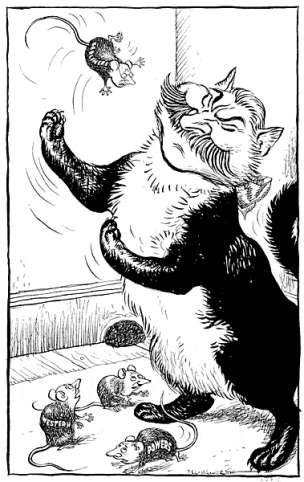
Source CThis cartoon by the British cartoonist Illingworth appeared in the Daily Mail on 9 September 1948. Stalin has blocked the mousehole, and toys with a mouse labelled 'Berliners', whilst the other 'western powers' scuttle around in alarm. Click here for the interpretation
|
What happened?The American Army wanted to fight its way into Berlin – that would have caused a war. Instead, Truman decided to supply Berlin by air. The situation was bad at first, but things got better (pdf) as the blockade went on. On 12 May 1949, Stalin re-opened the borders.
Airlift Facts
|
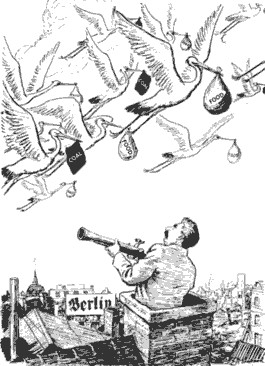
Source DThis cartoon of 14 July 1948 by EH Shepard for the British magazine Punch shows Stalin watching as storks fly coal and food into Berlin. Click here for the interpretation
Consider:2. Working as a whole class, draw a spidergram to show all the reasons why the Berlin blockade failed. 3. What were the results of the Berlin Blockade .
|
What were the Results? [CENA]
|
Source EThe crisis was planned in Washington behind a smokescreen of anti-Soviet propaganda... The self-blockade of the Western powers hit the West Berlin population with harshness. The people were freezing and starving. In the Spring of 1949 the USA was forced to yield. From a Russian history book.
Source FWe demonstrated to the people of Europe that we would act resolutely, when their freedom was threatened. Politically it brought the people of Western Europe closer to us. President Truman, speaking in 1949.
Source GNeither side gained anything. The USSR had not gained control of Berlin. The West had no guarantees that land communications would not be cut again. Above all confrontation made both sides even more stubborn. Historian Jack Watson writing in 1984.
|
|
| |