Why
did Hitler come to power?
[LIMP
PAPER]
The
story of why Hitler came to power is about the reasons why the
German people lost their senses and allowed a vicious madman
to come to power.
What
could have brought this about?
All
the following were present from the 1920s:
Deep
anger about the First World War and the Treaty of Versailles
created an underlying bitterness to which Hitler’s
viciousness and expansionism appealed, so they gave him
support.
Weaknesses
in the Constitution crippled the government.
In fact, there were many people in Germany who wanted
a return to dictatorship.
When the crisis came in 1929–1933 – there was no
one who was prepared or able to fight to stop Hitler.
3.
Money
The
financial support of wealthy businessmen gave Hitler the money
to run his propaganda and election campaigns.
Nazi
propaganda persuaded the German masses to believe that the
Jews were to blame and that Hitler was their last hope.
Hitler
promised everybody something, so they supported him.
6.
Attacks
on other parties
The
Stormtroopers attacked Jews and people who opposed Hitler.
Many opponents kept quiet simply because they were
scared of being murdered – and, if they were, the judges
simply let the Stormtroopers go free (see point 2).
7.
Personal
Qualities
Hitler
was a brilliant speaker, and his eyes had a peculiar power
over people. He
was a good organiser and politician.
He was a driven, unstable man, who believed that he had
been called by God to become dictator of Germany and rule the
world. This
kept him going when other people might have given up.
His self-belief persuaded people to believe in him.
Source
G
Hitler’s
financiers
Many
industrials bankrolled the Nazis, including allegedly:
·
Hjalmar
Schacht, Head of the Reichsbank, organised fund-raising
parties for Hitler.
·
Fritz
von Thyssen, the German steel businessman
·
Alfred
Krupp,
the owner of Krupp steel firm
·
Emil
Kirdorf,
the coal businessman
·
IG
Faben, the German chemicals firm, gave half the funds for
the 1933 elections
·
The German car firm Opel (a subsidiary of General
Motors)
·
Schroeder
Bank – on Jan. 3, 1933, Reinhard Schroeder met
Hitler and asked him to form a government.
And
many foreign firms including:
·
Henry
Ford of Ford Motors.
Hitler borrowed passages from Ford's book The
International Jew to use in Mein Kampf and had a picture
of Ford on the wall of his office.
·
Union
Banking Corporation, New York (George Bush’s
great-grandfather was president of the Corporation)
·
WA
Harriman and Co.,
the American shipping and railway company (George Bush’s
grandfather was vice-president)
·
Irenee
du Pont, head of the
American Du Pont explosives company, and on the Board of General Motors, advocated the creation of a
super-race by spinal injections to enhance children of
‘pure’ blood.
|
Source
A

This
poster of 1932 says: ‘Hitler – our last hope’
Source
B
[Hitler's
policies] were half-baked, racist clap-trap... but among
the jumble of hysterical ideas Hitler showed a sure sense of
how to appeal to the lowest instincts of frightened masses.
Tony
Howarth, a modern historian.
Source
C
He
was holding the masses, and me with them, under an hypnotic
spell by the sheer force of his beliefs. His words were like a whip.
When he spoke of the disgrace of Germany, I felt
ready to attack any enemy.
Karl
Ludecke, an early follower of Hitler (1924).
Source
D
Of
course, I was ripe for this experience.
I was a man of 32, weary with disgust and
disillusionment, a wanderer seeking a cause, patriot seeking
an outlet for his patriotism.
Karl
Ludecke (1924).
Source
E
There
were simply not enough Germans who believed in democracy and
individual freedom to save the Weimar republic.
Written
by the modern historian S Williams.
Source
F
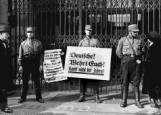
SA
men stop people going into a Jewish shop.
|


