Summary
The
Nazis grew out of a small right-wing party, which Hitler took
over after 1919. He developed a Twenty-Five Point
Programme based on hatred, and built up a paramilitary group
(the SA) to defend his meetings and attack other parties.
The Nazis appealed to a wide range of people, but especially
the 'middling' sort of people, and the party grew rapidly in
the years of crisis 1919-1923.
After
the disaster of the Munich Putsch, and during the prosperity
of the Stresemann years, however, support for the Nazis fell.
During this time Hitler believed that he could be elected to
power. He used these years to develop and
strengthen the party's organisation.
|
Links
The
History Place
Good basic notes
Detailed
timeline
National Socialist German Workers Party
Sturmabteilung
|
The
Formation of the Nazi Party and its Beliefs and Organisation
1. Start
The
German Workers’ Party, led by Anton Drexler, was formed in
1919.
Hitler
joined and soon became leader.
His speeches gave people scapegoats to blame for
Germany’s problems:
• The
Allies.
•
The
Versailles Treaty and the ‘November Criminals’ (the
politicians who signed it).
•
The
Communists, and:
• The
Jews.
In
1920, the party renamed itself the National Socialist German
Workers’ Party (Nazis), and announced its Twenty-Five Point
Programme.
At first, the Nazis were both nationalist
(they believed in Germany’s greatness) and socialist
(they believed the state should benefit everybody equally). After
the failure of the Munich Putsch in 1923, Hitler was sent to
Landsberg jail.
There he wrote Mein
Kampf (My Struggle) advocating:
•
National
Socialism
– loyalty to Germany, racial purity, equality and state
control of the economy.
•
Racism
 – the triumph of the Aryan race by armed
force, because all races, especially the Jews, were
inferior to the Aryan (pure German) ‘Master Race’.
– the triumph of the Aryan race by armed
force, because all races, especially the Jews, were
inferior to the Aryan (pure German) ‘Master Race’.
•
Lebensraum
– to expand into Poland and Russia to get ‘Living
Space’.
•
Strong
Government – complete obedience to the Führer.
4.
Organisation
At
first, there were a number of people involved in running the
party, but Hitler soon became the sole boss, and he built up
the organisation so that he was unquestioned leader.
Source C
Nazi Membership in the 1920s
by social group
|
(%)
|
In
Germany |
|
Skilled
workers (e.g. plumbers) |
33 |
27 |
|
Businessmen
(e.g. factory owners) |
19 |
7 |
|
Lower
employees (e.g. shop assistants)
|
18 |
18 |
|
Unskilled
workers (e.g. farm labourers) |
12 |
37 |
|
Farmers
|
11 |
8 |
|
Students
|
4 |
0.5 |
|
Professionals
(e.g. doctors, lawyers) |
3 |
2.5 |
|
Aristocrats
(lords)
|
0 |
0 |
(see also: Who voted Nazi? - difficult article)
|
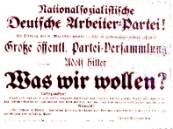
Source A
This
Nazi poster, 11 May 1920, advertises a speech by Hitler:
‘What Do We Want?’
It reads: "Do not believe that other parties can
save the Germany of misfortune and misery, the nation of
profiteers and debt, the land of Jewish corruption!"
Source B
In
the future we may be faced with problems which can be solved
only by a superior race of human beings, a race destined to
become master of all the other peoples and which will have
at its disposal the resources of the whole world.
Hitler,
Mein Kampf (1924)
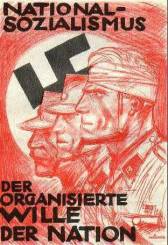
Source D
At
first the Nazis were just another right-wing terrorist
group.
Nazi ‘Stormtroopers’ attacked opposition parties.
|
|
After
the failure of the Munich Putsch, Hitler decided that he would
have to get power by being elected, rather than by rebellion.
However, he was banned from speaking until 1928.
The
prosperity of the Stresemann years, also, meant that the
Nazi’s message became less appealing and the
party lost support.
Extra:
Copy
the figures from the table below into an Excel workbook and
use the Chart wizard to draw a graph of party electoral
fortunes 1919–1933.
|
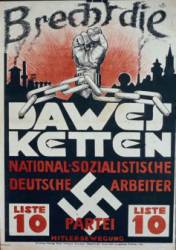
Source E
This
Nazi poster from the 1928 election reads ‘Break the Dawes
chains’.
|
|
In
this period, however, Hitler set about reorganising the Party.
He put in place many of the things which helped it take
power after 1928:
•
He
reduced the number of Stormtroopers (SA) and set up the
SS, a personal bodyguard fanatically loyal to himself.
•
He
set up a network of local parties.
He merged with other right-wing parties, then took
them over.
•
He
set up the Hitler Youth, which attracted young people to
the party.
•
He
put Josef Goebbels in charge of propaganda.
Goebbels and Hitler believed that the best way to
get the support of the masses was by appealing to their
feelings rather than by argument.
They waged a propaganda campaign using posters,
leaflets, radio and film, and organised rallies.
•
He
cultivated the support of wealthy businessmen promising
them that, if he came to power, he would destroy Communism
and the Trade Unions.
This gave him the finance to run his campaigns.
|
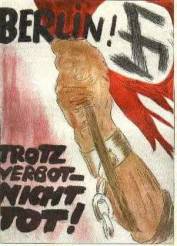
Source G
This
Nazi poster c.1927 reads ‘Despite the Ban, not
dead’.
This poster was drawn by "Mjölnir," (real
name was Hans Schweitzer) who set new standards for Nazi
publicity.
|


