|
| |
|
May the hand wither that signs this treaty. Frederick Scheidemann, the German Chancellor (June 1919)
|
Going DeeperThe following links will help you widen your knowledge:
|
Source A
This cartoon appeared in
the British satirical magazine Punch, 28 May 1919. |
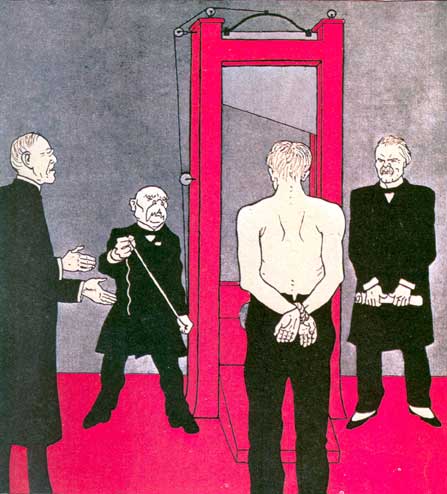
Source B This cartoon appeared in the German satirical magazine Simplissimus, 3 June 1919 Click here for the interpretation
|
The German Reaction at VersaillesOn 7 May, the victors presented their Treaty to the small German delegation. Count Brockdorff-Rantzau angered the Big Three by giving a long speech criticising the Treaty; then the delegation left and set about countering it. A little later, they sent their counter-proposal (based on the Fourteen Points) to the Big Three – their reply was so good that one of the British delegation said it was much better than the Allies' suggestions, and even Lloyd George wondered for a time if they ought to rethink the treaty. Then the delegation went home. Many Germans wanted to refuse to sign the treaty; some even suggested that they start the war again. So it was with great difficulty that the President got the Reichstag to agree to sign the treaty, and the imperious way the two German representatives were treated when they were forced to sign made things worse.
The Germans HATED the Treaty of Versailles [BRAT-U]1. The Germans hated Clause 231; they said they were not to Blame for the war. The soldier sent to sign the Treaty refused to sign it – ‘To say such a thing would be a lie,’ he said. Clause 231 did not physically harm Germany, but it hurt Germany's pride – and it was this, as much as anything else, that made them want to overturn the treaty. 2. The Germans hated Reparations; they said France and Britain were trying to starve their children to death. At first they refused to pay, and only started paying after France and Britain invaded Germany (January 1921). 3. The Germans hated their tiny Army. They said it left them helpless against other countries. At first they refused to reduce the army, and the sailors sank the fleet rather than hand it over. 4. The Germans also hated the loss of Territory – they claimed that the treaty was simply an attempt to destroy their economy. Other nations were given self-determination – but the Treaty forced Germans to live in other countries. Germans were also angry that they could not unite with the Germans in Austria. 5. Most of all, the German delegates argued that the Treaty was morally Unfair – a 'Diktat' (IMPOSED settlement). They had not been allowed to take part in the talks – they had just been told to sign. |
Primary Sources Brockdorff-Rantzau on the economic articles of the Treaty - difficult but worthwhile.
Source CThe disgraceful Treaty is being signed today. Don’t forget it! We will never stop until we win back what we deserve. From Deutsche Zeitung, a German newspaper, 28 June 1919.
Source DWe are told that we should acknowledge that we alone are guilty of having caused the war. I would be a liar if I agreed to this. We are not trying to avoid all responsibility for this world war. However, we emphatically deny that the German people should be seen as the only guilty party. Count Brockdorff-Rantzau, leader of the German delegation to Versailles (15 May 1919).
Source EThose who sign this treaty, will sign the death sentence of many millions of German men, women and children. Count Brockdorff-Rantzau (15 May 1919).
|


 Simple Essay: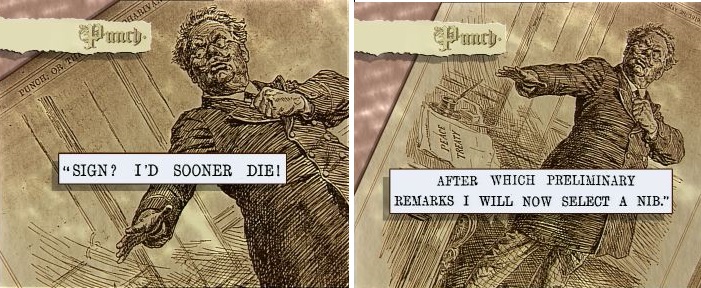

Source F |
Source G |
Did You Know?Fritz Haber (the German-Jewish scientist who had invented the use of chlorine gas as a weapon during the First World War) spent years after the war trying to find a way to extract the gold dissolved in seawater. He hoped it might be a cheap way for Germany to pay off reparations
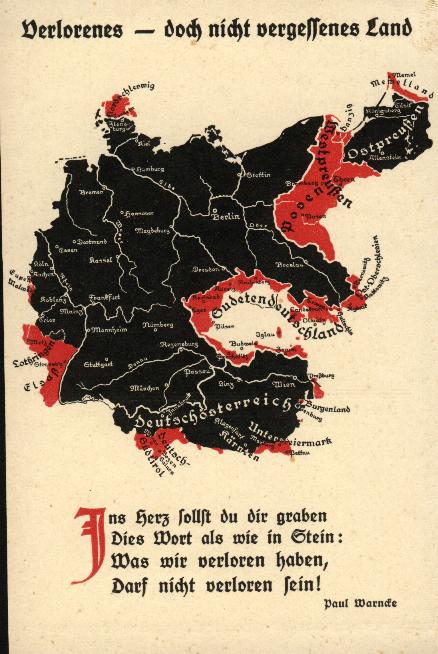
← Source FA German postcard, produced at the time, shows the lands where Germans lived.
The areas in red are the lands given to other countries by the
Treaty of Versailles (including land
lost by Austria).
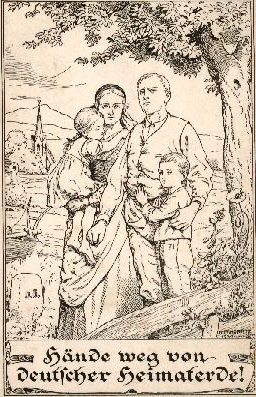
← Source GSource F is another German postcard produced at the time. Its title is 'Hands off German Homeland'.
|
Was the Treaty Unfair to Germany? [BRAT-UP]Many historians have denied that the Treaty was unfair, most recently the American historian Sally Marks (2013). 1. Actually, the peacemakers had explicitly decided NOT to Blame Germany for the war, although some delegates wanted to do so. Instead they used the word ‘responsible’ (which gave them the legal right to charge Germany reparations). The German delegation, however, (intentionally) translated the word ‘responsible’ with the German word ‘Schuld’ – a word meaning ‘responsible’ in the sense of blame/ ‘moral guilt’ – so that they could be outraged about it. Historians have known about this since 1929. 2. As for Reparations, Marks says bluntly: “There are those, not all German, who claim reparations were unpayable. In financial terms, that is untrue”. Germany had not suffered any damage during the war, and its economy boomed in the 1920s. Taxes in Germany were lower than in most of Europe, but the government refused to increase them. The Treaties only required Germany to pay the first 50bn marks (£2.5bn) – the rest dependant on her ability to pay – over a period of 60 years, and the term was extended in 1924, and the amount reduced in 1929. By comparison, the War had cost Britain £6.2bn, including a debt to the USA of £1bn, which the Americans required paying back in full. It was not that Germany could not pay; Germany would not pay. 3. As for the Army, Marks comments: “The German army was ample to maintain internal order and defend against all neighbors except France … critics do not say why Germany needed a larger army, nor do they explain why states that had spent four years defeating one German effort to conquer the continent should enable another.”. 4. And as for Territory, Germany did NOT lose, as is often claimed, 13% of the land, 10% of its population, and 13.5% of its economy. Recently, the historian Robert Boyce (2009) has pointed out that most of the areas lost had been newly acquired and/or were non-German. Meanwhile, the peacemakers refused France’s attempt to make the demilitarised Rhineland a separate state, and left it as part of Germany. 5. Modern historians do not believe that the Treaty was Unfair to Germany, especially compared to the terms that Germany had imposed on Russia in 1918, and intended to impose on the Allies if Germany won the war. Correlli Barnett (1986) declared Versailles: “hardly a slap on the wrist”. 6. So why is it, asked Sally Marks, that not just popular opinion, but many professional historians, still condemn the Treaty as unfair on Germany? In Mistakes and Myths, she finds the answer: “one of the world’s most successful and longest-lasting Propaganda efforts.
|
Source HThe peace settlement … came to be perceived by all political parties and by the public at large as unduly harsh and punitive in its treatment of Germany. Catherine Ann Cline, British Historians and the Treaty of Versailles (1988).
Source IIt was a mistake, however reasonable the settlement, to give the ex-enemy nations no real chance to sit around the peace table. PJ Larkin, European History for Certificate Classes (1967).
Did You Know?Germany did not pay off the reparations bill until 2010.
The historic
final payment of £59m was not made until Sunday, 3rd October 2010,
Consider:Discuss the following question, suggesting points for and against: How justified were the German objections to the Treaty of Versailles? Are you able to make a judgement?
|
|
|
| ||