|
|
NOTE: this topic is a stated topic on the AQA, Edexcel and iGCSE specifications. It is NOT a stated topic on the OCR specification, though it is essential pre-knowledge.
|
|
The Weimar Republic faced many problems. Perhaps the greatest danger was 'the weakness within' - the constitution gave the President, the states and the army too much power, whilst proportional voting meant that the Reichstag was divided and weak. In 1919-23, extremists on both the Left (especially the Spartacist revolt) and the Right (especially the Kapp Putsch) tried to overthrow the government. The worst crisis occurred in 1923, when the French invaded to try to force Germany to pay reparations. This led to hyperinflation and a number of rebellions (particularly Hitler's Munich Putsch).
|
Going DeeperThe following links will help you widen your knowledge: Basic account from BBC Bitesize on Political Unrest 1919-23
In greater depth:
YouTube Mr Dear's Helpful History - overview, and a brilliant Mnemonic! Mr Portman's video on why the Repubic suffed so many problems
... and on individual events: • Long time ago on the Spartacist Revolt • The Soviet Republic in Bavaria, 1919 • Long time ago on the Kapp Putsch • The Red Ruhr Rising from History with Hubert • Long time ago on Hyperinflation • Munich Putsch - from the TV drama The Rise of Evil |
Germany 1919–1923
|
|
What problems faced the Weimar Government 1919–1923? [ILRIM]
1. Ineffective ConstitutionThe Weimar Constitution did not create a strong government:
2. Left-wing RebellionsThe Communist KPD hated the new government:
3. Right-wing terrorismMany right-wing groups hated the new government for signing the Versailles Treaty (June 1919):
4. Invasion-Inflation: the crisis of 1923The cause of the trouble was Reparations – the government paid them by printing more money, causing inflation. In January 1923, Germany failed to make a payment, and France invaded the Ruhr. This humiliated the government, which ordered a general strike, and paid the strikers by printing more money, causing hyperinflation:
5. Munich PutschOn 8–9 November 1923, Hitler’s Nazis tried to take control of Bavaria (the Munich Putsch).
|
Source AThe new republic faced early problems mainly as a result of signing the Treaty of Versailles and weaknesses in the new constitution. A modern textbook, Essential Modern World History (2001).
Source B
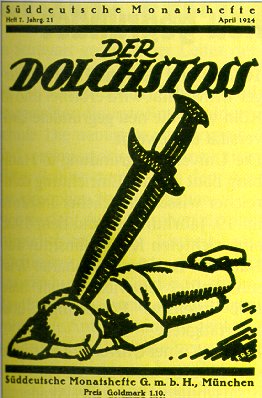
One of the main problems for the Weimar government was the right-wing Dolchstosslegende – the claim that the Army had been 'stabbed in the back' by the new government (whom the right called 'the November Criminals') when it signed the Treaty of Versailles.
Source CThe hyperinflation which happened in 1923 forced the Weimar government to fear for its own existence. After the French had occupied the Ruhr, the industrial workers had gone on strike. The Weimar government supported the strikers by printing more paper money in order to pay them. As the strike continued, the government could not find a solution and simply printed even more money. This ruined the economy. People talked openly about removing the government by a popular revolution or a military putsch. From Alpha History, a history website.
Consider:1. Using the 'Go Deeper' links, make notes on the various crises the Weimar republic faced. For each, decide how big a problem it was. 2. Which was the most serious problem Germany faced at this time? Explain your choice. 3. Causes of Weimar's problems [POOR CHAV] These factors gave the Weimar government problems: Proportional voting
For each factor: a. find the times when it caused problems for the government. b. think how it created instability in Germany.
|
|
|
|
|
Spotted an error on this page? Broken link? Anything missing? Let me know. |
|