|
|
|
|
Jerry was fighting hard, but soon the beach was swarming with our chaps. A British infantryman, speaking in 1944.
By 1944, the Allies (Britain, Canada and the USA) were ready to dislodge Hitler from ‘Fortress Europe’. This involved a (very dangerous) invasion of the mainland. The invasion was codenamed ‘Operation Overlord’ and was led by the American General Ike Eisenhower. The invasion day (D-Day) was set for some time in June – the actual date to be decided by Eisenhower at the last minute. The invasion force was fully ready by 1 June – but the invasion was delayed because of bad weather. In one of their first important roles ever, weather forecasters predicted that the weather would clear on 6 June. Eisenhower ordered the attack. |
Going DeeperDaily Past - pretend newspaper Map of the attacks Memories (BBCi) Hannah Hatfield's Spirit of Normandy prize-winning work on a parachutist's memory of D-Day! Interactive D-Day game - old-fashioned! Images of VE Day - from the Daily Mail
YouTube and other movies Colour footage - very clear School project - good
|
PreparationsIt was decided not to try to invade at Calais (where Nazi fortifications were strongest), but in Normandy. So that the invasion forces would know every detail of the landing sites, immensely careful research was done from: • Low-level aerial reconnaissance photos • French holiday guide books • The BBC asked for holiday photos (10 million were sent) • Sailing books • French spies • Col Sam Bassett landed secretly at night to test that the sand was hard enough to bear the weight of tanks.
Other preparations included: • Huge forces were gathered all over the south of England. Some were sent even to Dover (they were provided with wooden models of tanks) – they were called ‘Patton’s First Army’ (after an American general) to make the Nazis think that the invasion was planned for Calais. • Thousands of Americans were posted to Britain (people complained that they were ‘overpaid, oversexed and over here’) – some of them eventually married British girls. • Months of training, practising attacking copies of the Nazi emplacements. These were so realistic that many men were killed in these exercises • Building ‘mulberries’ – floating harbours that could be towed across the Channel and set up once a bridgehead had been established • A series of specialist machines were built (e.g. ‘crab’ tanks to clear mines/ bridge-carrying tanks) – they were nicknamed ‘Hobart’s funnies’ after the man who designed them all. • A Spanish double agent convinced the Nazis that the main invasion was going to take place at Calais, and that the Normandy attack was just a diversion. • There was one panic when 12 copies of the D-Day plans blew out of the window into the street!
|
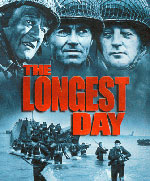
The 1961 film
The Longest Day
was an historically accurate account of the fighting on D-Day, starring the
American actor John Wayne.
Did You KnowBritish Propaganda
|
D-DayAt 3 am on 6 June 1944, a huge armada of 6,000 ships – including 864 converted merchant ships and 4126 landing craft – set sail for Normandy in 47 convoys. They carried 200,000 seamen, 185,000 soldiers and 20,000 vehicles. The weather was still fairly bad. Many of the soldiers were so seasick that they joked that they would not mind going into battle, just to get off the ships! A few Royal Navy ships raced back and forth between Dover and Calais to make Nazi radar operators think that the invasion was going to take place at Calais. 20,000 men were dropped by parachute or landed in gliders behind enemy lines to disrupt communications and seize key points. The invasion was supported by 11,000 planes, which attacked the Nazis from the air. 7 battleships, 23 cruisers and 105 destroyers laid down a massive bombardment of the Nazi shore defences.
Then the infantry went ashore: The British and Canadian soldiers landed on three beaches – Gold, Juno and Sword. They experienced heavy casualties (over 4,500) but by nightfall had captured a large area of coastline. The Americans were less successful. At Utah beach they landed by accident at the wrong place but – by chance – found little Nazi resistance there and captured the beach with only 210 casualties.
|
Source B
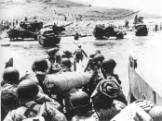
Allied troops go ashore from a landing craft, 6 June 1944. Comparing this picture with the opening scene of the film Saving Private Ryan will help you to appreciate what D-Day was like for the soldiers.
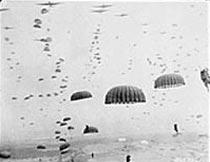
Allied paratroopers are dropped behind enemy lines, 6 June 1944.
|
Source BIt was wonderful. There they were, marching in to die, just as if they were going to a ball game… The Germans had hidden themselves in cliffs facing the beach and were pouring deadly mortar fire down upon the advancing Americans… They did not have any cover except bomb-made mounds, but they pushed forward, with men falling every way you could look. It was heart-breaking…. British Air Navigator, speaking of D-Day.
|
Source CI took a look toward the shore and my heart took a dive. I couldn't believe how peaceful and how untouched, the scene was. The land was green. All the buildings and houses were intact. 'Where', I yelled to no one in particular, 'is the damned Air Corps?’ Captain Walker, an American, remembering 1944.
|
What happened on Omaha Beach?At Omaha beach, things were much worse: • In the morning fog, the B17 bombers had overshot the Nazi defences by 5 kilometres, and most of the naval bombardment fell short, so the Nazi defences (dug into the cliffs) were still very strong. • Instead of just 800 men of the weak 716th Division, the Nazis had just moved in their crack 352nd Division. • As the Americans were landing, the powerful tide swept many men and vehicles back out to sea and 10 landing craft sank. In particular, it sank all but 2 of the 'floating tanks' which were supposed to give the infantry firing cover. • The Americans did not have any of Hobart’s funnies.
Within ten minutes of landing every officer and sergeant of the 116th Regiment was dead or wounded, and the Americans sustained 3,000 casualties in first few hours. By 10am, only 300 men had managed to struggle ashore safely, and by nightfall the Americans still only had ‘a toehold’ on the beach.
|
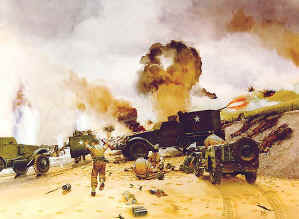
The 197th AAA Automatic Weapons Battalion shoots its way off Omaha Beach.
|
Source DI’m sick of this ‘John Wayne won the war’ message in Hollywood films. The Americans on Omaha were heroes and I owe them my freedom, but I have yet to be persuaded that they were any braver (or that their objective was any harder) than the British or Canadians – they just didn’t do as we British Air Navigator, speaking of D-Day.
|
Source ENormandy was an American victory Written by SLA Marshall, The Atlantic Monthly (1960).
Consider:DEBATE:
|
On to VictoryEven so, by the end of D-Day, 132,715 men were ashore, and this rose quickly over the next few days – by 12 June 2 million men were in Normandy. The Nazis fought desperately, but by this time Germany was at the end of her strength, and many Nazis soldiers were just 16-year-olds. By August Paris had fallen and (despite a short Nazi counter-attack called ‘The Battle of the Bulge’) the Allies pushed relentlessly into Germany until they met up with Russian forces advancing from the east (23 April 1945). On 7 May, 1945, the Nazis surrendered – it was VE Day (Victory in Europe)!
|
|
|
|
|
|
Spotted an error on this page? Broken link? Anything missing? Let me know. |
|