|
| |
|
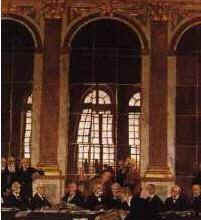
The treaty was signed today at Versailles. At 10:30 am Washington time Phillips and I sat in the telegraph room on the 4th floor of the Dept. and had a direct wire from there to Versailles - with only two relays, one at London and one at Newfoundland, where it went into and came out of the submarine cable. It was 5¼ hours different time at Versailles. As each signed it was signalled out over the wire and ticked off on the receiver at our side and the operator read it by ear and wrote it out as received on a typewriter. We leaned over his shoulder and read the bulletins. It was a unique and most interesting experience - and a great occasion Breckenridge Long, Diary (Saturday, 28 June 1919), Long was a US diplomat
|
Going DeeperThe following links will help you widen your knowledge: Terms of the Treaty - fuller outline
|
|
For five months the Big Three debated the terms of the Treaty. They crawled over huge maps of Europe spread over the floor. Clemenceau and Wilson quarrelled to the point where the Conference was in danger of failing altogether; that was where Lloyd George stepped in -- on 25 March he issued the
Fontainbleau Memorandum, then he persuaded Clemenceau to accept the League of Nations, and Wilson to accept reparations, and the Conference was saved.
|
|
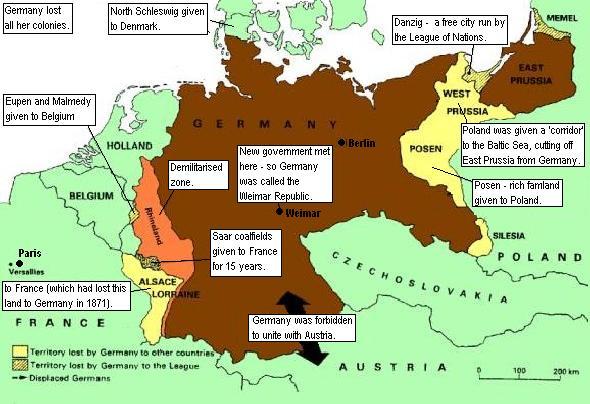
The Main Points of the Treaty [BRAT]The first 26 Articles of the Treaty set out the Covenant of the League of Nations (qv); the rest of the 440 Articles detailed Germany's punishment: 1. Germany had to accept the Blame for starting the war (Clause 231). This was vital because it provided the justification for... 2. Germany had to pay £6,600 million (called Reparations) for the damage done during the war. 3. Germany was forbidden to have submarines or an air force. She could have a navy of only six battleships, and an Army of just 100,000 men. In addition, Germany was not allowed to place any troops in the Rhineland, the strip of land, 50 miles wide, next to France. 4. Germany lost Territory (land) in Europe (see map, below). Germany’s colonies were given to Britain and France. You will see it claimed that Germany lost 13% of its land, 10% of its population, and 13.5% of its economy.
(Also, Germany was forbidden to join the League of Nations, or unite with Austria.)
|
Source AThe Allied governments affirm, and Germany accepts, the responsibility of Germany and her allies for causing all the loss and damage to which the Allied governments and their peoples have been subjected as a result of the war. Treaty of Versailles, Clause 231:
|
|
|
Consider:If you had been a German in Paris in 1919, can you find FOUR things about the conduct of the Conference which would have outraged you?
|
|
| |


 Simple Essay: