|
| |
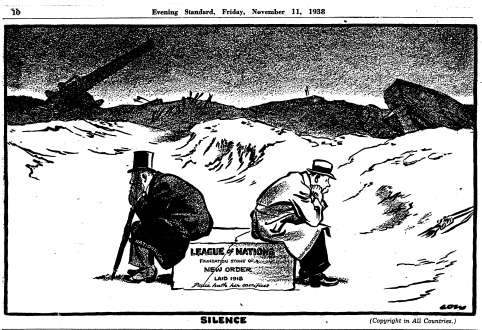
Source A
This cartoon by the British cartoonist David Low appeared in the Evening Standard newspaper, 11 November 1938. Two figures sit on a cracked stone, which carries the inscription: 'League of Nations. Foundation stone of a New Order, laid 1918. Click here for the interpretation
After the Abyssinian crisis, the League gradually died. It stopped intervening in international crises (such as the Spanish Civil War or the occupation of Czechoslovakia). Few countries left the League, but they stopped relying on the League to protect their sovereignty. Instead they made alliances, re-armed as fast as possible and prepared for war. Many countries – including Britain – contracted out of Article 16 (ie they let it be known that they would not support sanctions). The League, however, did not do nothing: 1. In 1936, acknowledging the failure of 'collective security' to stop Italy in Abyssinia, the League set up a Reform Committee, to try to adapt to the new political realities of the 1930s. Member states were invited to submit suggestions: some wanted to be tougher, others to stop even trying to stop wars, others to be more consultative, others to concentrate on prevention not intervention. Given the differences, no progress could be made. 2. The League's Agencies did continue their work and, in May-Aug 1939, a committee led by the Australian delegate Stanley Bruce recommended that they be reorganised under a central 'Committee for Economic and Social Questions' ... thus saving the economic and social work of the League whilst its political impact died. Although the League adopted the Report, war broke out a few days later. (After the war the Bruce Committee's recommendations were adopted by the United Nations.) 3. When war broke out in September 1939, the League closed down; its headquarters in Geneva remained empty throughout the war. 4. In 1943 – at a Conference in Tehran – America, Britain and Russia agreed to set up a new international organisation (the 'United Nations') when the war finished. 5. On 12 April 1946, the League met in Geneva and formally abolished itself. The British delegate, Robert Cecil, said: 'The League is dead. Long live the United Nations'.
|
Going DeeperThe following links will help you widen your knowledge: UN debate (1946) on the failure and achievements of the League Impact of the 1930s Depression
Why did the League fail - Sources - essential Why did the League fail - article by Peter Catterall The League of Nations - views from the web
75 pupil statements on Mr Clare's History Blog - Why did the League fail?.
Consider:1. Look back at the previous pages – especially, analyse the League's weaknesses, and the reasons why it failed in Manchuria and Abyssinia. 2. Make a spidergram of all the ideas you can think of why the League failed.
This 1920 cartoon by John T. McCutcheon for the Chicago Tribune shows the leading members of the League failing to keep their promise to promote world peace, and instead sowing the seeds of future wars.
|
Reasons for FailureThe League failed in Manchuria and Abyssinia because it WAS DUMB! Try to explain how each of the following contributed to the failure of the League; click on the yellow pointers to reveal my suggestions.
... and a final word:Source BIf the nations want peace, the League gives them the way by which peace can be kept. League or no League, a country which is determined to have a war can always have it. The 1930s historian H.A.L. Fisher sums up the failure of the
League
|




Consider:1. Think about the reasons the League failed. For each, suggest: 2. Read HAL Fisher’s ‘last word’ on the League in Source B.
He used 35 words.
|
|
|
|
|
|
Spotted an error on this page? Broken link? Anything missing? Let me know. |
|