How Strong was the League?
|
The League had no means of enforcing its decisions other than the effect of world opinion. S Reed Brett, European History 1900-1960 (1967).
Strengths and WeaknessesThe main strength of the League was that it had been set up by the Treaty of Versailles, and agreed by everybody at the conference. When, later, many people started to criticise and attack the Treaty, this was also a major weakness.
|
Going DeeperThe following links will help you widen your knowledge:
|
1. OrganisationOne of the biggest weaknesses was that the Organisation of the League was a muddle. The different parts of the League were supposed to act together; but in a crisis, no-one could agree.
2. MembershipForty-two countries joined the League at the start. In the 1930s about
60 countries were members
Britain and France were the main members, helped by Italy and Japan; they were quite powerful countries. A critical weakness was that the most powerful countries in the world were not members. The USA did not want to join. The Russians refused to join – they were Communists and hated Britain and France. Germany was not allowed to join. Without these three big powers, the League was weak.
|
The Organisation of the League1. Assembly (the League's main meeting – all members met once a year. Decisions had to be unanimous.) 2. Council (a small group of the more important nations – inc. Britain, France, Italy & Japan – met 4–5 times a year). 3. Agencies (committees of the League): • Permanent Court of International Justice. • Health. • International Labour Organisation. • Slavery • Mandates Commission (looked after former German colonies). 4. Secretariat (was supposed to organise the League).
|
3. How the League kept peaceThe League hoped that it could influence countries to 'do the right thing' by: The 'moral power' of the League lay in the League's Covenant, especially Articles 10-17, in which members promised to keep the peace. Many writers have pointed out that this is hardly a very effective deterrent against a powerful country which was determined to disobey the League. If these moral influences failed, the League had three powers it could use to make countries do as it wanted. Theoretically, the League was able to use military force, but the League did not have an army of its own – so if a country ignored it, in the end, there was nothing the League could do..
Source AIf any member of the League goes to war, all the other members will behave as if that member country had declared war on them. They will stop trading with that country. They will advise the Council of the League about any armed action that should be taken. adapted from the Covenant of the League of Nations (1919).
Source BOne basic weakness of the League was that it was tied in people's minds to the Versailles settlement, and criticism thrown at Versailles fell on the League. The refusal of the USA to join the League and the fact that Britain and France were the only major nations of Europe who remained full members, severely handicapped its efforts. Written by PJ Larkin, European History for Certificate Classes (1965).
|
Three Powers of the League1. Condemnation (the League could tell a country it was doing wrong). 2. Arbitration (the League could offer to decide between two countries). 3. Sanctions (stopping trade)..
Source C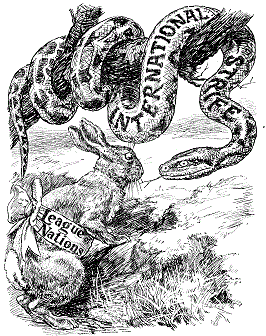 
‘Moral Persuasion'– a Punch cartoon of 1920.
Click here for the interpretation
|
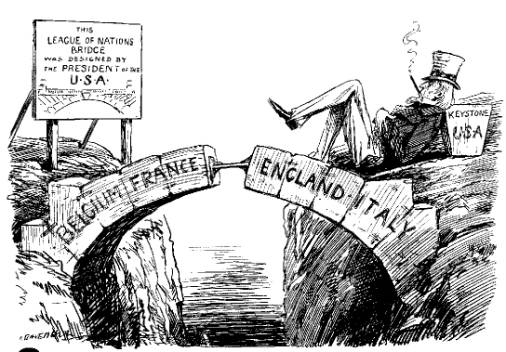
America Pulls OutPerhaps the greatest weakness of the League was that, when Wilson got back home to the United States, the American Senate refused to join the League. Americans did not want to get dragged into other countries’ problems. This damaged the League a lot. It did not have access to the prestige, influence, wealth or military power of the United States. It was forced to rely on Britain and France, who had both been weakened by the First World War.
|
Should America join the League? - a brilliant explanation by Ben Walsh of why America refused to join. Sources showing why America refused to join Speeches by American politicians
◄ Source D‘The Gap in the Bridge’ – a cartoon of 1919 by Leonard Ravenhill in the British magazine
Punch.
Click here for the interpretation
Consider:1. Does Source C suggest that the League of Nations was powerful when it came into existence?
|
|
| |

 Simple Essay: