|
|
|
Some ideas:Source ARecent events have shown that the British people's hope that [the League of Nations] would be adequate for the maintenance of peace is premature... In existing conditions, [a government White Paper suggests that] an additional expenditure on the armaments of the Defence Services can no longer be postponed The Times newspaper (5 March 1935) reports a decision by the British government that growing
Source BIn June 1935, Britain made a naval agreement with Hitler, to let Germany have a navy one-third of the size of Britain's. It was the sign that Britain had given up on the League as a way to keep the peace, and was trying a new policy - appeasement. A modern historian suggests that Britain's naval agreement with Germany was
Source CThe Covenant of the League has been violated... We shall therefore have to climb down, and Hitler has scored. We must swallow this humiliation as best we may, and be prepare to become the laughing stock of Europe. I do not mind that very much. We can rebuild our shattered name. But it does mean the final end of the League and that I do mind dreadfully. Quite dreadfully. A letter written by the British diplomat Harold Nicolson to a friend,
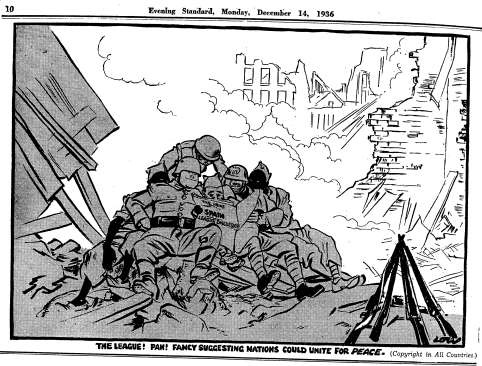
Source D
This cartoon by the British cartoonist David Low, drawn during the Spanish Civil War, appeared
The headline on the newspaper reads: 'SPAIN - League
Discussion'.
Click here for the interpretation
Source EThe events of the 1930s doomed the League of Nations. By 1936, after the Disarmament Conference had failed, few people looked to Geneva for the answers to Europe's problems. As civil war erupted that summer, Spain was added to Manchuria, Abyssinia and the Rhineland in the roll-call of the League's failures. Hardly surprising, then, that the Spanish foreign minister should accuse the League of following 'a strange theory which said that the best way to help the League was to stop making any attempt to keep the peace or defend the Covenant'. The historian Mark Mazower sums up the effect that these failures
|
Consider:You have studied the weaknesses of the League, and its failures in Manchuria and Abyssinia. Sources A-D suggest other events which undermined the League of Nations. 1. Read Source A-D, identify the four additional events which undermined the League, and explain how they did so. |
... and some more ideasSource FThe clue lies in the name: the League of Nations. Not 'states' or 'countries' - 'Nations'. Wasn't it Wilson who insisted that self-determination was at the centre of the Treaty of Versailles? Wilson made a Peace which created a world of nations, but he formed a League which relied on 'moral persuasion' and 'collective security'. The League never had any chance of success. As soon as any of his nations found that its national self-interest was threatened, the League could go hang A modern historian suggests that the tension between national interest
Source GHitler did not object to the League of Nations simply because it defended the Versailles settlement. If that had been so, he would simply have negotiated at Geneva to change in the settlement... Hitler saw world politics as a racial struggle - in Darwinian terms, a battle for survival. The fundamental problem, therefore, with the League was - in Nazi eyes - it embodied a wholly mistaken philosophy of international affairs. There could be no equality among states, for some 'are not worthy of existence'... There was no longer a cohesive value-system or an international society in the old sense; and it was a 'fiction' to talk about international 'rules'. The historian Mark Mazower suggests that it was
|
Consider:You have studied the way EVENTS undermined the League. Sources F and G suggest that there were wider underlying factors which destroyed the League of Nations. These sources suggest that it wasn't events which destroyed the League, but ideas. 2. Read Source F and G, and put into your own words the reasons they suggest for the failure of the League. |
|
| |