


Khrushchev and 'Peaceful Co-existence'
QUESTION:
Imagine a class with a really tough and nasty teacher. After a while, that teacher leaves, and a more gentle, reasonable teacher takes over
Will behaviour in the class get better, or worse?
Stalin died in 1953. He was hated all over eastern Europe. When they heard he was dead, people in East Berlin rioted.
After a short struggle for power, Khrushchev became the new ruler in Russia.
New Words
summit: meeting of the major world powers.
destalinisation: dismantling Stalin’s tyranny.
co-existence: living together.
capitalism: western system of a free economy.
economic aid: money given to a country to help build up its economy.
Peaceful Co-existence
At first, the western powers hoped that Khrushchev would be the start of a ‘thaw’ in the Cold War.
-
Khrushchev often met western leaders at ‘summit’ meetings.
-
Stalin had made all Communist countries do what he wanted – and he had fallen out with President Tito of Yugoslavia. But in 1955 Khrushchev went to Yugoslavia, telling Tito that ‘there are different roads to communism’<. > Western leaders thought he would no longer insist that all communist countries take orders from Russia.
-
In a speech (text) at the Twentieth Party Congress in 1956, Khrushchev attacked Stalin, saying that Stalin was a murderer and a tyrant. Khrushchev began to ‘de-stalinise’ Russia - political prisoners were set free and Beria (Stalin’s Chief of Secret Police) was executed. In 1961 Khrushchev declared that the period of 'the dictatorship of the proletariat' was at and end, and that he would bring in instead: 'the state of the whole people'.
Did you know
While denouncing Joseph Stalin in a speech one day, Khrushchev was interrupted by a voice from the audience: "You were one of Stalin's colleagues," the man declared. "Why didn't you stop him?"
"Who said that!?" Khrushchev roared. This was followed by a terrified silence - only broken at last by Khrushchev himself.
"Now..." he said in a quiet voice, "Now you know why."
-
Khrushchev said that he wanted ‘peaceful co-existence’ (see Source A) with the West. Western leaders hoped this meant the end of the Cold War.
Source A
You do not like Communism. We do not like capitalism. There is only one way out – peaceful co-existence.
Khrushchev speaking on a visit to Britain in 1956.
Source B
We may argue. The main thing is to argue without using weapons.
Khrushchev speaking in 1959.
Source C
The death of Stalin (1953) was probably the starting point of the 'thaw' because it brought to the forefront leaders in Russia - for example Khrushchev - who wanted to improve relations with the west... Khrushchev explained the new policy in his famous speech (February 1956) in which he criticised Stalin and said that 'peaceful co-existence' was not only possible but essential: 'there were only two ways - either peaceful co-existence or the most destructive war in history. There is no third way'...
Norman Lowe, Mastering Modern World History (1982)
Written as a GCSE revision book by a History teacher.
Links:
Spidergram:
Mnemonic:
 - BBC debate-podcast
on Khrushchev's effect on the Cold War
- BBC debate-podcast
on Khrushchev's effect on the Cold War
Did you know
Even though he was a poorly-educated peasant, Khrushchev had insight and a good turn of phrase.
He once said that Communism and capitalism would only agree ‘when shrimps learned to whistle’.
Source D
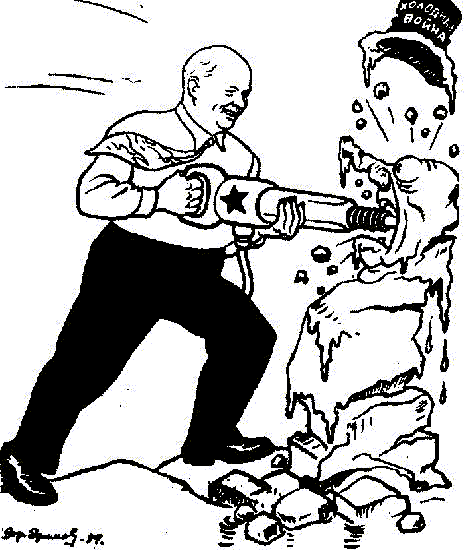
This Russian cartoon shows Khrushchev destroying the snowman (representing the Cold War).
Click here for the interpretation
Increasing Tension
If the rulers of the West hoped that Khrushchev would bring an end to the Cold War, they were disappointed. By ‘peaceful co-existence’, Khrushchev really meant ‘peaceful competition’. He started to build up Russian power:
-
'De-stalinisation’ did not mean a change back to capitalism, or freedom from Russian control.
-
When communist countries went too far in their reforms, Khrushchev sent in the Red Army.
-
He visited countries like Afghanistan and Burma and gave them economic aid if they would support Russia.
-
Russia began an 'arms race' and a ‘space race’ with America.
-
In 1955 Khrushchev set up the Warsaw Pact – a military alliance of Communist countries – to rival NATO. Pact countries had detailed plans of how to wage nuclear war against NATO if there was a war.
-
Russia waged a propaganda war against America and Britain.
Faced by this, America became just as aggressive:
-
In America, Senator McCarthy led a ‘witch-hunt’ for ‘Communists’ in America.
-
America was determined to win the 'arms race' and 'space race' with Russia.
-
The Americans used U2 planes to spy on Russia.
There was a propaganda war against Communism.
Here you can read in more detail about the developing tensions which Peaceful Coexistence caused.
EIGHT Countries in the Warsaw Pact:
• USSR
• Albania
• Bulgaria
• Czechoslovakia
• East Germany
• Hungary
• Poland
• Romania.
As a result, the period 1955–1963 was the time of GREATEST tension in the Cold War.
Source E
Although Khrushchev has been careful to pay lip service to the coexistence theme, this has apparently meant for him little more than an absence of armed conflict. In a speech in Prague in June 1954, he stressed Soviet possession of the atom and hydrogen bombs, as well as the necessity for maintaining and increasing Soviet armed strength. Several times he referred to the West as ‘the enemy’ and spoke of capitalist encirclement…
On 10 August … he indicated that there could be trade and increased diplomatic intercourse, but no change in ideology, thereby implying no respite from political warfare. [When pressed] Khrushchev blurted, ‘In this field there can be no coexistence’.
Analysis of Khrushchev's views in a top secret CIA briefing paper (September 1955)
Source G
In fact, however, the 'thaw' was only partial: Khrushchev's policy was a curious mixture which western leaders often found difficult to understand [and] he was quick to respond to anything which seemed to be a threat to the east.
Norman Lowe, Mastering Modern World History (1982)
Written as a GCSE revision book by a History teacher.
Did you know
Khrushchev was NOT a gentle easy-going man; he had been Stalin’s right-hand man – Stalin had used him to run the terror purges after World War II.
Khrushchev loved to argue. This often caused tension between leaders.
Source F
He displayed a shocking rigidity in his thinking about the West – an apparent willingness to swallow the propaganda he himself has helped create.
Marshall MacDuffie, quoted in a top secret CIA briefing paper (1955).
MacDuffie was the American UNRRA representative. The CIA described him as the person who had ‘seen more of Khrushchev than any other westerner’