Four Steps to War June-Aug 1914 [ARSE]
|
The nations slithered over the brink into the boiling cauldron of war without any trace of apprehension or dismay... The nations backed their machines over the precipice ... not one of them wanted war; certainly not on this scale. David Lloyd George, War Memoirs (1934) Lloyd George was a minister in 1914 and Prime Minister during the war.
There was no 'slide' to war, no war caused by 'inadvertence', but instead a world war caused by a fearful set of elite statesmen and rulers making deliberate choices. Book review in The American Historical Review of Richard F. Hamilton and Holger H. Herwig, The Origins of World War I (2003)
Five weeks after the assassination of Franz Ferdinand on 28 June 1914, there was a world war. How did such a thing happen?
|
Going DeeperThe following links will help you widen your knowledge The July crisis - how the assassination of Franz Ferdinand caused a war The Rush to War - by the amateur historian Frank Smitha.
|
1. Austria declares warWhat was Austria-Hungary to do? It is important to realise that Austria hated Serbia anyway. Nationalism threatened the very existence of the 'polyglot empire', and the Austrian Chief of Staff General Hotzendorf had asked for a 'surprise' war to destroy Serbia more than 25 times in the eight years after 1906. So the assassination was used by Austria as an opportunity to sort out the Serbs:
Did You Know?The historian Paul Schroeder, in 1972, suggested that the question should not be why war broke out in 1914, but why not before? What snapped in 1914? The answer, he argued, was Austria-Hungary.
|
Source AThe Austrian government was not much concerned to punish the crime of Sarajevo. They wanted to punish a different crime - the crime that Serbia committed by existing as a free national state. AJP Taylor, Europe - Grandeur and Decline (1967) AJP Taylor was a respected, but outspoken, historian
Source BThe sentence that caused a war The [Serbian] Government considers it its duty as a matter of course to begin an investigation against all those persons who have participated in the outrage of June 28th and who are in its territory. As far as the cooperation in this investigation of specially delegated officials of the [Austro-Hungarian] Government is concerned, this cannot be accepted, as this is a violation of the constitution and of criminal procedure. Serbian Response to the Ultimatum, 25 July, 1914
|
2. Russia mobilisesThe Serbs had wrong-footed the Austrians. Whereas, on 28 June, everyone in the world had supported the Austrians, now they looked unfair, unreasonable and war-mad. As the Austrian army shelled Belgrade (the capital of Serbia) the Serbians called up their army and asked their ally, Russia, for help. What was Russia to do?
|
Source CAn unjust war has been declared
on a weak country. The anger in Russia shared
fully by me is enormous. I foresee that very soon
I shall be overwhelmed by the pressure forced upon me and be
forced to take extreme measures which will lead to war.
To try and avoid such a calamity as a European war I beg you
in the name of our old friendship to do what you can to stop
your allies from going too far. Telegram, Tsar Nicolas to Kaiser Wilhelm, 29 July Nicholas and Wilhelm were cousins, and had been great friends.
|
3. Schlieffen Plan - Germany's responseWhat was Germany to do? To allow a country to mobilise against you without response, said the Germans, was like allowing someone to hold a loaded gun to your head without doing anything. Of course, the Germans knew what they were going to do. They had had a plan - called the Schlieffen Plan after the German Chief of Staff Alfred von Schlieffen. The Schlieffen Plan was Germany's Plan for mobilisation. It was based on three ideas:
The Schlieffen Plan, therefore, was developed as a huge hammer blow at Paris, using 90% of the German army, which it hoped would take France out of the war quickly (allowing Germany to transport its army back across Germany to fight Russia).
It is important to realise that the Schlieffen Plan for mobilisation was a plan of attack - so Germany mobilising, and Germany going to war, were one and the same thing. And the Schlieffen Plan did not allow for a situation like that in 1914. Things were going wrong for Germany - Russia was mobilising, but France showed no sign of going to war to help the Russians. Now Russia was mobilising and was going to be ready too soon - every day that passed gave the Russian army one more day to get ready. When the German Chancellor Bethmann-Hollweg asked General Moltke: 'Is the Fatherland in danger?' the reply was: 'Yes'.
|
Did You Know?'War by Timetable' In 1969 AJP Taylor published his book War by Timetable. In it, he argued that railway timetables played a key part in starting the First World War.
Mobilising millions of men was a hugely complicated job. Every country used the railways, and spent years working out how to get all those soldiers and all their supplies to where they needed to be - eg the Schlieffen Plan took nine years to devise (1897-1906). So every country had only one Plan - the Russians had 'Plan A', the French 'Plan 17' - and it was too much to devise another one!
So, when the crisis came - although it didn't fit the situation that these Plans envisaged - every country had to go ahead and implement their Plans because they had no other plans of what to do, and it was too late to make a new one. The Tsar HAD to order a general mobilisation, even though he only wanted to mobilise against Austria. And when, on 1 August, Kaiser Wilhelm tried to pause the German mobilisation, his generals told that he couldn't; 11,000 trains were on the move, and the war could not now be stopped.
|
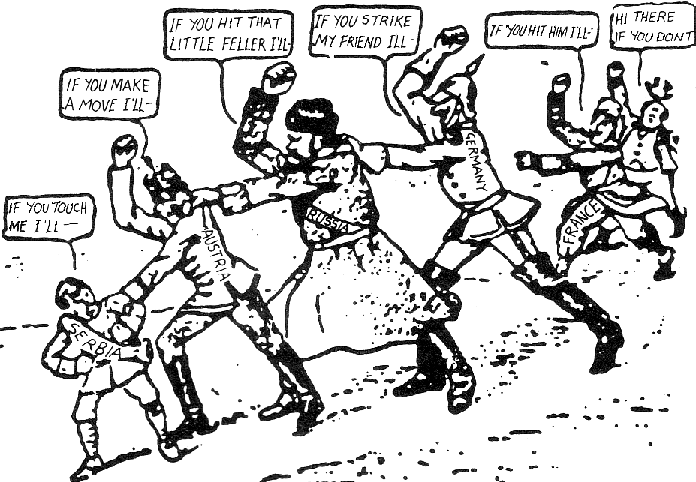
Source D
This cartoon - 'A Chain of Friendship' - appeared in the American newspaper the Brooklyn Eagle in July 1914. The caption read: “If Austria attacks Serbia, Russia will fall upon Austria, Germany upon Russia, and France and England upon Germany.”
|
|
4. England declares warThe British Foreign Secretary, Sir Edward Grey, had spent the crisis trying to get the different countries to negotiate - Lloyd George described him as being like the weak chairman of tempestuous committee: 'calling out in an appealing but not compelling voice: "Order! Order"'.
That night, crowds gathered in Parliament Square in London. As Big Ben struck 11 pm (midnight in Berlin) they sang God Save the King, and then ran home crying: 'War! War! War!' As Grey watched the crowds leave, he commented: 'The lights are going out all over Europe: we shall not see them lit again in our lifetime'.
|
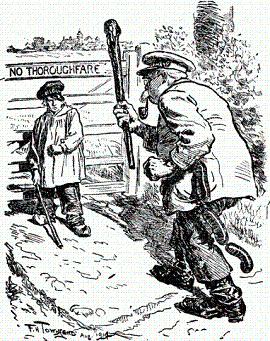
Source E
A cartoon by FH Townsend in Punch, 12 Aug 1914. Notice how the cartoon portrays Belgium as a threatened child, and the stereotyped figure of Germany, as an aggressive military man with sausages.
Source FThe greatest war of modern times, and perhaps in the whole history of the human race, was begun by Germany using the crime of a schoolboy as an excuse. The Great War - the Standard History (1914) A patriotic magazine published weekly in Britain.
|
Source G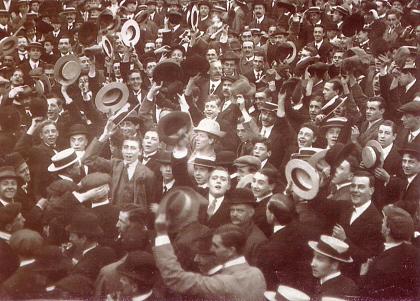
All over Europe, people greeted war with tremendous joy and enthusiasm. 'These people are very anxious to send our soldiers to face death', commented Lloyd George to the Prime Minister as they walked to the House of Commons.
|
Consider:1. Was this 'slide to war' inevitable? Could it have been halted at any point without one country appearing to have been humiliated? 2. Discuss: "Germany seized the assassination as an opportunity to deal with her enemies". 3. Write an essay: "Why did the assassination of Archduke Franz Ferdinand spark a World War?" (Note that your explanation will need to include the Background Tensions and the events of the Growing Crisis, as well as simply the Four Steps to War.) Ask your teacher if the class can play my 'Causes of WWI' game.
|
|
|
|
|
Spotted an error on this page? Broken link? Anything missing? Let me know. |
|