|
| |
|
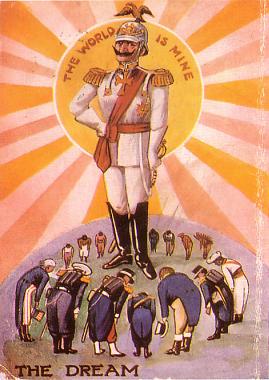
We have conquered for ourselves a place in the sun. It will now be my task to see to it that this place in the sun shall remain our undisputed possession, in order that the sun's rays may fall fruitfully upon our activity and trade in foreign parts... The more Germans go out upon the waters, whether it be in journeys across the ocean, or in the service of the battle flag, so much the better it will be for us. A speech by Kaiser Wilhelm to the North German Regatta Association.
The argument which follows suggests that Europe in 1914 was RIPE, even EAGER, for war to break out – that the causes of World War One went back long before 1914, and had so set Europe at odds that it only needed a tiny spark to push all Europe into war.
You will need to understand, not only WHAT the situation was in 1910-14, but HOW each element made war more likely...
|
Going DeeperThe following links will help you widen your knowledge: Powerpoint - Alliances and World War I Powerpoint - Arms Race and World War I
YouTube: Blackadder on the causes of World War One
Map of Austria-Hungary in 1914 Race map of Europe before 1914 |
1. MilitarismThis is not just an arms race, but also a government's attitude of mind, seeing war as a valid means of foreign policy. (This often includes the influence of government by the generals.) All the nations of Europe were militaristic, but the governments of Germany and Austria-Hungary were especially so.
All the countries of Europe built up their armies and navies. In 1914, their armed forces stood like this: • Germany: 2,200,000 soldiers, 97 warships • Austria-Hungary: 810,000 soldiers, 28 warships. • Italy: 750,000 soldiers, 36 warships • France: 1,125,000 soldiers, 62 warships • Russia: 1,200,000 soldiers, 30 warships • Great Britain: 711,000 soldiers, 185 warships As one country increased its armies, so all the others felt obliged to increase their armed forces to keep the ‘balance of power’.
Germany and Britain clashed over the size of their navies – in 1900 Kaiser Wilhelm began to build up the German navy (Tirpiz's Navy Law), announcing that he wanted Germans to sail all over the world and take for Germany 'a place in the sun'. After 1906, he began to build numbers of the new, large 'Dreadnought' battleships, which were more powerful than any other ship.
|
Source AThe German answer to all our talk about the limitation of armaments is: Germany shall increase to the utmost of her power... I have lived among Germans, but with the best will in the world I can see no solution to the present collision of ideals but war. A lecture given in 1913 by JA Cramb JA Cramb was an Englishman who went to university in Germany, and who loved Germany.
|
|
Another thing that the countries of Europe did was to train all their young men so that if there was a war they could call, not only on the standing army, but on huge numbers of trained reservists. One historian has estimated the total number of men (including reservists) that the countries could thus call upon as: • Germany: 8.5 million men • Russia: 4.4 million • France: 3.5 million • Austria-Hungary: 3 million It is important to realise that – although in 1914 the German army was the biggest and best in the world – the Russian army was growing the fastest, and German generals were worried that, in a few years' time, they would not be able to defeat Russia so easily.
|
Source BThe Naval 'War Cabinet' of 1912 General von Moltke [head of the army] said: I believe war is unavoidable; war the sooner the better. But we ought to do more to press to prepare the popularity of a war against Russia. The Kaiser supported this. Tirpitz [head of the navy] said that the navy would prefer to see the postponement of the great fight for one and a half years. From the Diary of Admiral Muller, 8 December 1912 Some historians say that this proves that Germany was wanting war in 1912, although others say that it records a general discussion of no great significance.
|
2. AlliancesAs well as seeking protection in the size of their armies, the countries of Europe sought protection by forming alliances. At first, Bismarck had kept Germany friendly with Russia. Kaiser Wilhelm overturned this, and concentrated instead on the Dual Alliance of 1879 between Germany and Austria-Hungary - which became the Triple Alliance (or Central Powers Alliance) when Italy joined in 1882. ê Alarmed by this strong central bloc: a. France in 1894 made an alliance with Russia, and b. In 1904 France and Britain made an Entente Cordiale (= ‘Friendly Relationship’ – not a formal alliance, but an agreement to work together). c. In 1907, Britain made an entente with Russia, thus forming the Triple Entente (France, Russia, Great Britain). d. In 1902 Britain made a naval treaty with Japan. ê The Triple Entente alarmed Germany, which felt itself surrounded by the France-Russia alliance. The countries of Europe thought that the alliance system would act as a deterrent to war; in fact it tied the countries together so that, when one country went to war, the others felt themselves obliged to follow. |
Alliances Timeline Diagram - very clear The Dual Alliance - Wikipedia article The Triple Alliance - Wikipedia article The Triple Entente - Wikipedia article
Did You Know?It is important to realise that the politicians of 1914 did not see - as we do today - the build-up of armed forces or the system of alliances as threats to peace; they thought that they would KEEP the peace by acting as a deterrent to any nation thinking of attacking them. They believed that peace would be kept by a BALANCE OF POWER between the two alliance blocks. |

A map showing the alliances in Europe in 1914. You can see how Germans regarded this situation here. |
|
|
3. NationalismEVERYONE was nationalist in those days, and this helped cause war in two ways: a. It made the people of countries like Britain, Germany and France more bellicose (warlike) – the British sang: ‘Rule Britannia’ and ‘Land of Hope and Glory’, and the Germans sang: ‘Deutschland uber alles’. French politicians like Clemenceau and Poincare (who had been around in 1870) HATED the Germans. People were enraged when someone insulted their country. b. It made the races ruled by Turkey (such as the Romanians and the Bulgarians) and by Austria-Hungary (such as the Serbs) want to be free to rule themselves. In the Balkans this was called ‘Panslavism’ because the people who wanted to be free were all Slav races. The most nationalistic of all were the Serbs – Serbia had become an independent country by the Treaty of San Stefano in 1878, but in 1900 many Serbs were still ruled by Turkey and Austria-Hungary, and Serbia was determined to rule over them all. This led to rebellions and terrorism which destablised the Balkans.
|
Source CLand of Hope and Glory, mother of the free... God who made thee mighty, make thee mightier yet. The words of Land of Hope and Glory, written by the English composer Elgar and sung by British people at the Prom concerts every year. Germany, Germany above all over everything in the world, When it steadfastly holds together, offensively and defensively. The words of the German national anthem, Deutschland uber Alles |
4. ImperialismCountries who believed that they were superior thought it was alright to conquer and rule others – particularly if they were inhabited by races they thought were inferior. This is why countries like Britain, France, Belgium and Italy thought it was OK to colonise vast areas of Africa in the 19th century. In 1900, the British Empire covered a fifth of land-area of the earth. a. This led to clashes between imperialist powers. Britain was trying to conquer Africa from Cape Town (in South Africa) to Cairo (in the north). France was trying to conquer Africa from the Atlantic to the Red Sea. In 1898 their two armies met, at Fashoda in the Sudan, almost causing a war. b. Most of all, it led to HUGE tension when Kaiser Wilhelm of Germany decided that HE wanted some colonies too!
|
Source D
This British postcard suggests what would happen if the Kaiser took the 'place in the sun' that he wanted.
|
5. Awful GovernmentsNot only were many of the governments of Europe autocratic (ruled by one man), many countries had stupid and corrupt governments (click here to find out the shocking facts). Note that very few of the countries of Europe were democracies – it is harder for a democracy to go to war because the people (not just an individual ruler or small group of ministers) need to agree to do so. Remember also that in these days there was no idea of going to war for the 'right' reasons – many people in those days thought it was alright to go to war simply to win more power and territory for the ruler. |
Source FA peaceable, industrious, sensible mass of 500 million [European people], was hounded by a few dozen incapable leaders, by falsified documents, lying stories of threats, and chauvinistic catchwords, into a war which in no way was destined or inevitable. Emil Ludwig (writing in 1929) Emil Ludwig was born in Germany but during the First World War he lived in Switzerland and worked as the foreign correspondent for the Berliner Tageblatt newspaper.
|
Consider:1. For each of the background 'pressures-towards-war' 1-5, suggest how it helped to bring war nearer. 2. Why was Britain so concerned by Germany’s naval plans? 3. What was the most serious underlying source of tension in Europe - explain your suggestion? 4. Was a major European War inevitable?
|
|
|
| |