|
| |
|
Summary Stalin modernised industry by means of the 5-Year Plans. He achieved fantastic successes, but at the most appalling human cost, and while industrial output soared, the production of consumer goods remained static.
Source AIf we are backward and weak, we may be beaten and enslaved. But if we are powerful, people must beware of us. We are 50 to 100 years behind the advanced countries of the West. We must make up this gap in 10 years. Either we do this or they crush us. from a speech made by Stalin to the First Conference of Workers in 1931.
There were two Five Year Plans – 1929–33 and 1932–1937. This webpage deals with the reasons for the Five-Year Plans and how they were achieved, and also with how successful they were.
NOTE: there is much more on the overall effect of Stalin's rule on people's lives in the webpage on How Did Life in Russia Change 1914-45?
|
Going DeeperThe following links will help you widen your knowledge: Old Bitesize - simple intro (pdf) Why Did Stalin Introduce the 5-Year Plans? - Save My Exams Were Stalin's Economic Policies a Success? - Save My Exams
New Russian Primer - Soviet children's book from 1930: wonderful!
How did Stalin's economic changes affect people - Save My Exams Homo Sovieticus - everyday life in Stalin's Russia.
YouTube Life in Stalin's Russia - History File
Old textbook accounts of the 5-Year Plans Reed Brett, European History (1967)
|


 Building the Moscow Metro
Why did Stalin do it?[Modernise And Catch Up]
1. Many regions of the USSR were backwardStalin said that to be backward was to be defeated and enslaved. ‘But if you are powerful, people must beware of you’. 2. Armed forcesHe believed (correctly) that Germany would invade. In 1931, he prophesied: ‘We make good the difference in 10 years or they crush us’. 3. Compete with the Western WorldStalin believed (with Lenin) that the USSR should ‘overtake and outstrip the capitalist countries’. He believed in ‘Socialism in one country’ – the USSR would become strong enough to survive, then would take over the rest of the world. 4. Useful propagandaThe 5-year plans were very useful propaganda – for Communism and for Stalin.
|
How the 5-Year Targets were achieved
|
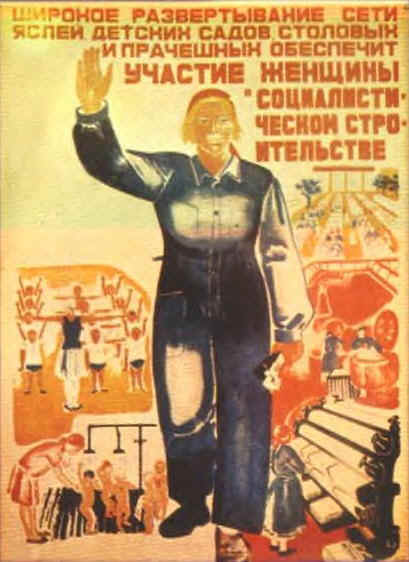
Source B
A poster from 1931: "A network of creches, kindergartens,
canteens, laundries to ensure participation of women in socialist construction".
|
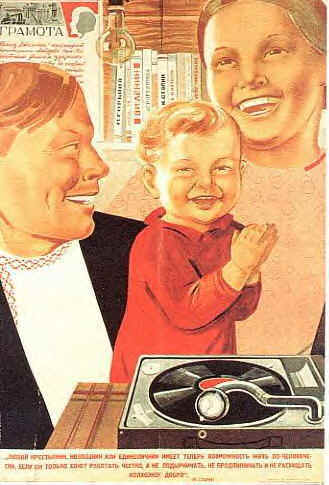
Source C
A poster of 1934: "Peasants can live like a Human Being".
|
Source D
Stalin at the hydro-electric dam at Ryon in the Caucasus
(1935).
|
||||||||||||||||||||
Successes...
|
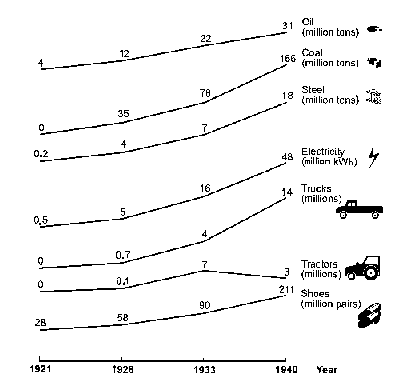
Source ESoviet industrial production figures, 1921–40
This chart is based on official Soviet statistics
From official government figures. Note that historians have found that Stalin's statisticians overstated the increases by about a third - they dared not do anything else! It was the official line that Stalin had achieved a remarkable improvement, and a statistician who found otherwise would have been sent to Siberia.
|
|||||||||||||||||||||
... and Failures
|
|
Source FThe Five-Year Plans had a dramatic effect on the Soviet Union, making it the second largest industrial power in the world. Huge new steel plants, hydro-electric power stations, railways and canals were built. Vast numbers of factories in hundreds of new towns poured out manufactured goods. A major symbol of this growth was the new city of Magnitogorsk. Between 1928 and 1932 Magnitogorsk was transformed from a tiny, isolated village to a thriving industrial city, with more than a quarter of a million citizens. N Kelly, Russia and the USSR 1905–1956 (1996).
Source HStalin’s industrialisation policies created new opportunities for workers in towns in the Soviet Union. More generous pay was offered for certain jobs, which encouraged the workers to improve their lives. People competed to be the most efficient workers and were rewarded with promotion. Better jobs meant they could afford better housing. In workplaces discipline was less strict, which made working conditions easier. More workers were able to become managers. Children of workers benefited from the increased educational opportunities that were on offer. In 1933 Stalin announced, ‘life has become better, comrades, life has become more joyous.’ From Tsarist and Communist Russia 1855–1964 by Sally Waller, published in 2015.
Source JTo conclude, we must first of all forever banish the suggestion that Stalin commits errors, that he is a bad defender of the conquests of the October Revolution and that his faults derive from his theory of 'socialism in one country'. No, Stalin is carrying out the policies of a new class based on the exploitation of the workers; all that is left of the October Revolution in Russia has been transformed into a counterrevolutionary instrument. Its monopoly of foreign trade, its economic plans and industrialization are not bringing the USSR closer to socialism, but to modern capitalism, to fascism. Guy Sabater, a French professor ofeducation and socialist, 1977.
|
Source GThe Soviet people and industrialisation The Soviet people achieved so much in such a short time. This happened because all the country's wealth belongs to the working people who create this wealth. The Stakhanovite movement spread all over the country. Thousands of workers produced more that their quota. Miracles were created by the enthusiastic work of the Soviet people. from a Soviet school textbook published in 1976.
Source IWorking conditions in the city of Magnitogorsk in the early 1930s In early April it was still bitterly cold, everything was frozen. By May the city was swimming in mud. Plague had broken out not far away. People were in poor health because of lack of food and overwork. Sanitary conditions were appalling. By the middle of May the heat had become intolerable. from Behind the Urals (1942) by John Scott.
|
|||||||||||||||||||
Consider:1. Why did Stalin want to modernise Soviet industry? Explain your answer using Source A and your own knowledge'. 2. How useful are Sources B and C to an historian studying Stalin's policy of industrialisation? Explain your answer using Sources B and C and your own knowledge. 3. How useful is Source D as evidence about the results of the Five-Year Plans on Russian industrial production? Explain your answer using Source D and your own knowledge. 4. Does Source E give an accurate interpretation of the industrialisation of Russia in the period 1928–40? Explain your answer using Source E and your own knowledge. 5. Study Sources E and I. Which is more useful to an historian studying Stalin's policy of industrialisation? Explain your answer using Sources E and I and your own knowledge. 6. "Stalin's policy of industrialisation was a success in the period 1928 to 1941." Do you agree or disagree with this interpretation? Explain your answer using the Sources and your own knowledge. 7. "The Five Year Plans brought glory to Stalin and misery to his people". Is this a fair interpretation of Stalin's achievement?
|
|
|||||||||||||||||||||


|
|
||
|
Spotted an error on this page? Broken link? Anything missing? Let me know. |
| |