|
|
|
Germany and Russia agreed to bury the hatchet; they agreed to bury it in Poland. BBC TV, Why Appeasement?
|
Going DeeperThe following links will help you widen your knowledge: From the British point of view - WHY did Britain let the alliance go?
|
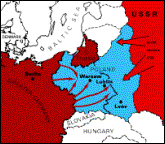
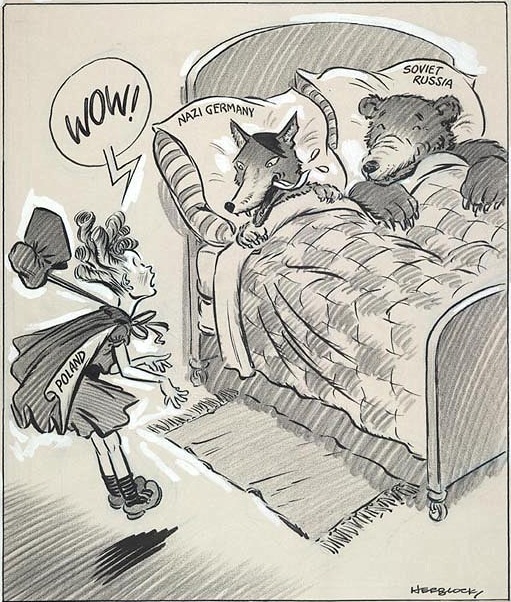
1. A Nazi-Soviet PactOn 23 August, 1939, the world was shocked when, suddenly, Russia and Germany signed a 'Non-aggression Pact'. People would have been even more shocked if they had known at the time that, in addition, the two countries had made a 'secret protocol' agreeing 'spheres of influence' in Finland, Estonia, Latvia, Lithuania, Romania and Poland. It amounted to an agreement to invade and divide the countries of eastern Europe between them ... with Poland first on the list.
|
Eastern Europe in 1939. Germany and Russia invade Poland.
◄ Source AThis 1939 cartoon was drawn for the American public by the US cartoonist Herb Block. Click here for the interpretation
|
|
|
|
2. The Story of the Pacta. Britain and RussiaStalin knew that Hitler’s ultimate aim was to attack Russia. In 1939, he invited Lord Halifax, the British Foreign Secretary to go to Russia to discuss an alliance against Germany. The British feared Russian Communism, and they believed that the Russian army was too weak to be of any use against Hitler. In August 1939, with war in Poland looming, the British eventually sent a minor official called Reginald Ranfurly Plunckett-Ernle-Erle-Drax. He travelled by slow boat, not by plane. He did not have authority to make any decisions, and had to refer every question back to London. The talks dragged on. The Russians asked if they could send troops into Poland if Hitler invaded. The British refused. The talks broke down.
|
|
Why did Anglo-Soviet Talks Fail? [SCAB]
Suspicion a. Chamberlain did not trust Stalin, who was a Communist and a dictator. In particular, he would not ever have allowed Russia to control Estonia, Latvia and Lithuania. b. The Russians thought Britain wanted to trick them into war against Germany. c. Poland did not trust that the Russians (who wanted to send troops into Poland), once in, would ever leave.
Choice a. Britain could not send troops to fight in Poland, so if Stalin supported Britain, he would end up fighting a war in Poland on Britain’s behalf. On the other hand, Hitler was promising him peace, half of Poland and a 'sphere of influence' over eastern Europe.
Appeasement After Munich, Stalin was convinced that Britain would break its promise to Poland. He was convinced that Britain would leave Russia fighting Hitler alone.
Britain delayed a. At first, Lord Halifax refused Stalin’s offer of a meeting. b. When the British sent an official, he could not make any decisions. Stalin got fed up with British delays.
|
|
b. Hitler and RussiaIn August 1939, Hitler sent Ribbentrop, a senior Nazi, to Russia. He offered a Nazi-Soviet alliance – Russia and Germany would not go to war, but would divide Poland between them. Germany would allow Russia to annex Estinia, Latvia, Lithuania and Poland. Stalin knew Hitler was lying, but he did not trust the British either – the Munich Agreement had convinced him that Britain and France would never dare to go to war with Hitler. Stalin had two choices: • if he made an alliance with Britain, he would end up fighting a war with Hitler over Poland. • if he made an alliance with Germany, he would get half of Poland, and time to prepare for the coming war with Germany. He chose the latter. On 23 August 1939, he signed the Pact with Hitler.
|
Consider:1. Plan an essay: ‘Why did Stalin make a Pact with Hitler rather than an Alliance with Britain?’ Your essay will have TWO sections, each of FOUR paragraphs, each paragraph having
The FIRST section will deal - in FOUR paragraphs - with the four reasons that the Anglo-Soviet talks failed. The SECOND section will deal - in FOUR paragraphs - with the four reasons that the Nazi-Soviet talks succeeded
|
Why did the Nazi-Soviet Pact happen? [THUG]
Time to prepare for War Stalin said: ‘We got peace for our country for 18 months, which let us make military preparations’.
Hope to gain Stalin was sure that Russia could only gain from a long war in which Britain, France and Germany exhausted themselves.
Unhappy with Britain Stalin was insulted by Britain’s slowness to negotiate, and did not trust Britain. When the Anglo-Soviet alliance failed [SCAB], he turned to Germany.
Germany Hitler wanted the alliance because only Russia could keep Britain’s promise to defend Poland. He believed that, if he got a promise of peace with Russia, Britain would be forced to back down over Poland and Danzig.
|
|
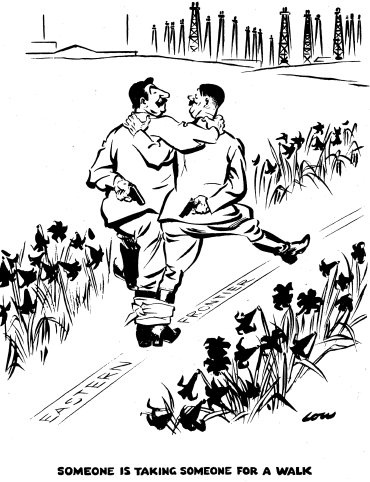
3. The Shock to the SystemThe British government had know about the Nazi-Soviet negotiations since the bgeinning of August but the Pact came as a complete surprise to the British public, who found it hard to believe that communist, Hitler-hating Russia had made an alliance with nazi, Communist-hating Germany. They judged, correctly, that the Pact was a cynical lie to devour Poland. The following Low cartoons reflect their amazement and outrage, as well as the hope/feeling that the two liars would get their come-uppance in the end: |
|



|
Source BThis cartoon by the British cartoonist David Low was published in the Evening Standard newspaper on 20 September 1939. It shows Hitler, who is saying: 'The scum of the earth I believe?' and Stalin, who replies: 'The bloody assassin of the workers, I presume?' Click here for the interpretation
|
Source CThis cartoon by the British cartoonist David Low was published in the Evening Standard newspaper on 21 October 1939. Having destroyed Poland, Hitler and Stalin stroll down their now-shared frontier. Click here for the interpretation
|
|
Consider:Study Sources B and C: • What elements indicate that they are allied?
|
4. The Nazi-Soviet Pact and WarHistorians have argued that the Nazi-Soviet Pact was instrumental in causing the Second World War, inasmuch as it: 1. Freed up Hitler to invade Poland - he knew that Britain couldn't do anything to defend Poland (he invaded 9 days later). 2. Ended Britain's hopes of an alliance with Russia to stop Hitler - people in Britain realised that nothing would stop Hitler now but war. 3. Improved the morale of British people for war - showed Hitler as an opportunist and a trickster, who could never be trusted.
|
|
|
|
|
|
Spotted an error on this page? Broken link? Anything missing? Let me know. |
|