|
| |
My good friends, this is the second time in our history that there has come back from Germany to Downing Street peace with honour. I believe it is peace for our time... And now I recommend you to go home and sleep quietly in your beds. Chamberlain, speaking to the crowds outside 10 Downing Street after the Munich Agreement in 1938.
Thus we begin our march into the great German future. Hitler, speaking after the Munich Agreement in 1938.
|
Going DeeperThe following links will help you widen your knowledge: The Munich Agreement - key information Chamberlain's speech - how Chamberlain justified appeasement (after the event) Verdicts on Munich - a collection of sources Radio Days - includes soundbites
|
The Sudeten CrisisBefore 1938, Britain had already given way to Hitler on a number of occasions, but it was the events of the Sudeten crisis which showed appeasement in action – trying to buy off Hitler by giving way to his demands. On 11 March 1938, Hitler invaded Austria. It was clear he wanted to do the same in the Sudetenland. On 7 September 1938, the German Sudeten Party demanded union with Germany. • There were riots. • German newsreels showed ‘evidence’ of Czech ‘atrocities’ against the Sudeten Germans. • Hitler threatened to support the Sudeten Germans with military force.
At this point, Chamberlain intervened: 1. Chamberlain met Hitler at Berchtesgaden (15 September). • Hitler promised him that this was the ‘last problem to be solved’. • Chamberlain decided Hitler was ‘a man who can be relied upon’. • Chamberlain persuaded the Czechs to hand over the Sudetenland. 2. Chamberlain met Hitler at Bad Godesberg (22 September). • Hitler made more demands. • At first Chamberlain refused, but then he decided that Czechoslovakia was not one of the ‘great issues’ which justified war, but just ‘a quarrel in a far-away country between people of whom we know nothing’. 3. Britain and France made a Pact with Hitler at Munich (29 September). • They gave the Sudetenland to Germany. • Czechoslovakia was not even invited to the talks. The Czechs were free to fight if they wished, but they had no support. They chose not to fight.
On 30 September, Chamberlain returned to England with his famous piece of paper. ‘I believe it is peace for our time’, he told the cheering crowds.
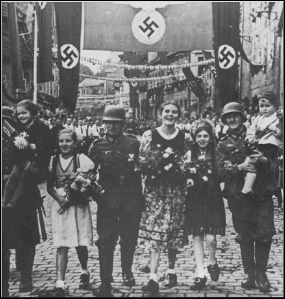
On 1 October 1938, Hitler marched unopposed into the Sudetenland. He said that it was the start of a 1000-year German Reich (empire).
|
Is it significant that Germans troops entering the Sudetenland were greeted as liberators and heroes? |
|
|
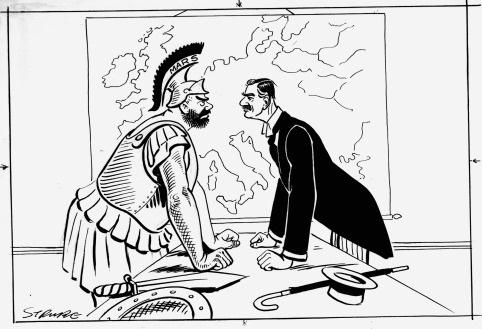
◄ Source AThis cartoon by the British cartoonist Sidney 'George' Strube appeared in the Daily Express on 3 October 1938 (shortly after the Munich Agreement). Chamberlain (on the right, with nothing but a hat and umbrella), confronts Mars (the God of War). Click here for the interpretation
|
Source BWe, the German Fuhrer and Chancellor and the British Prime Minister, have had a further meeting today and are agreed in recognising the question of Anglo-German relations as of the first importance for the two countries and for Europe. We regard the agreement signed last night and the Anglo-German naval agreement as symbolic of the desire of our two people never to go to war with one another again. We are resolved that the method of consultation shall be the method adopted to deal with any other questions that may concern our two countries, and we are determined to continue our efforts to remove probable sources of difference and thus contribute to assure the peace of Europe.. Joint communiqué issued on 30 September 1938 in Munich by Chamberlain and Hitler (the famous ‘piece of paper’).
|
Consider:1. Consider Source A. What did George Stube think of appeasement? 2. Study Source B. Did Chamberlain get ANYTHING out of Hitler?
|
|
|
|
|
Spotted an error on this page? Broken link? Anything missing? Let me know. |
|