|
|
|
|
The 'Great War', as it came to be called, had destroyed a generation, and it is understandable that it raised high emotions in those who went to the peace conference:
Source 1Some of the Objections to the League of Nations made by Senator Henry Cabot Lodge, 1920 2. The United States assumes no obligation to preserve the territorial integrity or political independence of any other country . . . under the provisions of article 10, or to employ the military or naval forces of the United States under any article of the treaty for any purpose… Congress… has the sole power to declare war. 3. No mandate shall be accepted by the United States… 5. The United States will not submit to arbitration or to inquiry by the assembly or by the council of the league of nations... 9. The United States shall not be obligated to contribute to any expenses of the league of nations… 10. If the United States shall at any time adopt any plan for the limitation of armaments proposed by the council of the league . . . it reserves the right to increase such armaments without the consent of the council whenever the United States is threatened with invasion or engaged in war... 14. The United States assumes no obligation to be bound by any election, decision, report, or finding of the council or assembly. Henry Cabot Lodge, 1920
Source 2Senator Borah’s objection What is the result of all this? We are in the midst of all of the affairs of Europe. We have entangled ourselves with all European concerns. We have joined in alliance with all the European nations which have thus far joined the League and all nations which may be admitted to the League. We are sitting there dabbling in their affairs and intermeddling in their concerns. In other words, Mr. President -- and this comes to the question which is fundamental with me -- we have forfeited and surrendered, once and for all, the great policy of "no entangling alliances" upon which the strength of this republic has been founded for 150 years Senator Borah, 1919
Source 3Wilson returned home determined to persuade the American people to join the League. It was here that all Wilson’s Paris disappointments faded away beside the tragedy awaiting him. The average American voter, the average American politician, had no desire to be mixed up in European affairs. Irish Americans, in particular, disliked a Treaty which promised that Ireland would remain part of the British Empire. Congress refused either to accept the Treaty or to join the League. Wilson travelled 8000 miles round the USA making speech after speech to try to change people’s minds. He was not believed. Tired and miserable, he suffered a stroke which left him paralysed for the rest of his life. The American people turned their backs on Europe. HE Snellgrove, Modern World History (1968)
Source 4American public opinion hardened against any further entanglement in the affairs of Europe. America had brought the Great War to and end. But many Americans believed that membership of the League would turn that temporary involvement into a permanent responsibility for the affairs of a continent from which many new Americans had only recently fled. Tony Howarth, Twentieth Century History (1979)
Source 5Woodrow Wilson confidently expected the USA to join the League of Nations. But many Americans hated the idea. Many had been against US involvement in the war, and they certainly did not want the USA to get entangled in European affairs after 1919. They did not want to be involved in what they saw as petty squabbles in Europe that could cost Americans a lot of money. Also, within the USA there were millions of recent immigrants from many European countries, including Germany and Austria Hungary. David Ferriby, Modern World History for AQA (2001)
Source 6A Cartoonist’s View, 1920 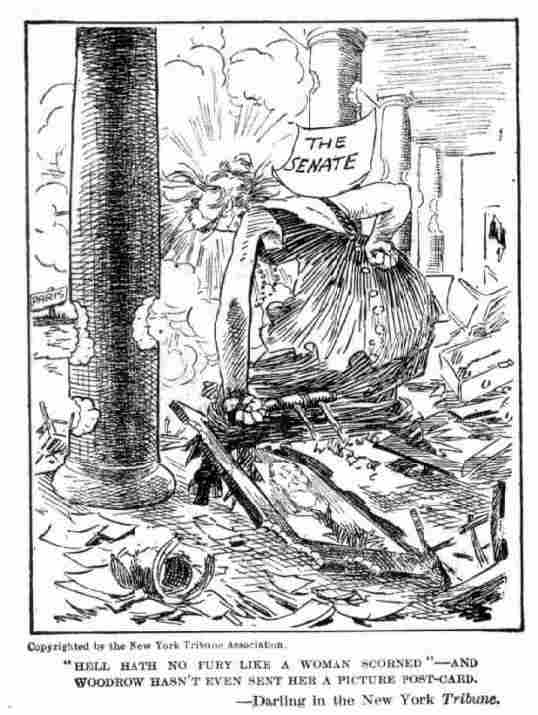
This American cartoon suggests that the Senate rejected the Treaty
|
|
|
