|
      
What measures did Roosevelt introduce to deal with the Depression?
|
|
Mr. Roosevelt is the only man we ever had in the White House who would understand that my boss is a sonofabitch.
North Carolina mill worker (c.1935).
* * * * *
The New Deal
Roosevelt had been elected in November 1932 on his promise to
give the people of America a 'New Deal.
The New Deal was remarkable ... revolutionary. Nothing
like it had ever been tried before. Historians have suggested that the it was based on four
principles:
To create a ‘humanised’ system of capitalism which would provide security for everyone. -
To set up a regulatory state that would restrain capitalism’s excesses.
-
That government has a responsibility to provide for
people what they need, but cannot provide for themselves.
Experimentation – if it doesn’t work, try something different.
In his Fourth Fireside Chat (June 1934), Roosevelt said that his ‘New Deal’ had three related steps:
Relief (helping the poor and unemployed to survive)
Recovery (getting the economy going again) and
Reform (changing things
so a depression could never happen like that again).
And Roosevelt's New Deal had two parts.
First, he set about offering relief and
trying to get the economy to recover.
After 1935, however, he set about a much more radical agenda of social reform.
Initially, however, he was faced
with a crisis. During the four months Roosevelt was waiting to come into office (March 1933), the economy declined further, culminating in a banking crisis. At the beginning of March, millions of people marched into their banks and demanded their money – as they were allowed – in gold. It was impossible; banks in 34 states closed and padlocked their doors.
The entire financial system of the USA was on the verge of collapse.
Roosevelt persuaded Congress to give him emergency powers from 9 March to 16 June 1933 (the 'Hundred Days'). Although many of Roosevelt's ideas were not new (some just copied Hoover's), 1933 - especially the 100 days - saw a burst of legislation to tackle the Depression like never before.
|
Going Deeper
The following links will help you widen your knowledge:
Basic accounts from
BBC Bitesize
Clear account from
Social
Studies Help
 BBC Bitesize podcast on Roosevelt
- Roosevelt speaks for himself BBC Bitesize podcast on Roosevelt
- Roosevelt speaks for himself
BBC Sounds - The New Deal
(excellent)
The New Deal - BBC Witness History
YouTube
Roosevelt and the New Deal - BBC 20thC History
The New Deal and the
TVA

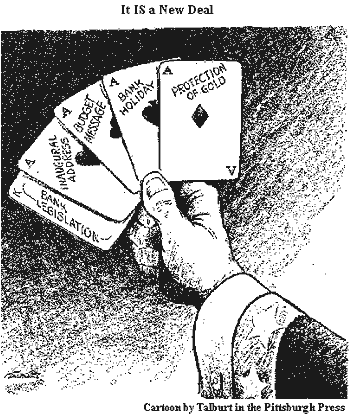
This famous cartoon of the time shows FDR throwing out all Hoover's policies. How true is it?
|
|
-
Confidence
Roosevelt undertook a series of measures to end 'fear' and to get the American people on board:
Abolished Prohibition:
- He said: “I think this would be a good time for a beer”.
This restored faith in the government because it stopped the humiliation of the
government’s laws being openly ignored.
- (It also increased the government’s revenues.)
Fireside Chats:
- FDR described his policies in radio broadcasts called
‘fireside chats’.
- FDR made sure that everyone who sent him a letter
got a reply (he and Eleanor Roosevelt received up to 8,000 letters a day -
see Sources A and B), and that everyone who telephoned the White House was
never cut off.
Bank holiday:
- The Emergency Banking Act closed the banks for four days.
The government checked that all were financially sound, and when they reopened,
they reopened with the backing of the Federal Reserve.
-
“I can assure you that it is safer to keep your money in a reopened bank than under the mattress.” (1st Fireside Chat, March 1933)
-
The Glass-Steagall Act
of June 1933 forced the banks to keep their
depositors money separate from any money they were using for speculative
activities (e.g. buying shares themselves, or lending 'on margin' to others
to do so).
- This restored confidence in the banks, and people
deposited their money there again.
Stock Exchange:
- The Securities and Exchange Commission introduced rules for the Stock Exchange to prevent another Crash like 1929.
-
Finance and the Economy
Roosevelt believed that he had to make sure that the
economy was ‘sound’.
Budget:
Bankruptcies:
- The Farm Loan Act and the Bankruptcy Act prevented banks
from foreclosing on solvent businesses until they had had a chance to borrow
from the Federal Reserve.
- The Home Loan Act and the Home Owners Loan
Corporation did the same for ordinary home owners.
Prices and Wages:
- The Agricultural Adjustment Act (AAA) paid farmers to
take fields out of production; the idea of this was to stop over-production and
to drive up prices.
- The National Industrial Recovery Act (NRA) gave businesses the right to form cartels, set their own codes of conduct, and force up prices, as long as they promised to cut production, pay good wages and allow workers to join a union.
Those who did joined a ‘Roll of Honour’ (and were allowed to show a blue
eagle symbol) – 2.5
million firms, employing 22 million people, joined the scheme.
- FDR also abolished Child Labour – this put more
adults into work.
Currency:
You will read in some books that FDR 'abolished the gold standard' (a
rule which links the value of a dollar to a certain weight of gold). This is not true. He did:
- stop people owning gold (they had to
deposit it in banks).
- make the banks give all the gold to the government.
- increase the price of gold from $20 to £35 an ounce.
(This stopped people hoarding/saving their money, and increased the amount of government reserves. Since the dollar was still linked to gold, moreover, many foreign investors bought American dollars for gold, which increased the amount of government reserves.)
-
Alphabet Agencies
FDR set up what came to be called the ‘alphabet agencies’ because their names were reduced to acronyms. The main ones were:
CCC (Civilian Conservation Corps):
- provided paid conservation work to give unemployed young men jobs – by 1941, 2.5 million had taken part PLUS millions of trees panted/ parks and forest areas developed.
CWA (Civil Works Administration):
- a temporary programme to create manual jobs to get unemployed people through the inter of 1933-34.
The CWA spent $200 million, created 4 million jobs, laid 2,300 miles of sewer pipes and built or improved 255,000 miles of roads, 40,000 schools, 3,700 playgrounds, and nearly 1,000 airports
FERA (Federal Emergency Relief Administration):
- provided matched funding to help states provide work for the unemployed and homeless.
In 1933-35, FERA gave states $3.1 billion and provided work (and wages) for 20 million people who developed facilities on public lands across the country.
HOLC (Home Owners Loan Corporation):
- refinanced mortgages of homeowners who were having problems making the payments on their mortgage loans "through no fault of their own"..
PWA (Public Works Administration):
- was given $3.3bn in 1933, and $7bn in total, to build large-scale public works such as dams, bridges, hospitals, and schools.
TVA (Tennessee Valley Authority):
- built 21 dams in ten years – stopped flooding, provided cheap electricity and provided work.
|
THE FIRESDE CHATS
(They are worth
listening to – they will give you the best impression of what FDR was about.)
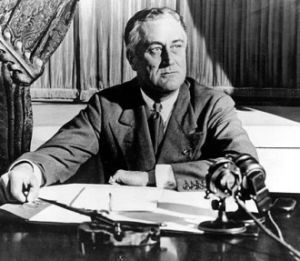
These chats were brilliant propaganda and they had three key aspects:
Homeliness – the chats were delivered “like a father discussing public affairs with his family in the living room” (people could hear the fire in the background).
FDR told people that he went fishing to think over big reforms, so he would not
get out of touch with ordinary people’s thinking.
Reasonableness – FDR said that he was not going to make false promises, and that he would not succeed every time. (“We may make mistakes.
I have no expectation of making a hit every time I come to bat”).
Blame – he spoke of ‘the 10%’ who wanted the New Deal to fail.
(“They may be divided roughly into two groups: First, those who seek special
political privilege and, second, those who seek special financial
privilege.").
Ordinary people believed that he was fighting the rich and selfish in their behalf – as a result, even though the gains of the first New Deal were not great, FDR won the 1936 election by another landslide
Source A
Dear Mr. President:
This is just to tell you that everything is all right now. The man you sent found our house all right, and we went down to the bank with him and the mortgage can go on for a while longer. You remember I wrote you about losing the furniture too.
Well, your man got it back for us.
I never heard of a President like you.
Letter to the President from
an old man and his wife, (summer, 1933).
Source B
Dear Mrs. Roosevelt,
About a month ago I wrote you asking if you would buy some baby clothes for me...
Do you remember?
As a proof that I really am sincere, I am sending you two of my dearest possessions to keep as security, a ring my husband gave me before we were married, and a ring my mother used to wear. If you will consider buying the baby clothes, please keep them (rings) until
I send you the money you spent.
It is very hard to face bearing a baby we cannot afford to have, and the fact it is due to arrive soon, and still there is no money for the hospital or clothing, does not make it any easier.
If you will get these for me I would rather no one knew about it. I promise to repay the cost of the layette as soon as possible.
We will all be very grateful to you, and I will be more than happy.
Sincerely yours,
Mrs. H.E.C.
Letter to Eleanor Roosevelt, written by an expectant mother of two in New York.
|
|
In 1935, Roosevelt's New Deal was still hugely popular with
the people, but it was running into opposition (see next page for greater
detail).
The most important elements of this opposition were:
The Supreme Court, which ruled the NRA and the AAA
illegal, because they took away the right of states to run their own affairs.
Some businessmen, who attacked and ignored the NRA
saying that it was expensive and wasteful.
Poosevelt's reaction, in the run up to the 1936 election and after it,
was to 'double down' and follow a much more radical 'reform' agenda:
-
National Labour Relations Act (1935):
-
To replace the banned NRA.
Also known as the Wagner Act.
-
Protected workers' right to
join a trade union.
Set up the National
Labour Relations Board (NLRB) to prevent employers from victimising workers. -
Opposed by the Republicans and
businessmen as a violation of 'freedom of contract' between employers and
employees.
-
Soil Conservation Service (1935):
To replace the banned AAA.
Allowed the government to
continue subsidising farmers by helping them combat soil erosion.
-
Opposed by the land-grant
Agricultural Colleges who saw it at their job, and by the States who saw the
SCS as a rival to their authority.
-
Public Works Administration (1935):
Headed by Harry Hopkins, it
ran small-scale projects which provided work for the unemployed, e.g. in arts, drama, media, and literacy projects, as well as in construction, and running relief programmes – although its wags were poor
three million people earned a small amount and felt valuable.
-
Opposed even by Democrats such
as Senator Josiah Bailey, who argued that it was boodoggling – spending
money for the sake of it – and would lead to higher taxes. Other
Senators feared that it was like a bribe to vote Democrat, and the Hatch Act
(1939) was passed to prevent federal employees engaging in politics.
-
Resettlement Administration (1935)
and the Farm Security Administration (1937):
-
Took over from FERA.
-
Resettled thousands of farmers from agriculturally exhausted land.
-
Built planned 'Greenbelt cities' including Greenbelt, Maryland;
Greendale, Wisconsin; Greenhills, Ohio; and Mileston, Mississippi (an
entirely African-American Community).
-
Built Relief Camps in California for migrants fleeing the Dust Bowl.
-
Opposed by wealthy landowners who did not want to lose their tenant farmers.
It was also inefficiently run, and was closed down in 1937.
The Farm Security Administration took over from the RA in 1937. -
It
continued the Greenbelt communities programme, made loans to help tenant farmers buy their land, gave educational aid to almost half a million farm families, and ran the very famous photography programme.
-
Social Security Act (1935):
Provided America's first
system of social welfare, funded by a 6% tax on wages, paid equally by the
employer and the employee.
-
set up a national system of old-age pensions.
-
gave help to people with physical disabilities.
-
gave help to children in need.
set up a national system of unemployment insurance.
-
Opposed by the rich who feared it would mean higher taxes; by businesses who
feared the 3% of wages they would have to pay would reduce their profits;
and by Republican Presidential candidate
Alf Landon, who claimed
it was a "cruel hoax" on the employee, taking 3% of his wages with no
guarantee of how the government would use the money.
-
National Housing Act (1937):
Also called the Wagner-Steagall Housing Act.
-
Provided loans to buy houses.
Reduced excessive rents.
-
Opposed by landlords who feared it would reduce rents and sale-prices; and by rural
areas which feared it would favour towns over villages.
-
Fair Labour Standards Act (1938):
Also called the Black-Connery
Act. -
Set hours and conditions of
work – especially attacked sweatshops, child labour and 'scrip' payments for use
in company stores.
Fixed a 40-cent-an-hour minimum wage, a 40-hour maximum workweek, and a minimum working age of 16. -
Opposed by business-owners –
particularly from the South, where wages were much lower – who claimed that
they would go bankrupt if they had to pay more than 25 cents an hour, and
that they would have to spend all their time on " these everlastingly multiplying governmental mandates".
Others saw it as a "tyrannical industrial dictatorship".
Consider:
1. Sources A and B make me cry. What about them
makes them so emotionally moving? What do they reveal about people's
attiudes towards Roosevelt?
2. How was the Second New Deal different to
the first?
3. 'Roosevelt transformed the lives of America's workers.' How far do you agree with this interpretation?
|
Source C
Never before in all our history have these forces of
[organised money] been so united in their hate for one
candidate – and I welcome their hatred.
I should like to have it said of my first administration
that in it the forces of selfishness and of lust for power met their match. I should like to have it said of
my second administration that in it they met their master..
Franklin D. Roosevelt, 'We Have Only Just Begun to Fight', election speech October 31, 1936.
.
Source D
But here is the challenge to our democracy: In this nation
I see tens of millions of its citizens - a substantial part of its whole
population - who at this very moment are denied the greater part of what the
very lowest standards of today call the necessities of life...
I see millions denied education, recreation, and the
opportunity to better their lot and the lot of their children.
I see one-third of a nation ill-housed, ill-clad,
ill-nourished...
The test of our progress is not whether we add more to the abundance of those who have much; it is whether we provide enough for those who have too little.
2nd Inaugural Address (1937).
Source E
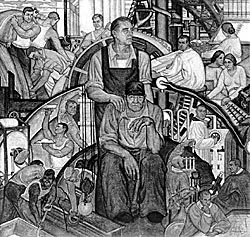
This 1934 mural sees Roosevelt as the protector and friend of the working man.
- AQA Exam-style
Questions
4. Describe two problems faced by President Roosevelt in implementing the
New Deal.
6. Which of the following had the greater impact on
the lives of Americans:
• the first New Deal
• the second New
Deal?
- OCR-style Questions
5. Describe one
‘Alphabet’ Agency.
6. Explain how the New Deal tried to end the Depression.
8. ‘A war against the rich and the powerful’. How far do you agree with this view
of Roosevelt's New Deal?
-
iGCSE-style Questions
(a) Describe TWO features of the Alphabet Agencies.
• Describe TWO features of the Tennessee Valley Authority.
• Describe TWO features of the Wagner Act (1935).
|
|
|
Spotted an error on this page? Broken link? Anything missing?
Let me know.
|
|