The Paris Peace Conference
|
Last night, for the first time since August in the first year of the war, there was no light of gunfire in the sky, no sudden stabs of flame through darkness, no spreading glow above black trees where for four years of nights human beings were smashed to death. The Fires of Hell had been put out. Phillip Gibbs in the New York Times (11 November 1918)
|
Going DeeperThe following links will help you widen your knowledge: People's feelings after the war - sources
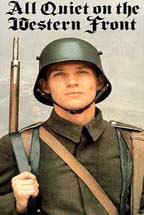
Erich Maria Remarque's novel, All Quiet on the Western Front (1926) tried 'simply to tell of a generation of men who, even though they may have escaped its shells, were destroyed by the war'.
|
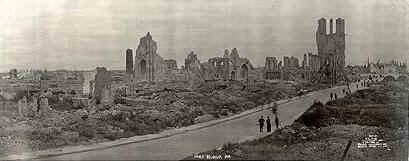
1. Background: The Legacy of World War OneTo understand the process of peace-making in 1919, you have to appreciate how people felt as they came out of th trauma of World War One. 10 million people had died in the First World War (1914-18). The part of France where there had been fighting (the Western Front) had been totally destroyed.
Source A A picture of Ypres in France (1918), showing the damage done during the war.
Source BMore than 65 million men fought in the First World War; over eight million of them were killed. In addition, nearly nine million civilians died - from starvation, disease, artillery fire and air raids. Twelve million tons of shipping were sunk. In France and Belgium, where most of the war was fought, 300,000 houses, 6,000 factories, 1,000 miles (1,600 kilometres) of railway, 2,000 breweries and 112 coal mines were destroyed. The human cost of the war - in terms of damaged minds and bodies, and ruined lives – was beyond calculation. In some ways, mankind has never recovered from the horrors of the First World War. John D Clare, First World War (1994)
|
|
2. Making PeaceOn 11 November 1918, Germany had signed a cease-fire. It was called ‘the Armistice’. The Germans could not fight any longer. But they did not think they had surrendered! On 18 January 1919, delegates from 32 countries came to Paris to make the treaties which would end the war. President Wilson of the USA gave an upbeat speech expressing his desire 'to lift from the shoulders of humanity the frightful weight' of the War. British Prime Minsiter Lloyd George told the delegates that 'the world is thirsting for peace ... and they will not forgive us too long delays'.
The conference was not initially intended to be the conference which determined the peace - it was originally conceived as a pre-meeting at which the victors could meet to agree what they would collectively demand of Germany at a peace conference which was meant to follow. However, as time went on, and more and more people converged on Paris to try to have their say in the proceedings, the pre-Conference turned into the actual Peace Conference, and its decisions became binding. Unlike other treaties in history, therefore, the Treaty of Versailles was not negotiated between Germany and the Allies. Germany was not allowed to send any delegates. Only the Allies were invited to the Conference - and they imposed their terms upon Germany. This was 'the Diktat' so resented by the Germans.
|
Did You Know?In 1918, Bassett's introduced a new sweetie - called 'Peace Babies' - to celebrate the end of the First World War. Unavailable during the Second World War (no sugar!) they were re-launched in the 1950s as 'Jelly Babies'.
Consider:If you had been a German in Paris in January 1919, can you find FOUR things about the start of the Conference which would have outraged you? |
Attitudes of the Victors
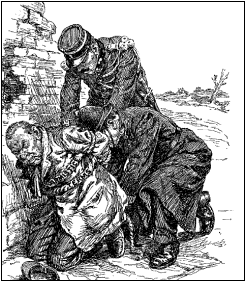
Source C
This cartoon by a British artist appeared in Punch on 19 February 1919. The caption read: German
Criminal to Allied Police: Here, I say, stop! You're hurting me! Click here for the interpretation
|
Delegates' feelings - spidergram
Did You Know?When the Russians had stopped fighting in 1917, the Germans had made them sign the Treaty of Brest-Litovsk. It took lots of land from Russia. When they heard this, many politicians decided they would be just as tough on Germany
|
Source DGermany is going to pay. We will get everything you can squeeze out of a lemon, and a bit more. The Germans should hand over everything they own. From a speech in 1918 by Sir Eric Geddes, a British politician standing for election as an MP.
Source EWe have assembled here for two purposes - to make the peace settlements, and also to secure the future peace of the world. Woodrow Wilson, speaking at the Versailles Conference (January 1919)
Source FOut of the horror of the War came a belief that nations should join together to keep the peace... D MacIntyre, The Great War: Causes and Consequences (1979)
|
Consider:Read Source D.
If you had been Mr Geddes’s speech-writer, what would you have written in the next paragraph?
|
|
| |