Was the League successful in the 1920s?
|
During the 1920s the League assimilated new members, helped settle minor international disputes, and experienced no serious challenges to its authority Encyclopaedia Britannica (1994)
|
Going DeeperThe following links will help you widen your knowledge: A timeline of key events, 1919-1932 Successes and failures in peacekeeping during the 1920s
Powerpoint - The League in the 1920s
|
Strengths and WeaknessesThe main aim of the League of Nations was to stop wars. In the 1920s, there were many small disputes between countries, which the League tried to solve - for example:
|
|
Corfu, 1923The Dispute: An Italian general was killed while he was doing some work for the League in Greece. The Italian leader Mussolini was angry with the Greeks. He invaded the Greek island of Corfu. The Greeks asked the League to help.
What the League did: The Council of the League met. It condemned Mussolini, and told him to leave Corfu. It told the Greeks to give some money to the League.
What happened: Mussolini refused to accept its decision. He refused to leave Corfu. The League changed its decision. It told Greece to apologise to Mussolini, and to pay the money to Italy. The Greeks did as the League said. Then Mussolini gave Corfu back to Greece.
|
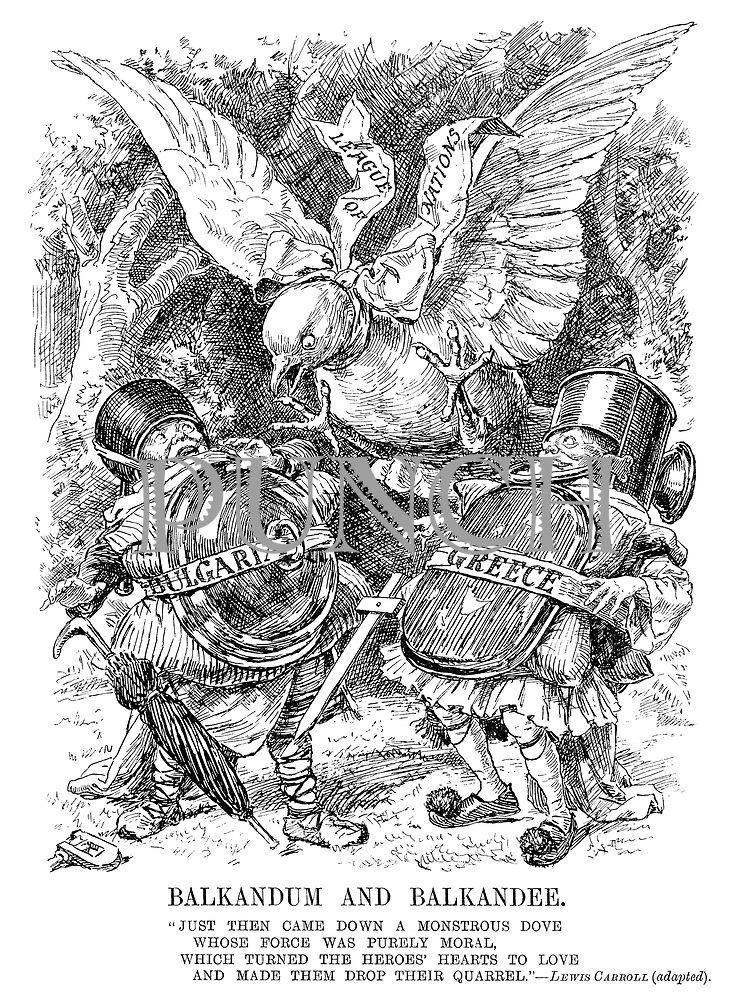
Bulgaria, 1925The Dispute: Some Greek soldiers were killed in a small fight on the border between Greece and Bulgaria. The Greeks were angry. They invaded Bulgaria. Bulgaria asked the League to help.
What the League did: The Council of the League met. It condemned the Greeks, and told them to leave Bulgaria.
What happened: The Bulgarian government told its army not to fight back. The Greeks did as the League said. They left Bulgaria.
|
Consider:Was the League successful in Corfu?
|
Consider:1. Was the League successful in Bulgaria? Note that his spread looks at only two disputes. Click this link for more information about the League's successes and failures in peacekeeping during the 1920s. 2. Did the League manage to stop wars in the 1920s? Decide if you think the League was a success or a failure.
◄ Source AThis British cartoon of 1925 shows Greece and Bulgaria fighting – like Tweedle-dum and Tweedle-dee in the story Alice in Wonderland. Click here for the interpretation
Consider:In 1925, Greece complained that there seemed to be one set of rules for small countries such as Greece, and a different set of rules for big countries such as Italy. Do you agree?
|
The League's Other Work in the 1920s [SIDER]Besides its aim to Stop Wars, the League of Nations had four other tasks: • Improve people’s lives and jobs, • Disarmament, • Enforce the Treaty of Versailles. • Reparations.
Historians have sometimes suggested that the League - whilst inevitably failing in its (impossible) task of preventing nations coming into conflict with each other - nevertheless did excellent work in these other tasks. As you study what the League did in these areas, it will help you to decide whether you think the League was a success or a failure: |
|
|
a. Disarmament The League set up a Commission to organise a Disarmament Conference (but when it eventually met in 1932, it failed because Germany demanded equality of armaments with everybody else). |
i. International Labour Organisation The ILO was set up as an international forum for regulating and improving the conditions of labour. It gathered information and passed Conventions, notably on minimum wages and social insurance. The ILO still continues its work today. |
|
b. Prisoners of War The League took home half a million World War One prisoners of war. |
j. Permanent Court of International Justice The Court made a number of decisions which enforced and interpreted the Treaty of Versailles, but it also made important decisions on general matters of international law. The International Court of Justice still continues its work today. |
|
c. Slaves The League attacked slave traders in Africa and Burma and freed 200,000 slaves. |
k. Economic problems The League sent economics experts to help Austria and Hungary. |
|
d. Disease The League worked to prevent malaria and leprosy. |
l. Drugs The League closed down four big Swiss companies which were selling drugs. |
|
e. Poland (1920) Poland took land from Russia, breaking the Treaty of Versailles. The Poles ignored the League’s order to stop. |
l. Jobs The International Labour Organisation failed to persuade countries to adopt a 48-hour week. |
|
f. Locarno Treaties (1925) A series of treaties in which Germany agreed to respect the Treaty of Versailles, and in return was allowed to join the League of Nations. Hailed as a victory for peace, it was a bad sign that this was agreed outside, not by, the League of Nations. |
n. SS Wimbledon case (1923) The Court of International Justice ruled that Germany was wrong to refuse right of passage through the Kiel Canal (given in the treaty of Versailles) to a French ship. |
|
g. Reparations (1921) When the Germans refused to pay, France and Britain invaded Germany and made them pay (as the Treaty of Versailes said). |
o. Invasion of the Ruhr (1923) France invaded the Ruhr in 1923 to force the Germans to pay Reparations (as the Treaty of Versailles said). |
|
h. Kellogg-Briand Pact (1928) Sixty-five countries signed the treaty to end war – but then they just ignored it. |
p. Refugees (1922) The League set up camps and fed Turkish refugees. |
|
|
|
Consider:1. Divide up boxes a–n into ‘successes’ and ‘failures'. 2. Divide up the 'successes' into the three kinds of 'other work' done by the League: 3. Now divide up the 'failures' into the four kinds of work done by the League. 44. Use your findings to make a comment on whether you think the League a success or a failure in the 1920s?
|
|

 Simple Essay: