|
|


 How do I interpret a cartoon?
|
|
Knowledge
about the events in that period |
|
|
|
|
|
|
Seeing
& understanding different things in the cartoon |
|
Thinking
about the cartoonist, and his motives |
To interpret a cartoon, you have to integrate the three skills – using them to inform the others. So, for instance, what you know about the period in which the cartoon was drawn will help you understand what’s in the cartoon – but, very often, what’s in the cartoon adds to your understanding of what was going on at the time.
So your brain has to to-and-fro and go round the different skills, and all the time your understanding of the cartoon is growing.
This webpage will give you a routine to help you interpret a cartoon:
remember
Once you understand the cartoon, you can go on to answer the question set by the examiner
AS YOU WOULD ANY OTHER SOURCEWORK QUESTION
Links:
This site has a list of 'things to look for'.
Theory...
Do things in this order:
-
First: Think about the events in that period
Look at the date. Think what was happening at that time. Who was involved?
-
Second: See the different things in the cartoon
At first, just make a list of things you see. List the things that are in the cartoon, what they are doing, and how they are presented. When I do this with pupils, they always choose one or twofont size="3" things – and MISS lots, even big things! Often, in a cartoon, everything (even little things) has a meaning. So study the details and jot them down (but don’t start to try yet to say what they mean).
-
Third: Think about the cartoonist, and his motives
Look at WHO drew the cartoon, and where he came from. What would he have thought about the topic he was drawing about? What would he have been wanting to say?
-
Fourth: Go back to the cartoon
Look at your list of things you saw. Can you see what/who they stand for – what they are ‘saying’ – what they mean? When you have thought about all the elements, think: ‘What is the overall message of the cartoon?’
-
Last: Go back to the events
Now you have thought about the cartoon and its meaning, think: ‘What does all this help you to understand about the time, and how people thought and felt?’
NOW – I think that’s VERY hard.
Practice...
To make things clearer, let’s go through the sequence once again, but this time working with an actual cartoon.
This cartoon appeared in an AQA exam in 2001.
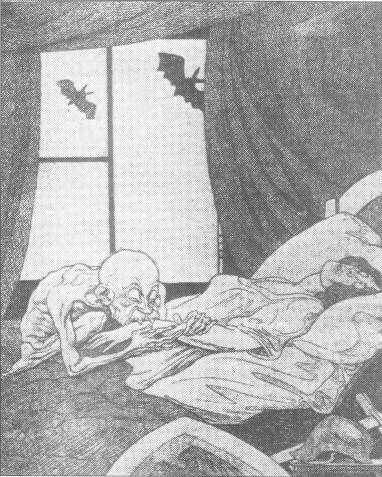
A cartoon with the title ‘Clemenceau the Vampire’
From the German newspaper Kladderadatsch (July 1919)
The figure lying on the bed represents Germany. Clemenceau was Prime Minister of France in 1919. He is shown as a vampire sucking the blood out of Germany.
Let’s now go through the steps to interpret this cartoon:
Click the yellow pointers to reveal the answers:
- What do you know about the events in that period?
Think about what you know of events about the date July 1919.
Make a list of 'key facts’.
Then click the yellow pointer to reveal what I wrote down.- • Germany had just been defeated in WWI.
- • The Treaty of Versailles had been signed on 28 June 1919.
- • It had been written by the ‘Big Three’ and imposed on Germany.
- • Clemenceau wanted to ruin Germany
- • The Treaty blamed Germany for the war
- • The Treaty made her pay ‘reparations’ for ALL the damage.
- • Germany lost lots of land.
- • Germany had to give up most of her armed forces.
- • The Germans hated the Treaty.
- See the different things in the cartoon
Now make a list of all the things you see in the cartoon.
Not all these things may have a meaning, but list them anyway.
Then click the yellow pointer to reveal what I wrote down.- • Young girl – beautiful but poorly.
- • Vampire – evil-looking.
- • The Vampire is sucking the girl’s blood.
- • Weapons – laid to one side.
- • Two more bats outside the window.
- • A bed.
- • The curtains are blowing – the window is open.
- Think about the cartoonist, and his motives
What would be your answer to the following questions?
Think, then click the yellow pointer to reveal what I wrote down.- WHO drew the cartoon, and where did he come from?
- A German newspaperman.
- What would he have thought about the topic he was drawing about?
- He would probably have hated the Treaty like other Germans.
- What would he have been wanting to say?
- He would have been biased against the Treaty He would have wanted to say that the Treaty was too harsh. He would have wanted to say that it was a wicked, unfair Treaty.
- WHO drew the cartoon, and where did he come from?
- Interpret the cartoon
Look at our list of things we saw.
For each, suggest what/who they stood for.
Suggest what they were ‘saying’ (what they meant)?
Then click the yellow pointers to reveal what I wrote down.- • Young girl – beautiful but poorly.
- Germany is a wonderful country, but she has just been defeated in the war and is very weak.
- • Vampire – evil-looking.
- The Vampire stands for Clemenceau. He is a wicked, evil man who just wants to hurt Germany.
- • The Vampire is sucking the girl’s blood.
- …just like Clemenceau (by taking reparations/ land from Germany) is killing Germans by ‘sucking the life blood’ out of Germany.
- • Weapons – laid to one side.
- The Treaty of Versailles had made Germany give up her submarines and planes, and most of the army and navy.
- • Two more bats outside the window.
- These are Britain and America – helping Clemenceau, and waiting to take their share.
- • A bed.
- Perhaps this doesn’t mean anything, but I think it adds an element of sex. Clemenceau is not just killing Germany, he is violating her – sort of raping her – when she cannot defend her honour. It makes what he is doing is seem just so much more immoral and disgusting.
- • The curtains are blowing – the window is open.
- Germany cannot defend herself. The way is open for other countries to swoop in and take what they want from defenceless Germany.
- • ‘What is the overall message of the cartoon?’
- The cartoonist is saying that Clemenceau was an evil man,
- who wanted to violate Germany,
- and that the Treaty – in taking land and reparations from Germany, and in not letting Germany have an army – would kill Germany
- (which was already weak after the war).
- • Young girl – beautiful but poorly.
- What does all this tell us about the events of the time?
‘What does this help us understand how people thought/felt at the time?’
Click the yellow pointer to see what I wrote:- • that the Germans thought the Treaty of Versailles would ruin Germany,
- • that they thought it was wicked what it had done to Germany,
- • how much they hated the French,
- • how much they hated reparations,
- • that they were scared that the reduction of their armed forces left them defenceless,
- • that they blamed Britain and America too
Click here to see a PowerPoint presentation which takes you through the steps of interpreting this cartoon.
for INTEREST
the question the examiners set on this cartoon was:
= Is
this Source reliable as evidence about the effects of the Treaty of
Versailles on Germany in the years 1919–21?