
This is an extract from Harry Elmer Barnes, The World War of 1914-1918 (1940)
Barnes was an American historian.
Balance Sheet of the First World War
The casualties of the World War were so astoundingly
extensive as to be almost unbelievable. Kirby Page lists them in the table
below:
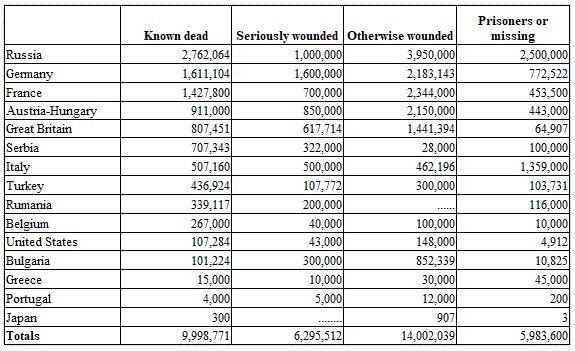 . .
Page further details some of the more prominent of the human costs of the war:
- 10,000,000 known dead soldiers
- 3,000,000 presumed dead soldiers
- 13,000,000 dead civilians
- 20,000,000 wounded
- 3,000,000 prisoners
- 9,000,000 war orphans
- 5,000,000 war widows
- 10,000,000 refugees
The total immediate economic cost of the war has been estimated by a careful student, Professor E. L. Bogart, at $331,600,000,000. Some of the specific economic losses have been computed as follows:
(1) Munitions and machines of war during the four years of fighting, $180,000,000,000;
(2) property losses on land, $29,960,000,000;
(3) losses to shipping, $6,800,000,000;
(4) production losses through diverted and non-economic production, $45,000,000,000.
These are simply immediate economic losses—those things which were actually
consumed during the conflict. No account is taken of subsequent costs such as
interest on loans, retirement of loans, pensions, and the like. Writing shortly
after the war was over, Professor E. L. Bogart commented as follows on the
matter of immediate war costs:
The figures . . . are both incomprehensible and appalling, yet even these do not take into account the effect of the war on life, human vitality, economic well being, ethics, morality, or other phases of human relationships and activities which have been disorganized and injured. It is evident from the present disturbances in Europe that the real costs cannot be measured by the direct money outlays of the belligerents in the five years of its duration, but that the very breakdown of modern economic life might be the price exacted.
The editor of the Scholastic magazine made an ingenious effort to translate these figures of war costs into terms that we can visualize. He indicated that the cost of the World War of 1914 would have been sufficient to furnish: (1) every family in England, France, Belgium, Germany, Russia, the United States, Canada, and Australia with a $2,500 house on a $500 one-acre lot, with $1,000 worth of furniture; (2) a $5,000,000 library for every community of 200,000 inhabitants in these countries; (3) a $10,000,000 university for every such community; (4) a fund that at 5 percent interest would yield enough to pay indefinitely $1,000 a year to an army of 125,000 teachers and 125,000 nurses; and (5) still leave enough to buy every piece of property and all wealth in France and Belgium at a fair market price. Such was what it cost to return Alsace-Lorraine to France, to try to get the Straits for Russia, and to punish Serbian plotters.
President Calvin Coolidge, relying on Secretary Mellon's estimates, once frankly stated that the ultimate cost to us of the participation of the United States in the World War would, in his opinion, be $100,000,000,000. Indeed, Professor Frank Dickinson has estimated that "the total post-war cost of the World War to our nation in terms of post-war price recessions and depressions probably exceeds $200,000,000,000." On January 16, 1935, the direct cost of the World War, exclusive of $11,600,000,000 of war loans abroad, to the United States was officially declared to be $50,000,000,000. Another estimate, in 1939, put the figure at $57,000,000,000. In 1916 our Federal budget was $735,000,000; in 1919, $18,500,000,000; and in 1938, $7,760,000,000.
|
|